


Obverse
Description:
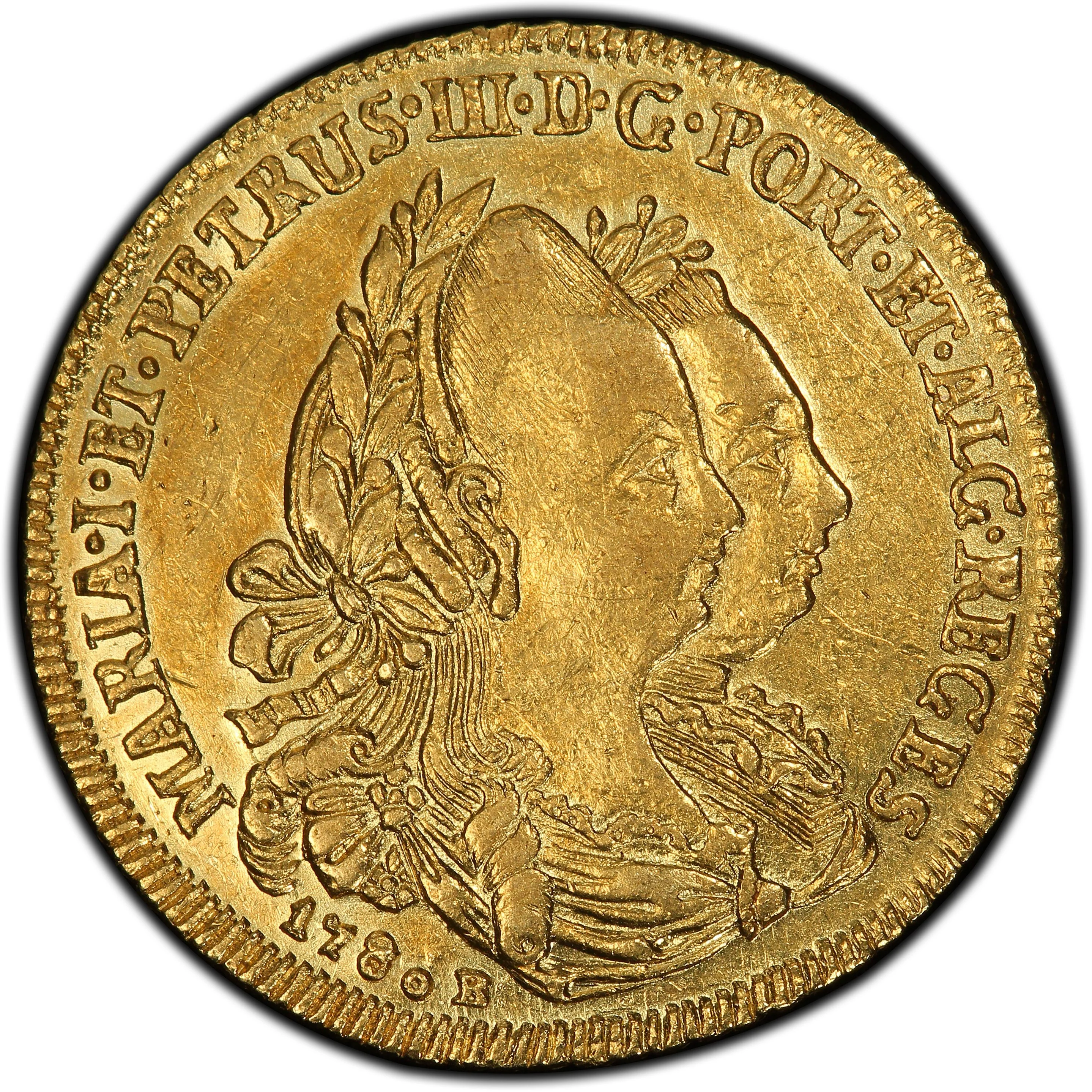
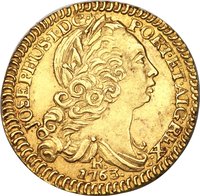
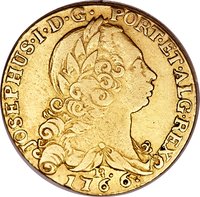
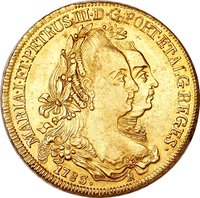
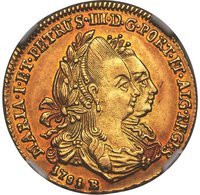
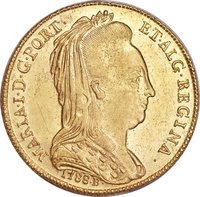
Conjoined busts of Maria I and Peter III facing right, with date and mintmark below.
Inscription:
MARIA.I.ET.PETRUS.III.D.G.PORT.ET.ALG.REGES
year_B
year_B
Script: Latin
Engraver: José Gaspard
Reverse
Description:
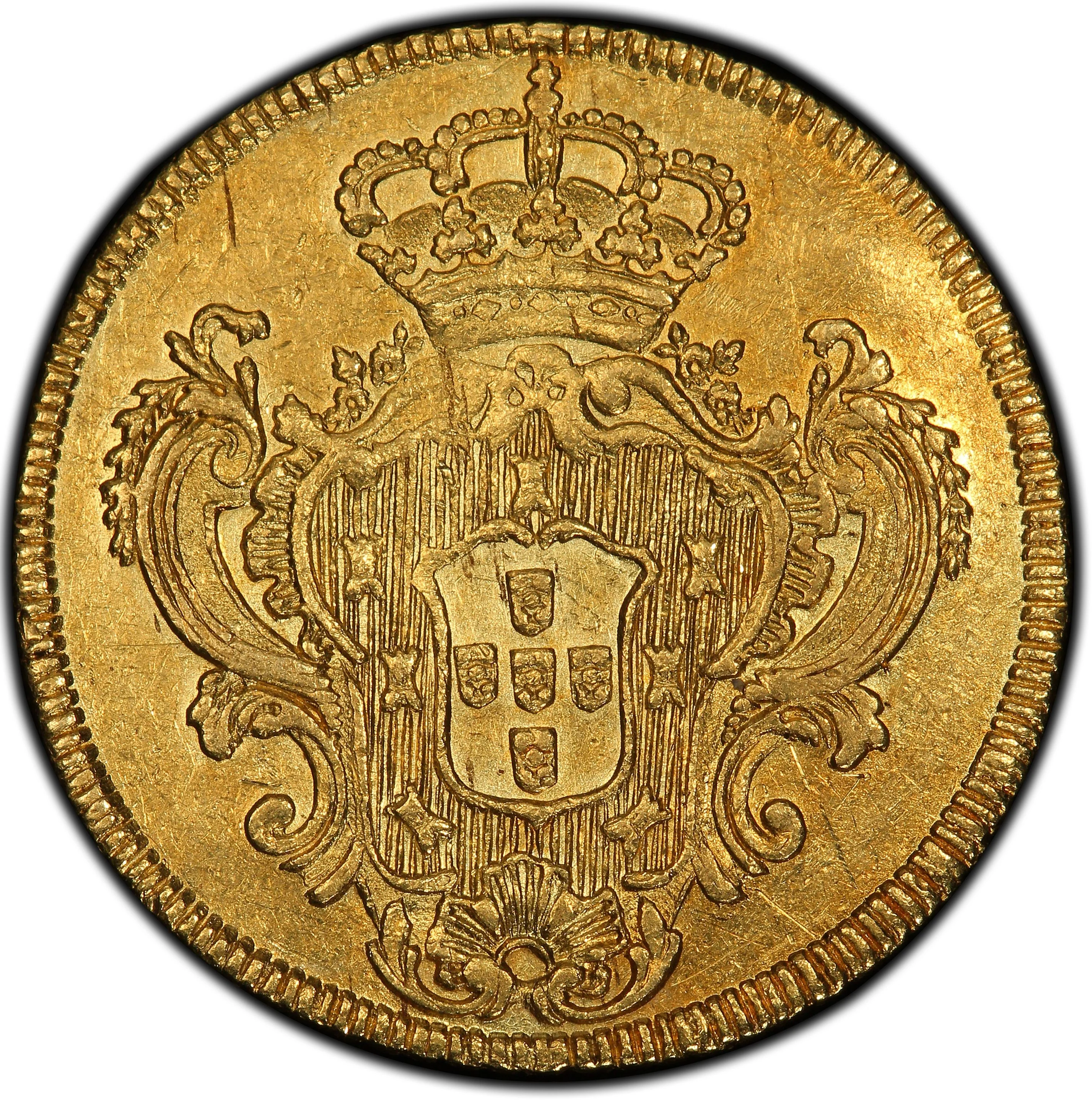
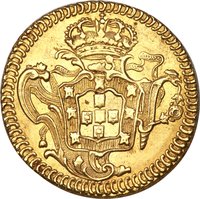
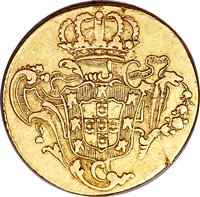
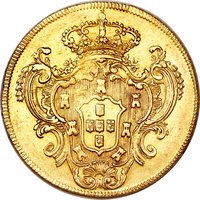
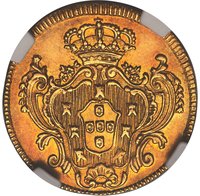
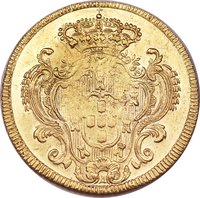
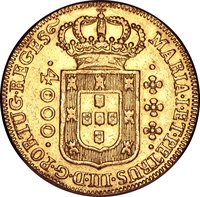
Royal arms of Maria I and Pedro III.
Engraver: José Gaspard
Edge
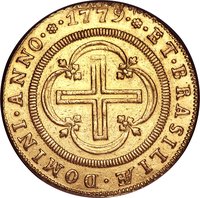
Reeded.
Mints
| Name | Mark |
|---|---|
| Bahia | B |
Historical background
In 1780, Brazil operated under a complex and often chaotic monetary system, a direct legacy of its colonial status under Portugal. The official currency was the Portuguese real (plural: réis), but the colony suffered from a severe and chronic shortage of official coinage. This scarcity was exacerbated by Portugal's mercantilist policies, which drained gold and silver from Brazil to finance the metropolis and its trade deficits, particularly with England. Consequently, a wide variety of foreign coins—especially Spanish-American pieces of eight—circulated alongside worn and clipped Portuguese coins, all valued by their weight and metallic content rather than their face value, leading to constant confusion and fraud.
To address the chronic lack of circulating medium, colonial authorities and private entities resorted to creative solutions. The most significant was the widespread use of commodity money, with standardized blocks of pressed sugar, rolls of tobacco, and even cattle serving as legal tender for local transactions and tax payments. Furthermore, due to the gold rush in Minas Gerais in the previous century, gold dust and unminted gold nuggets (ouro em pó) were commonly used in the mining region, measured against official weights. Perhaps the most innovative response was the issuance of paper notes, first introduced in 1772 by the local government of Rio de Janeiro. These early treasury notes (papel-moeda) were a pioneering but limited effort to create a fiduciary currency and alleviate the cash crisis.
This fragmented system created significant obstacles to economic integration and governance. Prices and accounting were complex, requiring meticulous conversion between various metallic and commodity standards. The situation also fostered regional monetary autonomy, as different captaincies might value coins differently. Ultimately, the monetary disorder of 1780 reflected the broader tensions of late colonial Brazil: a wealthy colony generating immense mineral and agricultural riches was stifled by a metropolitan power that failed to provide the basic financial infrastructure necessary for a modernizing economy, a contradiction that would fuel growing discontent in the decades leading to independence.
To address the chronic lack of circulating medium, colonial authorities and private entities resorted to creative solutions. The most significant was the widespread use of commodity money, with standardized blocks of pressed sugar, rolls of tobacco, and even cattle serving as legal tender for local transactions and tax payments. Furthermore, due to the gold rush in Minas Gerais in the previous century, gold dust and unminted gold nuggets (ouro em pó) were commonly used in the mining region, measured against official weights. Perhaps the most innovative response was the issuance of paper notes, first introduced in 1772 by the local government of Rio de Janeiro. These early treasury notes (papel-moeda) were a pioneering but limited effort to create a fiduciary currency and alleviate the cash crisis.
This fragmented system created significant obstacles to economic integration and governance. Prices and accounting were complex, requiring meticulous conversion between various metallic and commodity standards. The situation also fostered regional monetary autonomy, as different captaincies might value coins differently. Ultimately, the monetary disorder of 1780 reflected the broader tensions of late colonial Brazil: a wealthy colony generating immense mineral and agricultural riches was stifled by a metropolitan power that failed to provide the basic financial infrastructure necessary for a modernizing economy, a contradiction that would fuel growing discontent in the decades leading to independence.
Series: Serie of Shields

✨ Legendary