



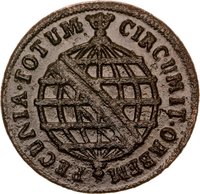
Obverse
Description:
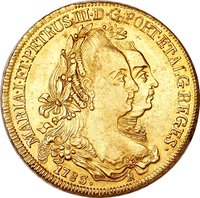
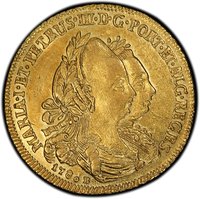
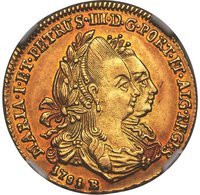
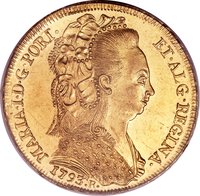
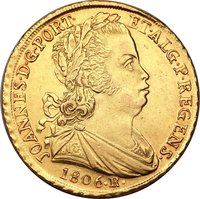
Conjoined busts of Maria I and Peter III facing right, with date and mintmark below.
Inscription:
MARIA.I.ET.PETRUS.III.D.G.PORT.ET.ALG.REGES
year_B
year_B
Script: Latin
Engraver: José Gaspard
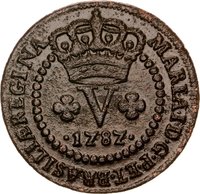
Reverse
Description:
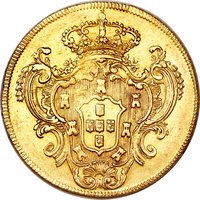
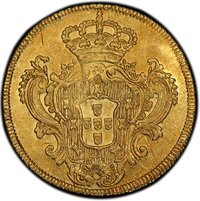
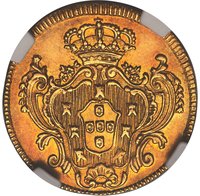
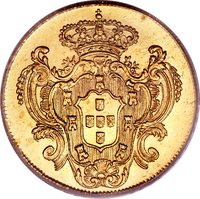
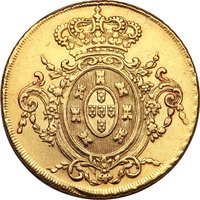
Royal arms of Maria I and Pedro III.
Engraver: José Gaspard
Edge
Reeded.
Mints
| Name | Mark |
|---|---|
| Bahia | B |
Historical background
In 1782, Brazil's currency situation was a complex and strained system under the Portuguese colonial administration. The primary circulating coin was the réis (plural: réis), a low-denomination copper and silver coinage that was perpetually scarce. This scarcity was exacerbated by Portugal's mercantilist policies, which drained gold and silver from the Minas Gerais region to Lisbon, leaving the colony with insufficient precious metal to mint an adequate supply of official currency. Consequently, the economy relied heavily on a chaotic mix of foreign coins—particularly Spanish American pesos—and even commodity money like sugar or tobacco in remote areas, leading to inconsistent valuations and widespread confusion in trade.
The financial strain was intensified by the policies of the Marquis of Pombal, whose earlier reforms had centralized economic control but failed to solve the currency shortage. Furthermore, the relocation of the Portuguese court to Rio de Janeiro in 1808 was still a quarter-century away, so Brazil lacked a mint of its own; all official coinage had to be imported from Portugal. This dependency created chronic deflationary pressures and hindered internal commerce. The colonial government attempted to address the shortage by periodically issuing copper sinetes (lead seals) as provisional currency, but these were deeply unpopular and prone to counterfeiting, further eroding public trust in the monetary system.
Ultimately, the currency crisis of 1782 was a symptom of Brazil's colonial subordination. The system was not designed for the colony's economic health but to facilitate the extraction of wealth for the metropole. The lack of a stable, abundant, and universally accepted medium of exchange stifled economic development and created a fragile financial environment. This instability would persist until the early 19th century, when the arrival of the Portuguese royal family finally prompted the establishment of the first Brazilian bank and mint, initiating a long and gradual process toward a more unified monetary authority.
The financial strain was intensified by the policies of the Marquis of Pombal, whose earlier reforms had centralized economic control but failed to solve the currency shortage. Furthermore, the relocation of the Portuguese court to Rio de Janeiro in 1808 was still a quarter-century away, so Brazil lacked a mint of its own; all official coinage had to be imported from Portugal. This dependency created chronic deflationary pressures and hindered internal commerce. The colonial government attempted to address the shortage by periodically issuing copper sinetes (lead seals) as provisional currency, but these were deeply unpopular and prone to counterfeiting, further eroding public trust in the monetary system.
Ultimately, the currency crisis of 1782 was a symptom of Brazil's colonial subordination. The system was not designed for the colony's economic health but to facilitate the extraction of wealth for the metropole. The lack of a stable, abundant, and universally accepted medium of exchange stifled economic development and created a fragile financial environment. This instability would persist until the early 19th century, when the arrival of the Portuguese royal family finally prompted the establishment of the first Brazilian bank and mint, initiating a long and gradual process toward a more unified monetary authority.
Series: Serie of Shields

✨ Legendary