

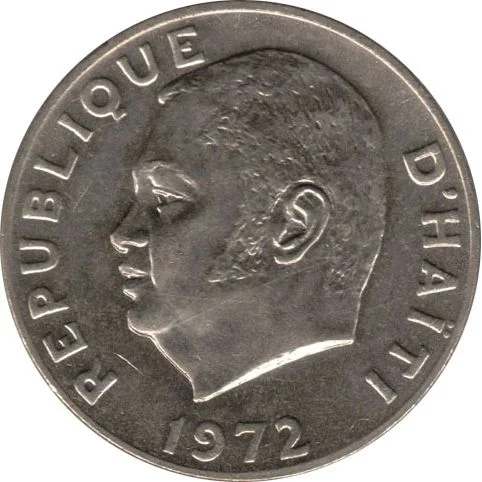
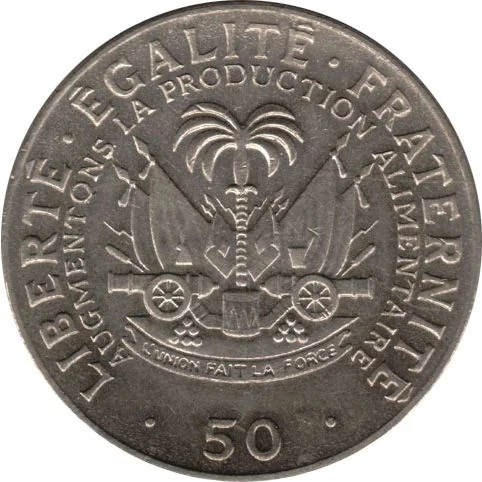
50 centimes – Haiti
Add to wishlist
Circulating commemorative coins
Commemoration: F.A.O.
Haiti
Context
Year: 1973
Year:: 1972
Issuer: Haiti
Period:
(1957—1986)
Currency:
(since 1872)
Demonetized: Yes
Total mintage: 600,000
Material
References
KM: #
Numista: #9544
Value
Exchange value: 0.50 HTG
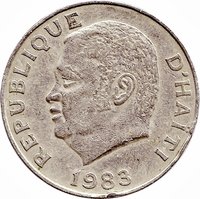
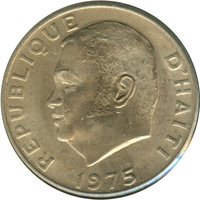
Obverse
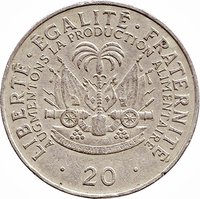
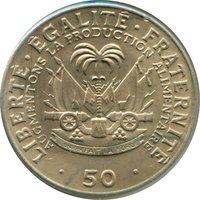
Reverse
Edge
Plain
Categories
| Symbols> Coat of Arms |
| Person> Politician |
| Organization> FAO |
Mints
| Name | Mark |
|---|---|
| United States Mint of San Francisco | — |
Mintings
| Year | Mint Mark | Mintage | Quality | Collection |
|---|---|---|---|---|
| 1973 | — | 600,000 |
Historical background
In 1973, Haiti's currency situation was characterized by the dominance of the gourde (HTG) under the authoritarian regime of President Jean-Claude "Baby Doc" Duvalier, who had recently succeeded his father. The gourde was officially pegged to the U.S. dollar at a fixed rate of 5 gourdes to 1 USD, a parity established in 1912 and maintained for decades. This peg provided a measure of stability for international accounting and the small formal sector, which included the crucial tourism industry and export operations for commodities like coffee and sisal.
However, this official stability masked significant underlying economic weaknesses and a dual currency reality. Alongside the fixed official rate, a thriving parallel black market for foreign exchange existed, where the gourde traded at a significant discount. This disparity reflected the country's chronic trade deficits, low foreign exchange reserves, and the widespread practice of currency speculation. The vast majority of Haitians, living in poverty and outside the formal banking system, were effectively subject to this weaker black-market rate, which eroded their purchasing power.
The currency regime in 1973 was fundamentally tied to the political economy of the Duvalier dictatorship. The state's tight control over the official exchange rate was a tool for channeling foreign currency to a small elite and the regime itself, facilitating imports for the wealthy and ensuring access to hard currency for the Duvalier family and their associates. This system exacerbated inequality, as the benefits of the strong official peg accrued to those with political connections, while the broader population contended with the economic distortions and inflation fueled by the black market and stagnant, agriculture-dependent economy.
However, this official stability masked significant underlying economic weaknesses and a dual currency reality. Alongside the fixed official rate, a thriving parallel black market for foreign exchange existed, where the gourde traded at a significant discount. This disparity reflected the country's chronic trade deficits, low foreign exchange reserves, and the widespread practice of currency speculation. The vast majority of Haitians, living in poverty and outside the formal banking system, were effectively subject to this weaker black-market rate, which eroded their purchasing power.
The currency regime in 1973 was fundamentally tied to the political economy of the Duvalier dictatorship. The state's tight control over the official exchange rate was a tool for channeling foreign currency to a small elite and the regime itself, facilitating imports for the wealthy and ensuring access to hard currency for the Duvalier family and their associates. This system exacerbated inequality, as the benefits of the strong official peg accrued to those with political connections, while the broader population contended with the economic distortions and inflation fueled by the black market and stagnant, agriculture-dependent economy.
🌱 Fairly Common