

50 centimes – Haiti
Add to wishlist
Circulating commemorative coins
Commemoration: F.A.O.
Haiti
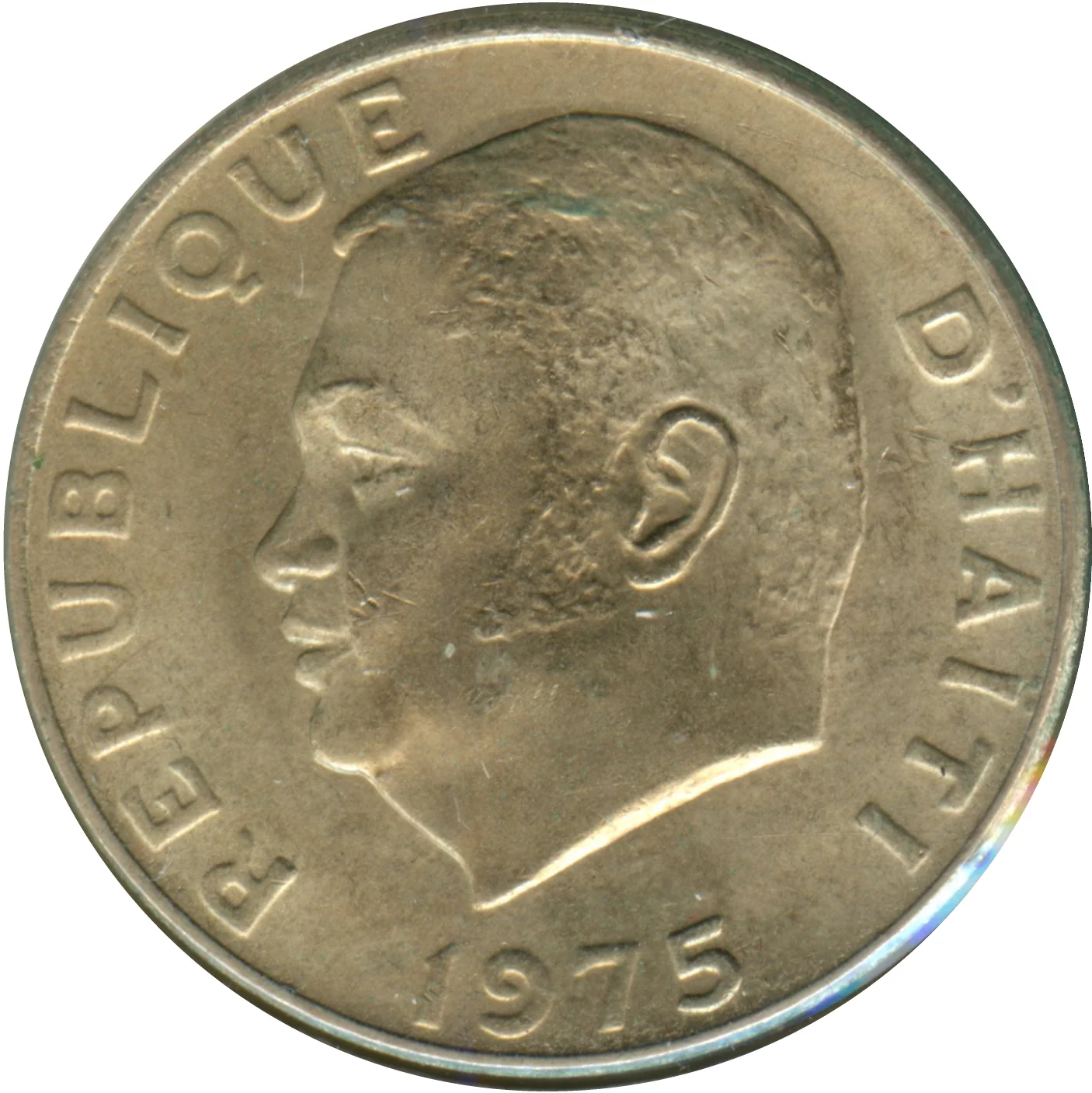
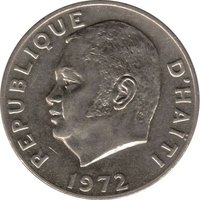
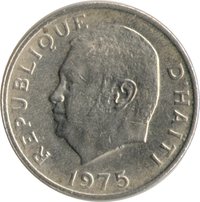
Obverse
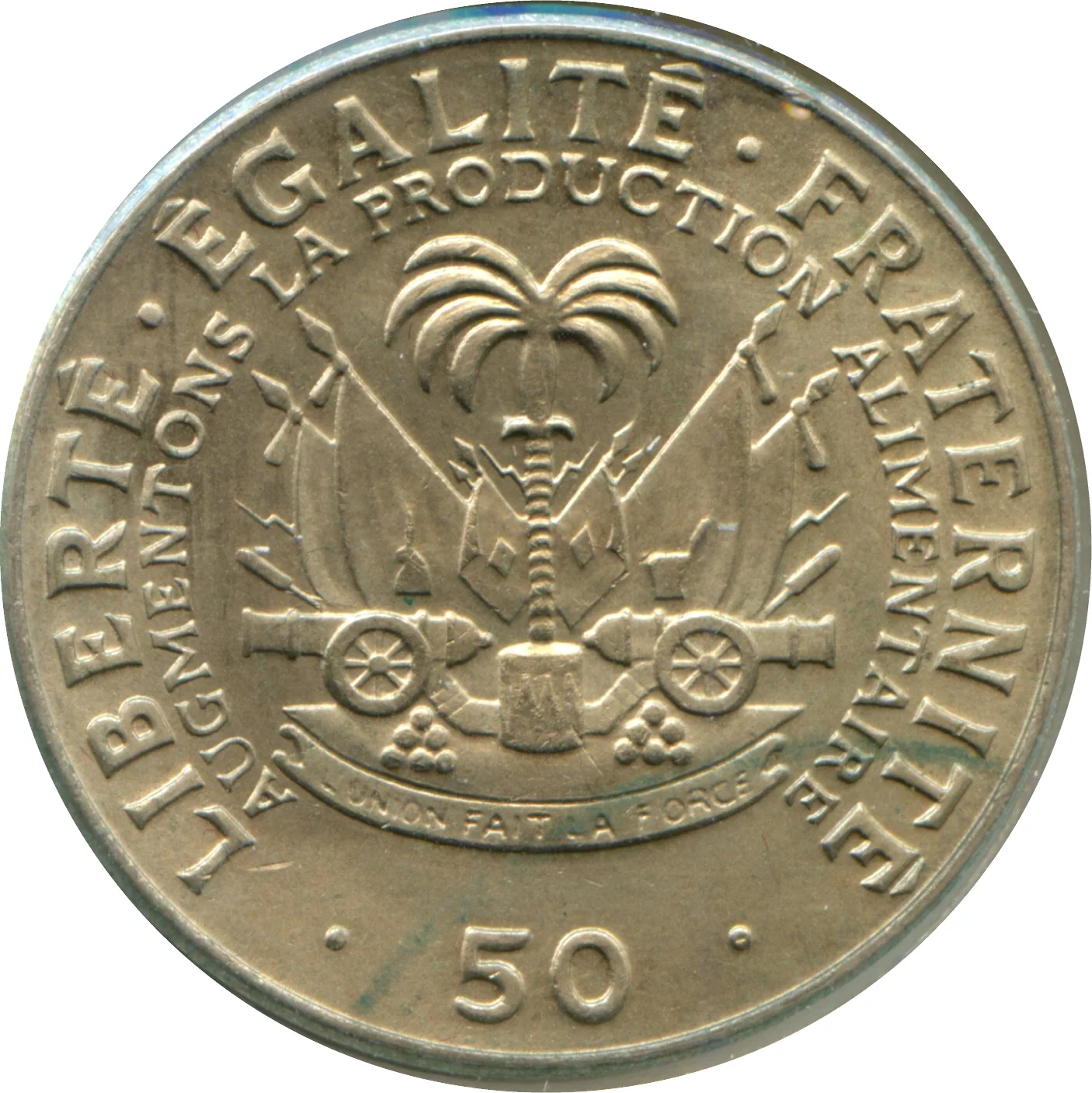
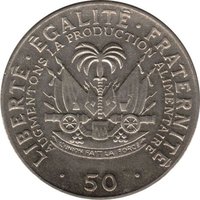
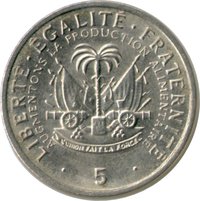
Reverse
Edge
Plain
Categories
| Person> Politician |
| Symbol> Flag |
| Organization> FAO |
| Plant> Tree |
| Symbols> Coat of Arms |
Mints
| Name | Mark |
|---|---|
| Royal Mint | — |
| United States Mint of San Francisco | — |
Mintings
| Year | Mint Mark | Mintage | Quality | Collection |
|---|---|---|---|---|
| 1975 | — | 1,200,000 | ||
| 1979 | — | 2,000,000 | ||
| 1983 | — | 1,000,000 | ||
| 1985 | — | — |
Historical background
In 1975, Haiti's currency situation was defined by the authoritarian rule of President Jean-Claude "Baby Doc" Duvalier, who had succeeded his father in 1971. The national currency, the gourde (HTG), was pegged to the U.S. dollar at a fixed rate of 5 gourdes to 1 dollar, a parity established in 1912 and maintained for decades. This peg provided a veneer of monetary stability but masked deeper economic vulnerabilities. The regime tightly controlled foreign exchange through the Banque Nationale de la République d’Haïti, with access largely reserved for the political elite and importers close to the Duvalierist state, fostering a system of patronage and corruption.
Economically, Haiti in the mid-1970s was experiencing a brief period of relative growth fueled by foreign aid, tourism, and the expansion of light assembly industries, known as the "Taiwan of the Caribbean" model. This influx of dollars helped support the fixed exchange rate. However, the underlying economy was fundamentally weak, relying heavily on agricultural exports like coffee, which were subject to volatile global prices. The fixed peg, while stable for transactions, did not reflect the true economic productivity of the nation and made Haitian exports less competitive, a problem exacerbated by a growing trade deficit.
Furthermore, the currency regime existed alongside a stark dual economy. While the Port-au-Prince elite and the formal sector operated within the official exchange system, the vast majority of Haitians lived in poverty, engaged in subsistence farming or informal trade. This disconnect meant that the perceived stability of the gourde offered little benefit to the populace. The system was inherently fragile, propped up by political will and foreign capital rather than sound economic fundamentals, storing up imbalances that would contribute to severe economic crises in the following decades after the Duvalier regime's collapse.
Economically, Haiti in the mid-1970s was experiencing a brief period of relative growth fueled by foreign aid, tourism, and the expansion of light assembly industries, known as the "Taiwan of the Caribbean" model. This influx of dollars helped support the fixed exchange rate. However, the underlying economy was fundamentally weak, relying heavily on agricultural exports like coffee, which were subject to volatile global prices. The fixed peg, while stable for transactions, did not reflect the true economic productivity of the nation and made Haitian exports less competitive, a problem exacerbated by a growing trade deficit.
Furthermore, the currency regime existed alongside a stark dual economy. While the Port-au-Prince elite and the formal sector operated within the official exchange system, the vast majority of Haitians lived in poverty, engaged in subsistence farming or informal trade. This disconnect meant that the perceived stability of the gourde offered little benefit to the populace. The system was inherently fragile, propped up by political will and foreign capital rather than sound economic fundamentals, storing up imbalances that would contribute to severe economic crises in the following decades after the Duvalier regime's collapse.
🌱 Common