

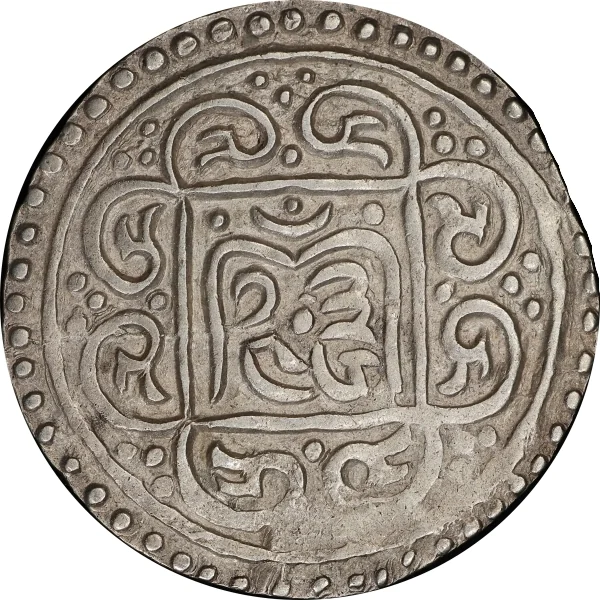

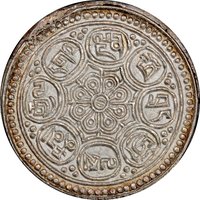
Obverse
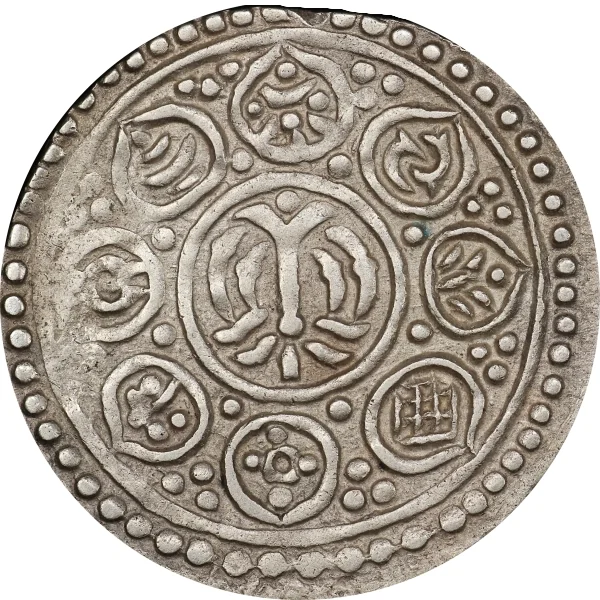
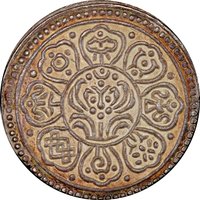
Reverse
Description:
A lotus encircled by the Eight Auspicious Symbols, all within an eight-petaled lotus.
Edge
Plain
Mints
| Name | Mark |
|---|---|
| Dopdal Mint | — |
Mintings
| Year | Mint Mark | Mintage | Quality | Collection |
|---|---|---|---|---|
| 1860 | — | — |
Historical background
In the mid-19th century, Tibet's currency system was a complex and localized mosaic, largely insulated from but peripherally affected by wider regional economic currents. The primary circulating medium was the Tibetan silver tangka coin, minted in Lhasa and other major towns, alongside Chinese silver sycee ingots and a vast array of copper and alloy coins for smaller transactions. This system operated under the authority of the Ganden Phodrang government and major monasteries, with monetary policy heavily influenced by religious institutions who controlled significant wealth and minting rights. The economy remained predominantly non-monetized, with barter in staples like barley, tea, and salt being widespread, especially in rural areas.
By 1860, external pressures were beginning to strain this insular system. The circulation of debased Nepalese mohar coins, a legacy of earlier treaties, created exchange rate complexities and periodic disputes with Kathmandu. More significantly, the large-scale influx of low-quality Indian rupees and British trade dollars from the southern border regions, linked to growing trans-Himalayan trade, started to challenge the purity and reliability of the Tibetan tangka. This subtle devaluation caused price instability in border markets and concern among merchants and authorities in Lhasa, though the core plateau regions remained buffered.
Ultimately, the currency situation reflected Tibet's political reality: a de facto autonomous region under the nominal suzerainty of the weakened Qing Dynasty, which was itself grappling with the Taiping Rebellion and Western imperialism. While the Qing Amban (resident official) in Lhasa represented imperial authority, day-to-day fiscal and monetary control rested with Tibetan institutions. The year 1860 thus represents a point of relative, but fragile, equilibrium—a traditional system still functioning with authority but showing early signs of stress from the increasing integration into broader, and often disruptive, economic networks spurred by British colonial influence in South Asia.
By 1860, external pressures were beginning to strain this insular system. The circulation of debased Nepalese mohar coins, a legacy of earlier treaties, created exchange rate complexities and periodic disputes with Kathmandu. More significantly, the large-scale influx of low-quality Indian rupees and British trade dollars from the southern border regions, linked to growing trans-Himalayan trade, started to challenge the purity and reliability of the Tibetan tangka. This subtle devaluation caused price instability in border markets and concern among merchants and authorities in Lhasa, though the core plateau regions remained buffered.
Ultimately, the currency situation reflected Tibet's political reality: a de facto autonomous region under the nominal suzerainty of the weakened Qing Dynasty, which was itself grappling with the Taiping Rebellion and Western imperialism. While the Qing Amban (resident official) in Lhasa represented imperial authority, day-to-day fiscal and monetary control rested with Tibetan institutions. The year 1860 thus represents a point of relative, but fragile, equilibrium—a traditional system still functioning with authority but showing early signs of stress from the increasing integration into broader, and often disruptive, economic networks spurred by British colonial influence in South Asia.
💎 Extremely Rare