

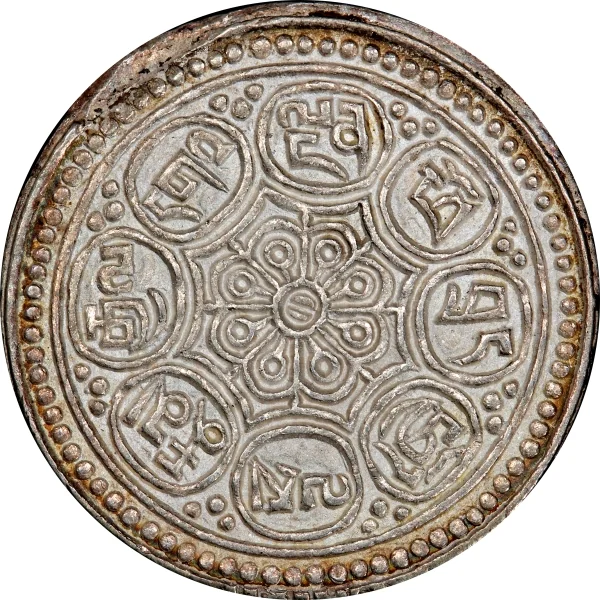
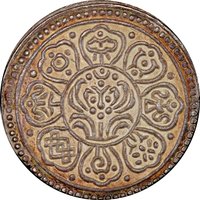
Obverse
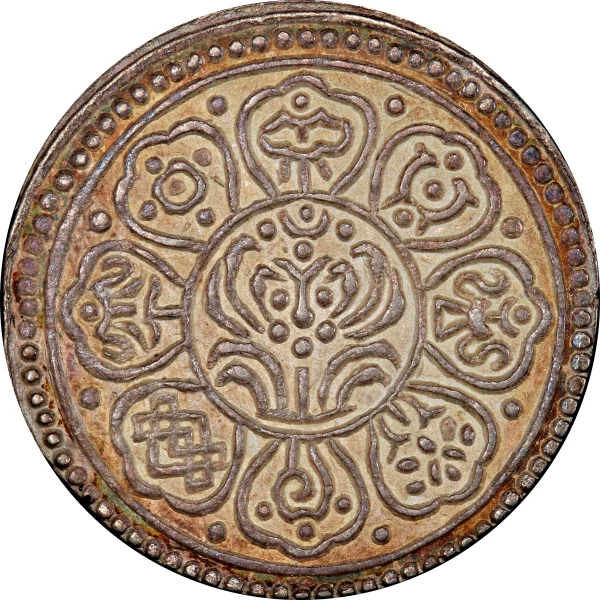
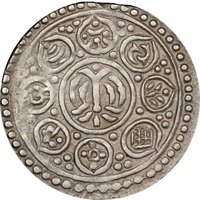
Reverse
Description:
Ornate lotus with the Eight Auspicious Symbols in its petals.
Edge
Plain
Mintings
| Year | Mint Mark | Mintage | Quality | Collection |
|---|---|---|---|---|
| 1840 | — | — | BU | |
| 1840 | — | — | ||
| 1880 | — | — | ||
| 1882 | — | — | ||
| 1885 | — | — | ||
| 1888 | — | — | ||
| 1891 | — | — | ||
| 1892 | — | — | ||
| 1895 | — | — | ||
| 1896 | — | — | ||
| 1897 | — | — | ||
| 1898 | — | — | ||
| 1899 | — | — | ||
| — | — | — | ||
| 1904 | — | — | ||
| 1909 | — | — | ||
| 1912 | — | — | ||
| 1921 | — | — | ||
| 1929 | — | — |
Historical background
In 1840, Tibet operated under a largely self-contained monetary system, distinct from the fiscal structures of the Qing Empire to which it was nominally subordinate. The primary currency in circulation was the Tibetan silver coin, known as the Tangka or Srang. Struck locally at the mint in Lhasa (and occasionally in Shigatse), these coins bore Buddhist symbols and inscriptions, and their silver content and weight were the basis of the region's economy. The system was supplemented by the use of Chinese silver sycee (ingots) for larger transactions and trade, as well as Nepalese Mohar coins, a legacy of historical trade agreements that granted Nepal minting rights—a source of recurring diplomatic and economic tension.
This multi-currency environment created significant complexity. The exchange rates between Tibetan Tangkas, Nepalese coins, and Chinese silver were unstable and often manipulated, leading to market confusion and periodic grievances. Furthermore, the debasement of coins (reducing their silver content) by various authorities was a chronic problem that eroded public trust and sparked inflation. The Qing Amban (imperial resident) in Lhasa had theoretical oversight, but practical monetary control remained largely in the hands of the Kashag (Tibetan government) and monastic institutions, reflecting the region's autonomous administration.
The year 1840 itself fell within a period of relative monetary stability under the 13th Dalai Lama, but the underlying structural issues were persistent. The system was fundamentally insular, designed to service a monastic-agrarian economy and the vital trans-Himalayan trade in wool, tea, and textiles. However, its reliance on imported silver and the pressures of neighboring economies made it vulnerable. This fragile equilibrium would be severely tested in the coming decades by external forces, including the declining authority of the Qing and increasing British commercial interests following the First Anglo-Sikh War (1845-46), which began to reshape the entire Himalayan economic landscape.
This multi-currency environment created significant complexity. The exchange rates between Tibetan Tangkas, Nepalese coins, and Chinese silver were unstable and often manipulated, leading to market confusion and periodic grievances. Furthermore, the debasement of coins (reducing their silver content) by various authorities was a chronic problem that eroded public trust and sparked inflation. The Qing Amban (imperial resident) in Lhasa had theoretical oversight, but practical monetary control remained largely in the hands of the Kashag (Tibetan government) and monastic institutions, reflecting the region's autonomous administration.
The year 1840 itself fell within a period of relative monetary stability under the 13th Dalai Lama, but the underlying structural issues were persistent. The system was fundamentally insular, designed to service a monastic-agrarian economy and the vital trans-Himalayan trade in wool, tea, and textiles. However, its reliance on imported silver and the pressures of neighboring economies made it vulnerable. This fragile equilibrium would be severely tested in the coming decades by external forces, including the declining authority of the Qing and increasing British commercial interests following the First Anglo-Sikh War (1845-46), which began to reshape the entire Himalayan economic landscape.
🌱 Common