

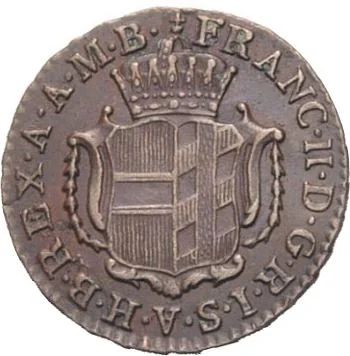
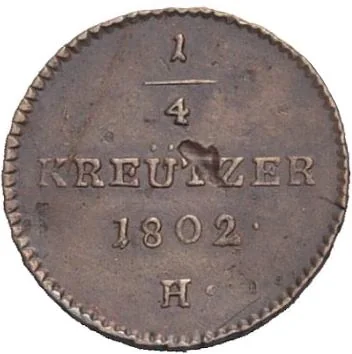
¼ Kreuzer – Further Austria
Austria
Context
Years: 1801–1803
Country: Austria 
Issuer: Further Austria
Ruler: Francis II
Currency:
Demonetized: Yes
References
KM: #Click to copy to clipboard25
Numista: #95034
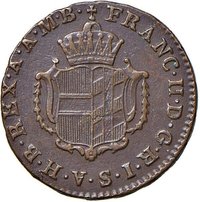
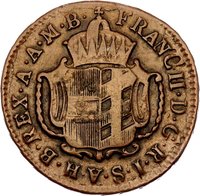
Obverse
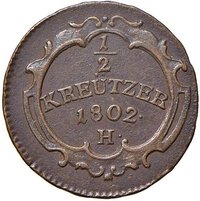
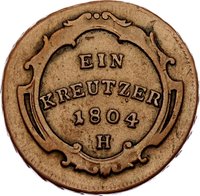
Reverse
Edge
Mintings
| Year | Mint Mark | Mintage | Quality | Collection |
|---|---|---|---|---|
| 1801 | H | — | ||
| 1802 | H | — | ||
| 1803 | H | — |
Historical background
In 1801, the currency situation in Further Austria (Vorderösterreich) was a complex and fragmented reflection of the territory's political and geographical dislocation. These scattered Habsburg possessions in the Swabian region, including the Breisgau and parts of modern-day Baden-Württemberg, lacked a unified monetary system. Instead, circulation was dominated by a multitude of foreign and domestic coins. The most important were the Conventionsthaler and Kreuzer from the Habsburg core lands, but these competed heavily with currencies from neighboring states, particularly the Gulden and Kreuzer of the Holy Roman Empire's Swabian and Rhenish circles, as well as French livres following revolutionary influences.
This monetary plurality created significant challenges for trade and daily life. Exchange rates between these various coins fluctuated, leading to confusion, arbitrage, and economic inefficiency. The problem was exacerbated by the ongoing Napoleonic Wars, which disrupted traditional economic patterns and saw French troops and financial demands directly impacting the region. Authorities in Freiburg, the administrative center, struggled to enforce monetary ordinances, as the practical reality of commerce required the acceptance of a wide array of specie.
Ultimately, the currency chaos of 1801 was a symptom of Further Austria's impending demise. Within just four years, the Pressburg Peace of 1805 would dissolve these ancient Habsburg territories, with most being absorbed into the Grand Duchy of Baden and the Kingdom of Württemberg. This political transition would forcibly end Further Austria's distinct monetary challenges by integrating the region into the new, simplified currency systems of its successor states, drawing the fragmented monetary era to a close.
This monetary plurality created significant challenges for trade and daily life. Exchange rates between these various coins fluctuated, leading to confusion, arbitrage, and economic inefficiency. The problem was exacerbated by the ongoing Napoleonic Wars, which disrupted traditional economic patterns and saw French troops and financial demands directly impacting the region. Authorities in Freiburg, the administrative center, struggled to enforce monetary ordinances, as the practical reality of commerce required the acceptance of a wide array of specie.
Ultimately, the currency chaos of 1801 was a symptom of Further Austria's impending demise. Within just four years, the Pressburg Peace of 1805 would dissolve these ancient Habsburg territories, with most being absorbed into the Grand Duchy of Baden and the Kingdom of Württemberg. This political transition would forcibly end Further Austria's distinct monetary challenges by integrating the region into the new, simplified currency systems of its successor states, drawing the fragmented monetary era to a close.
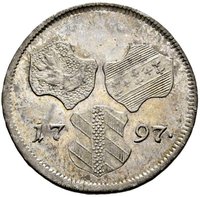
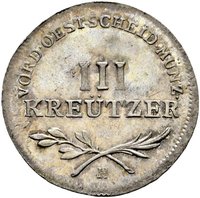
💎 Extremely Rare