

3 Kreuzers – Further Austria
Austria
Context
Years: 1793–1800
Country: Austria 
Issuer: Further Austria
Ruler: Francis II
Currency:
Demonetized: Yes
References
KM: #Click to copy to clipboard22
Numista: #81578
Obverse
Reverse
Description:
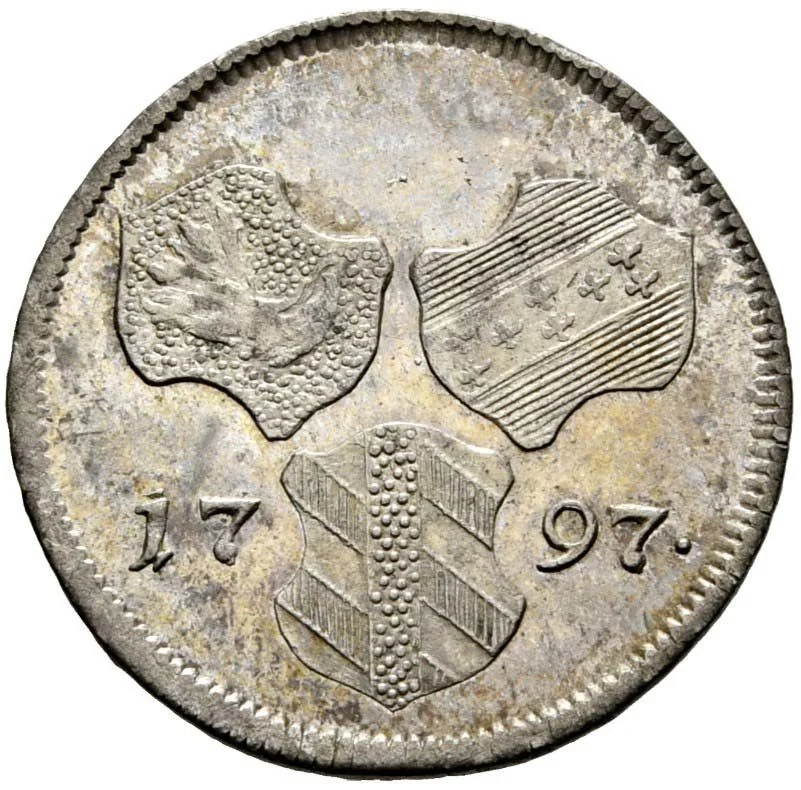
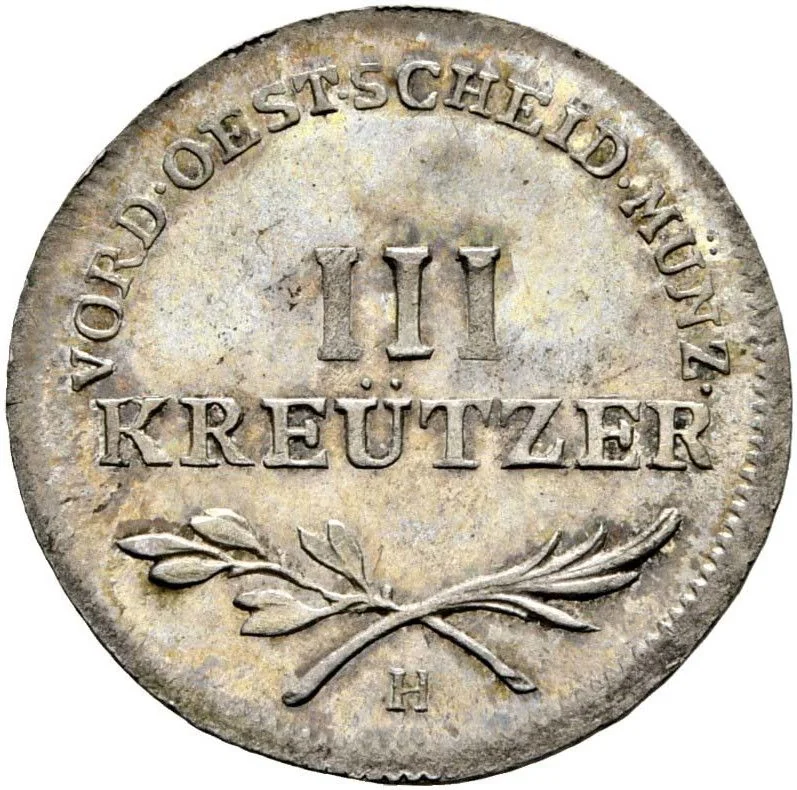
Legend above, two-line inscription below with denomination over laurel and palm branch. Mintmark at bottom.
Inscription:
VORD. OEST. SCHEID. MUNZ.
III KREÜTZER
H
III KREÜTZER
H
Script: Latin
Edge
Mintings
| Year | Mint Mark | Mintage | Quality | Collection |
|---|---|---|---|---|
| 1793 | A | — | ||
| 1793 | H | — | ||
| 1794 | A | — | ||
| 1794 | H | — | ||
| 1795 | H | — | ||
| 1796 | H | — | ||
| 1797 | H | — | ||
| 1799 | H | — | ||
| 1800 | H | — |
Historical background
In 1793, the currency situation in Further Austria (Vorderösterreich) was complex and fragmented, reflecting the territory's disparate geography and political structure. These Habsburg possessions, scattered across modern-day Baden-Württemberg, Alsace, and Switzerland, lacked a unified monetary system. Circulation was dominated by a mixture of regional coinage from various Swabian and Swiss mints, alongside a substantial influx of currencies from neighboring states like Bavaria, the Palatinate, and France. This created a chaotic marketplace where merchants and peasants had to constantly navigate fluctuating exchange rates and the uncertain value of numerous coin types.
The primary unit of account was the Gulden (florin), divided into 60 Kreuzer. However, the actual coins in circulation—such as Batzen, Groschen, and Thalers—varied greatly in their silver content and official valuation. The Habsburg state attempted to impose order by mandating rates for its own Konventionsmünze (convention coinage), a standardized monetary system used in the core Austrian lands. Yet, enforcing these rates in distant, semi-autonomous territories proved difficult. The economic strain of the ongoing War of the First Coalition against revolutionary France exacerbated the problem, as wartime financing often led to debasement and increased the circulation of inferior foreign coins.
Consequently, the monetary landscape was one of inherent instability and localized practice. Trade was hindered by the need for expert money changers, and the population faced the chronic risk of being paid in devalued currency. This fragmentation was a significant administrative and economic weakness for Vienna, highlighting the challenges of governing non-contiguous territories. The situation would only be resolved through sweeping political change, beginning with the territorial upheavals of the Peace of Pressburg (1805) and the later dissolution of the Holy Roman Empire, which ultimately integrated these lands into larger, more unified monetary zones.
The primary unit of account was the Gulden (florin), divided into 60 Kreuzer. However, the actual coins in circulation—such as Batzen, Groschen, and Thalers—varied greatly in their silver content and official valuation. The Habsburg state attempted to impose order by mandating rates for its own Konventionsmünze (convention coinage), a standardized monetary system used in the core Austrian lands. Yet, enforcing these rates in distant, semi-autonomous territories proved difficult. The economic strain of the ongoing War of the First Coalition against revolutionary France exacerbated the problem, as wartime financing often led to debasement and increased the circulation of inferior foreign coins.
Consequently, the monetary landscape was one of inherent instability and localized practice. Trade was hindered by the need for expert money changers, and the population faced the chronic risk of being paid in devalued currency. This fragmentation was a significant administrative and economic weakness for Vienna, highlighting the challenges of governing non-contiguous territories. The situation would only be resolved through sweeping political change, beginning with the territorial upheavals of the Peace of Pressburg (1805) and the later dissolution of the Holy Roman Empire, which ultimately integrated these lands into larger, more unified monetary zones.
💎 Very Rare