

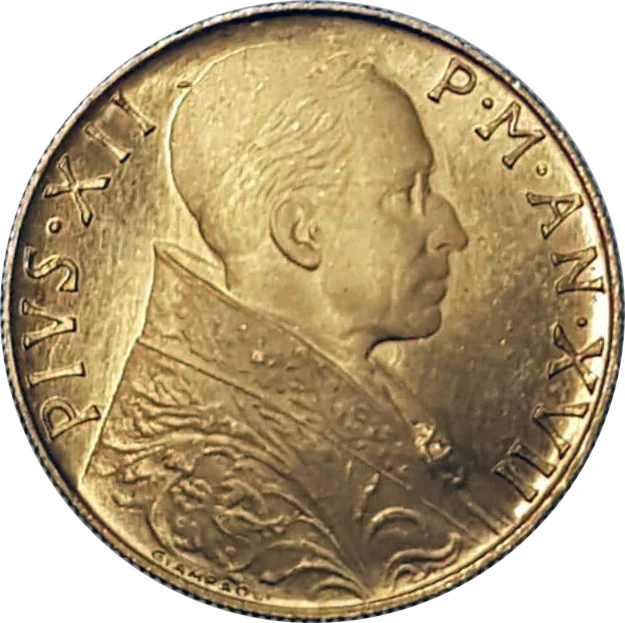
100 Lire – Vatican City
Vatican City
Context
Years: 1951–1956
Issuer: Vatican City 
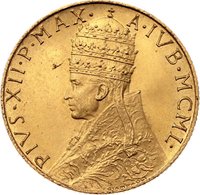
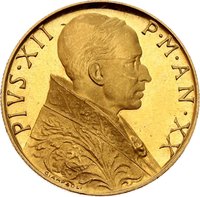
Ruler: Pius XII
Currency:
(1929—2001)
Demonetized: Yes
Total mintage: 6,000
Material
References
KM: #Click to copy to clipboard53.1
Numista: #94997
Value
Exchange value: 100 VAL
Bullion value: $778.80
Obverse
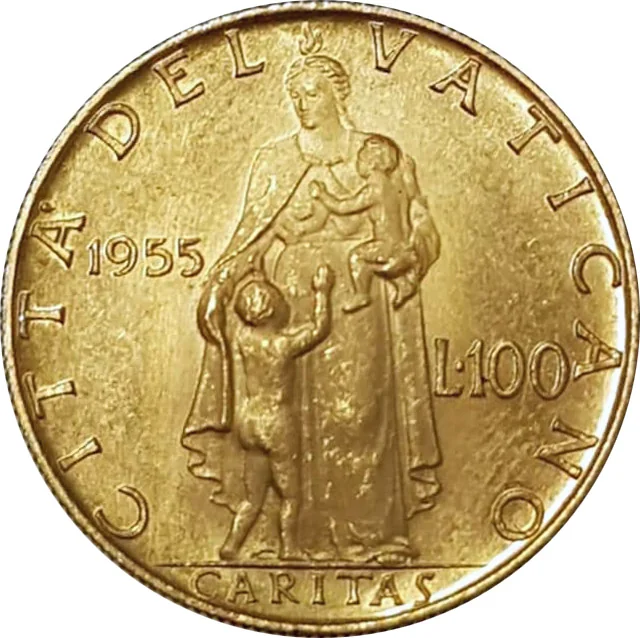
Reverse
Description:
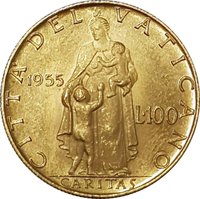
Caritas holding a child, another at her feet.
Inscription:
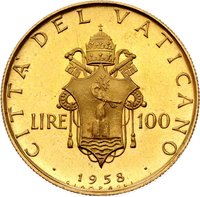
CITTA' DEL VATICANO
L·100
1951
CARITAS
L·100
1951
CARITAS
Script: Latin
Edge
Categories
| Person> Religious figure |
| Religion> Religious objects |
| Symbol> Allegory |
Mints
| Name | Mark |
|---|---|
| Rome | — |
Mintings
| Year | Mint Mark | Mintage | Quality | Collection |
|---|---|---|---|---|
| 1951 | — | 1,000 | ||
| 1952 | — | 1,000 | ||
| 1953 | — | 1,000 | ||
| 1954 | — | 1,000 | ||
| 1955 | — | 1,000 | ||
| 1956 | — | 1,000 |
Historical background
In 1951, Vatican City's currency situation was a direct consequence of its unique status as a sovereign city-state following the 1929 Lateran Treaty. While it possessed the right to issue its own coinage, it did not have an independent paper currency. Instead, the Vatican lira existed as a nominal unit of account and in coin form, but it was pegged at par and fully interchangeable with the Italian lira. This meant that Italian banknotes and coins circulated freely within the tiny state's borders, forming the practical backbone of everyday transactions. The Vatican's own coins, minted in limited quantities and often featuring religious iconography and the image of Pope Pius XII, were primarily intended for collectors, tourists, and ceremonial purposes rather than displacing Italian currency.
This monetary arrangement was governed by a financial convention within the Lateran Treaty, which integrated Vatican City into the Italian monetary zone. The Italian Banca d'Italia effectively served as the central bank for the Vatican's practical financial operations. Consequently, Vatican City had no independent monetary policy; its financial stability was inextricably linked to Italy's. The system was managed by the Administration of the Patrimony of the Holy See, which handled the state's finances and ensured the convertibility of its coinage.
The year 1951 fell within a period of post-war reconstruction for Italy, marked by inflation and the early efforts of the European Payments Union. For Vatican City, this context meant its tied currency experienced the same economic pressures as the Italian lira. The primary focus of Vatican finances during this era was not on currency sovereignty but on managing its investments and the annual financial contributions from global Catholic dioceses (known as Peter's Pence) to support the Holy See's operations and global missions, all conducted through the framework of the Italian monetary system.
This monetary arrangement was governed by a financial convention within the Lateran Treaty, which integrated Vatican City into the Italian monetary zone. The Italian Banca d'Italia effectively served as the central bank for the Vatican's practical financial operations. Consequently, Vatican City had no independent monetary policy; its financial stability was inextricably linked to Italy's. The system was managed by the Administration of the Patrimony of the Holy See, which handled the state's finances and ensured the convertibility of its coinage.
The year 1951 fell within a period of post-war reconstruction for Italy, marked by inflation and the early efforts of the European Payments Union. For Vatican City, this context meant its tied currency experienced the same economic pressures as the Italian lira. The primary focus of Vatican finances during this era was not on currency sovereignty but on managing its investments and the annual financial contributions from global Catholic dioceses (known as Peter's Pence) to support the Holy See's operations and global missions, all conducted through the framework of the Italian monetary system.
✨ Legendary