

100 lire – Vatican City
Add to wishlist
Non-circulating coins
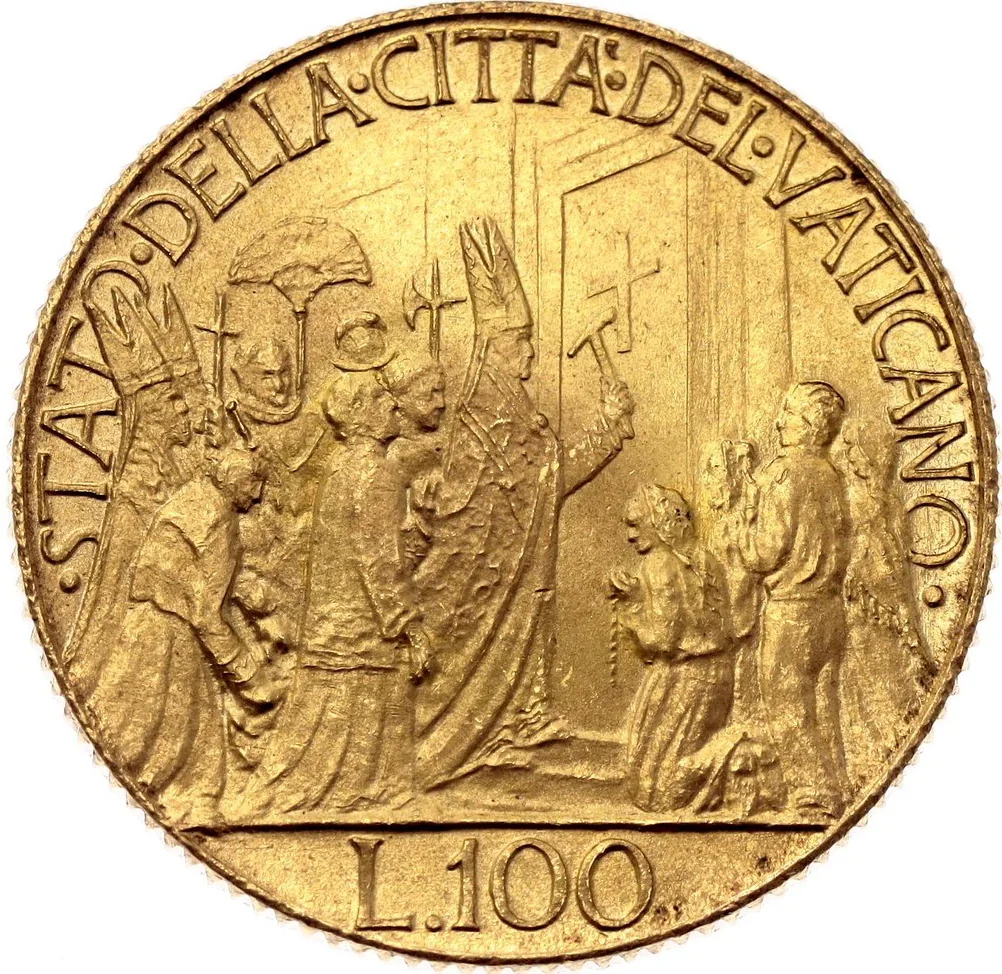
Commemoration: Opening of the Holy Year Door
Vatican City
Context
Year: 1950
Issuer: Vatican City
Ruler: Pius XII
Currency:
(1929—2001)
Demonetization: 1 March 2002
Total mintage: 14,000
Material
References
KM: #
Numista: #90218
Value
Exchange value: 100 VAL
Bullion value: $712.12
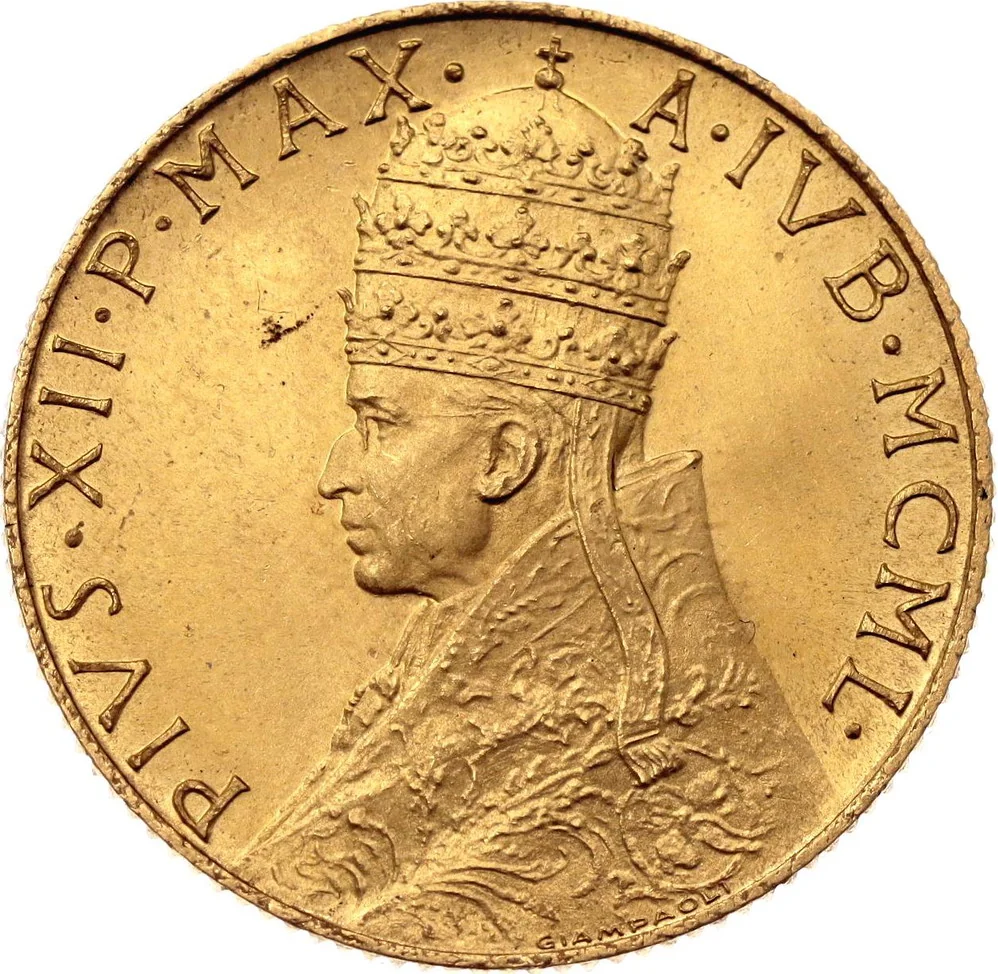
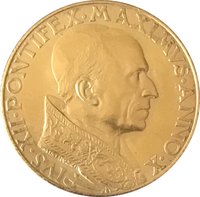
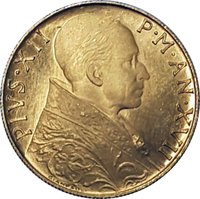
Obverse
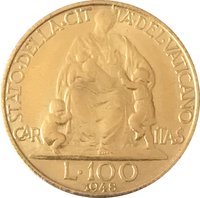
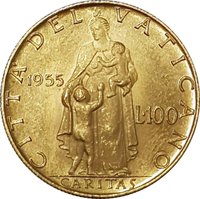
Reverse
Edge
Reeded
Categories
| Person> Religious figure |
| Symbol> Crown |
| Religion> Religious objects |
| Symbol> Cross |
Mints
| Name | Mark |
|---|---|
| Rome | — |
Mintings
| Year | Mint Mark | Mintage | Quality | Collection |
|---|---|---|---|---|
| 1950 | — | 14,000 |
Historical background
In 1950, Vatican City's currency situation was a direct consequence of its unique status as a sovereign city-state established by the Lateran Treaty of 1929. This treaty ended the "Roman Question" and granted the Holy See full independence, which included the right to issue its own currency. Consequently, the Vatican introduced the Vatican lira, which was legally equivalent to the Italian lira at a 1:1 parity and was the only legal tender within its walls. This arrangement meant the Vatican's monetary system was essentially a satellite of Italy's, lacking independent monetary policy but crucial for symbolic sovereignty and practical daily operations.
The issuance of currency was governed by a specific convention with the Italian Republic. Coins were minted at the Italian State Mint (Istituto Poligrafico e Zecca dello Stato), while banknotes were the Italian lira notes circulating in Italy, as the Vatican did not issue its own paper money. Vatican coins, however, bore distinctive designs featuring the image of the reigning Pope (Pius XII at the time) and various religious or state symbols. These coins were minted in limited quantities, primarily intended for collectors and ceremonial purposes, rather than for driving the tiny enclave's economy, which was funded through donations, investments, and tourism.
Therefore, the 1950 currency landscape was one of formal autonomy under practical Italian control. The Vatican lira existed as a potent symbol of papal sovereignty, circulating alongside and being fully interchangeable with Italian currency. This system ensured financial functionality while reinforcing the Vatican's political independence, a carefully balanced arrangement that would remain largely unchanged until the introduction of the Euro in 2002.
The issuance of currency was governed by a specific convention with the Italian Republic. Coins were minted at the Italian State Mint (Istituto Poligrafico e Zecca dello Stato), while banknotes were the Italian lira notes circulating in Italy, as the Vatican did not issue its own paper money. Vatican coins, however, bore distinctive designs featuring the image of the reigning Pope (Pius XII at the time) and various religious or state symbols. These coins were minted in limited quantities, primarily intended for collectors and ceremonial purposes, rather than for driving the tiny enclave's economy, which was funded through donations, investments, and tourism.
Therefore, the 1950 currency landscape was one of formal autonomy under practical Italian control. The Vatican lira existed as a potent symbol of papal sovereignty, circulating alongside and being fully interchangeable with Italian currency. This system ensured financial functionality while reinforcing the Vatican's political independence, a carefully balanced arrangement that would remain largely unchanged until the introduction of the Euro in 2002.
💎 Very Rare