

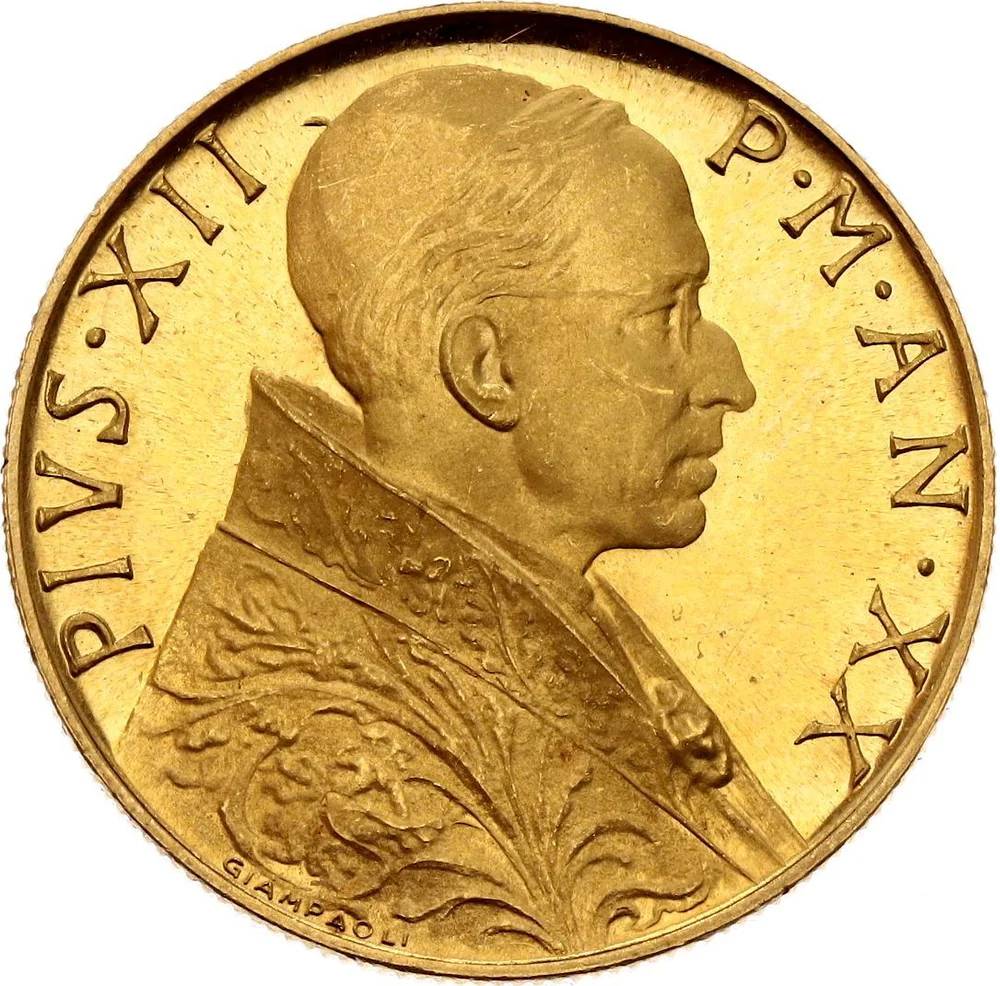
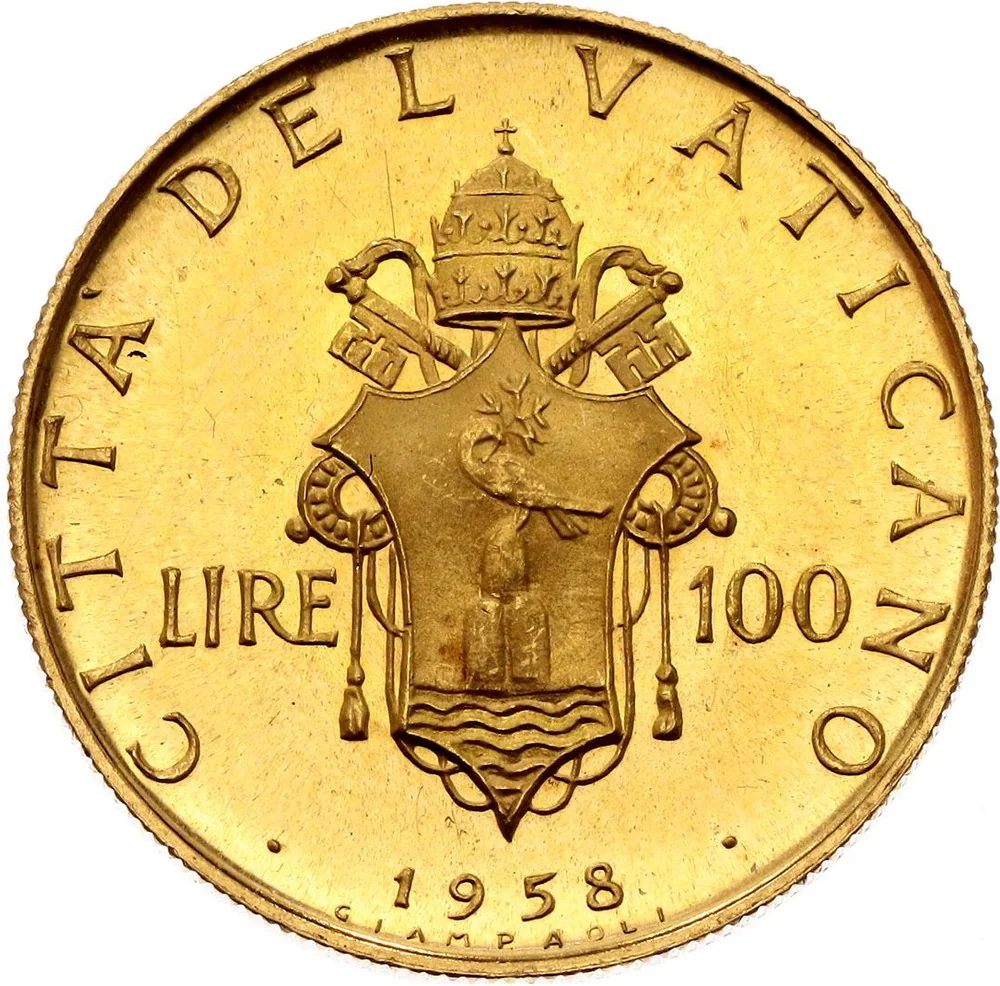
100 lire – Vatican City
Add to wishlist
Vatican City
Context
Years: 1957–1958
Issuer: Vatican City
Ruler: Pius XII
Currency:
(1929—2001)
Demonetized: Yes
Total mintage: 5,000
Material
References
KM: #
Numista: #131813
Value
Exchange value: 100 VAL
Bullion value: $712.12
Obverse
Reverse
Description:
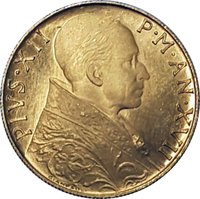
Arms of Pope Pius XII
Inscription:
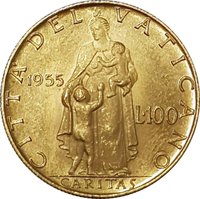
CITTA' DEL VATICANO
LIRE 100
1957
GIAMPAOLI
LIRE 100
1957
GIAMPAOLI
Translation:
Vatican City
Lire 100
1957
Giampaoli
Lire 100
1957
Giampaoli
Script: Latin
Language: Italian
Engraver: Pietro Giampaoli
Edge
Reeded
Categories
| Person> Religious figure |
| Religion> Religious objects |
| Symbols> Coat of Arms |
Mints
| Name | Mark |
|---|---|
| Rome | — |
Mintings
| Year | Mint Mark | Mintage | Quality | Collection |
|---|---|---|---|---|
| 1957 | — | 2,000 | ||
| 1958 | — | 3,000 |
Historical background
In 1957, Vatican City’s currency situation was uniquely defined by its status as a sovereign city-state and its deep integration with Italy. Following the 1929 Lateran Treaties, which established its independence, Vatican City was part of the Italian monetary area. The Italian Lira was the official and everyday circulating currency, used for all internal transactions and commerce. This practical arrangement was formalized in a monetary convention with Italy, which granted the Holy See the right to mint its own lire coins, but these were limited in quantity and intended more as commemorative or symbolic issues rather than replacing Italian currency.
However, the Vatican also exercised its sovereign right to issue its own distinct coinage. Struck at the Rome Mint, Vatican lire coins bore the image of the reigning Pope, Pius XII, and featured unique designs of religious and state symbols. Their legal tender status was guaranteed within Vatican City and, crucially, throughout Italy due to the monetary agreement, making them functionally equivalent to Italian coins in daily use. Their issuance was carefully regulated by treaty, with an annual cap on volume to prevent any disruptive impact on the Italian monetary system, ensuring the arrangement remained symbiotic rather than competitive.
This dual system reflected the Vatican’s hybrid reality: a theocratic sovereignty deeply embedded within the Italian economic sphere. The reliance on the Italian lira for practical finance, coupled with the issuance of sovereign coinage for symbolic and fiscal purposes, created a stable and functional monetary environment. This stability would become foundational for the significant financial developments within the Vatican in the subsequent decades, even as the specific agreements evolved, most notably with a new concordat with Italy in 1985 and the eventual adoption of the Euro in 2002.
However, the Vatican also exercised its sovereign right to issue its own distinct coinage. Struck at the Rome Mint, Vatican lire coins bore the image of the reigning Pope, Pius XII, and featured unique designs of religious and state symbols. Their legal tender status was guaranteed within Vatican City and, crucially, throughout Italy due to the monetary agreement, making them functionally equivalent to Italian coins in daily use. Their issuance was carefully regulated by treaty, with an annual cap on volume to prevent any disruptive impact on the Italian monetary system, ensuring the arrangement remained symbiotic rather than competitive.
This dual system reflected the Vatican’s hybrid reality: a theocratic sovereignty deeply embedded within the Italian economic sphere. The reliance on the Italian lira for practical finance, coupled with the issuance of sovereign coinage for symbolic and fiscal purposes, created a stable and functional monetary environment. This stability would become foundational for the significant financial developments within the Vatican in the subsequent decades, even as the specific agreements evolved, most notably with a new concordat with Italy in 1985 and the eventual adoption of the Euro in 2002.
✨ Legendary