

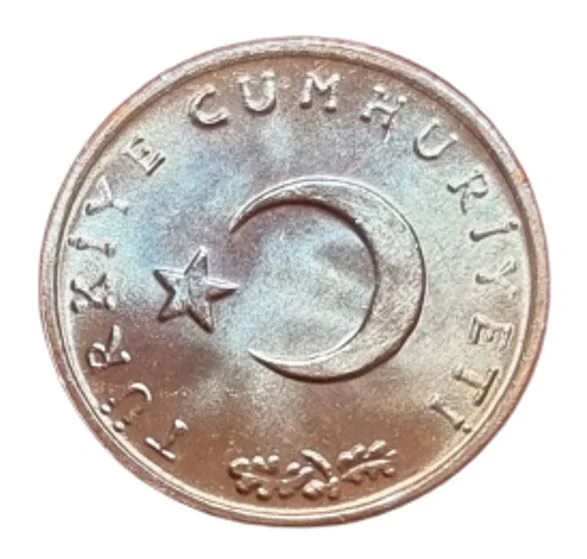
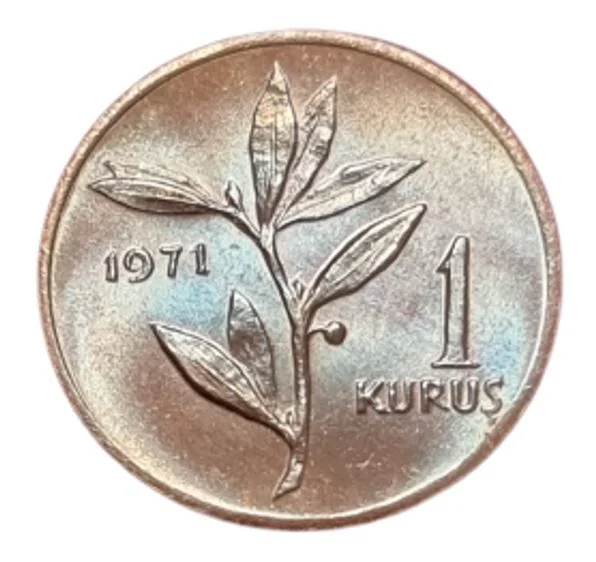

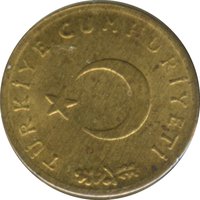
Obverse
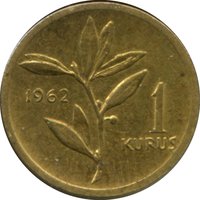
Reverse
Edge
Plain
Mints
| Name | Mark |
|---|---|
| Turkish State Mint | — |
Mintings
| Year | Mint Mark | Mintage | Quality | Collection |
|---|---|---|---|---|
| 1963 | — | 1,180,000 | ||
| 1964 | — | 2,520,000 | ||
| 1965 | — | 1,860,000 | ||
| 1966 | — | 1,820,000 | ||
| 1967 | — | 2,410,000 | ||
| 1968 | — | 1,040,000 | ||
| 1969 | — | 900,000 | ||
| 1970 | — | 1,420,000 | ||
| 1971 | — | 2,940,000 | ||
| 1972 | — | 720,000 | ||
| 1973 | — | 540,000 | ||
| 1974 | — | 510,000 |
Historical background
In 1963, Turkey's currency situation was characterized by the ongoing stability of the Turkish lira (TL) under a fixed exchange rate regime, a system managed by the Central Bank of the Republic of Turkey (TCMB) and supported by international agreements. The lira was pegged to the U.S. dollar at an official rate of 9 TL = 1 USD, a parity established in 1960 and maintained throughout the year. This stability was underpinned by Turkey's membership in the Bretton Woods system and its close economic ties with the West, including aid from the Organisation for Economic Co-operation and Development (OECD) and the International Monetary Fund (IMF), which provided a framework for controlled monetary policy and foreign exchange reserves.
This period of relative currency calm followed a major devaluation in 1960 and occurred within the context of Turkey's First Five-Year Development Plan (1963-1967), which marked a shift toward state-led import substitution industrialization (ISI). The fixed exchange rate was a deliberate tool to provide predictability for this ambitious industrial plan, as it kept the cost of importing essential machinery and raw materials stable. However, this policy also created underlying pressures, as the overvalued lira made Turkish exports less competitive on the global market and encouraged a growing demand for foreign currency that would strain reserves over time.
Consequently, while 1963 itself was not a year of currency crisis, the seeds of future instability were being sown. The ISI model, reliant on protected domestic markets and an overvalued currency, led to persistent trade deficits and a reliance on external borrowing. The rigidity of the fixed peg would eventually prove unsustainable, setting the stage for the economic challenges and devaluations that Turkey would face in the latter half of the 1960s and beyond, as the system struggled to balance the goals of development, price stability, and external balance.
This period of relative currency calm followed a major devaluation in 1960 and occurred within the context of Turkey's First Five-Year Development Plan (1963-1967), which marked a shift toward state-led import substitution industrialization (ISI). The fixed exchange rate was a deliberate tool to provide predictability for this ambitious industrial plan, as it kept the cost of importing essential machinery and raw materials stable. However, this policy also created underlying pressures, as the overvalued lira made Turkish exports less competitive on the global market and encouraged a growing demand for foreign currency that would strain reserves over time.
Consequently, while 1963 itself was not a year of currency crisis, the seeds of future instability were being sown. The ISI model, reliant on protected domestic markets and an overvalued currency, led to persistent trade deficits and a reliance on external borrowing. The rigidity of the fixed peg would eventually prove unsustainable, setting the stage for the economic challenges and devaluations that Turkey would face in the latter half of the 1960s and beyond, as the system struggled to balance the goals of development, price stability, and external balance.

🌱 Very Common