

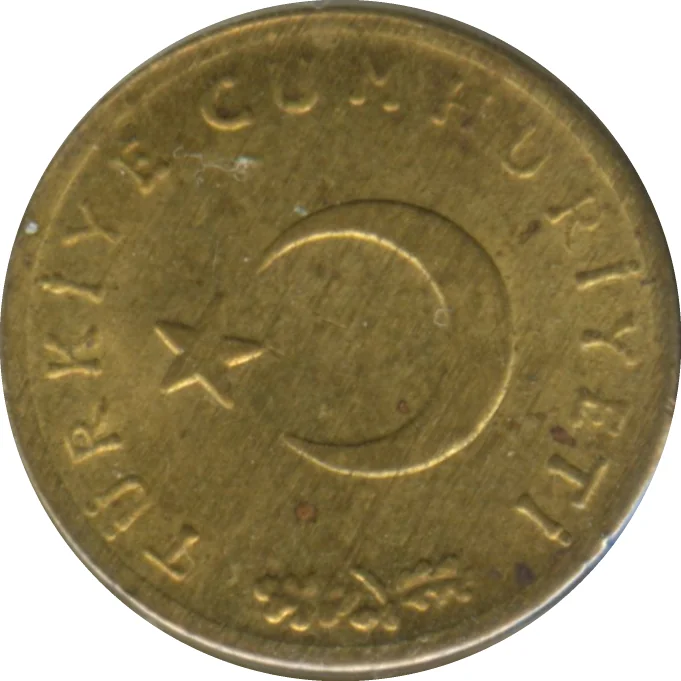
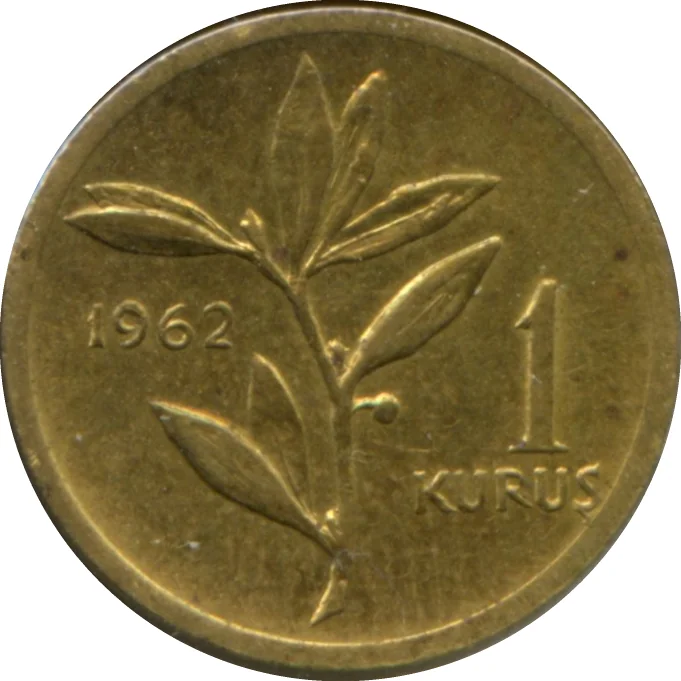

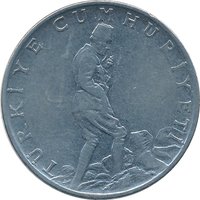
Obverse
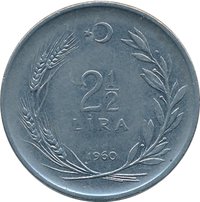
Reverse
Edge
Plain
Mints
| Name | Mark |
|---|---|
| Turkish State Mint | — |
Mintings
| Year | Mint Mark | Mintage | Quality | Collection |
|---|---|---|---|---|
| 1961 | — | 1,800,000 | ||
| 1962 | — | 3,520,000 | ||
| 1963 | — | 1,085,000 |
Historical background
In 1961, Turkey's currency situation was defined by the aftermath of the 1958 devaluation and the stabilization program implemented under the guidance of the International Monetary Fund (IMF) and the Organisation for Economic Co-operation and Development (OECD). This program had replaced the multi-tiered exchange rate system with a unified, devalued rate of 9 Turkish lira to 1 US dollar, a drastic measure aimed at curbing rampant inflation and correcting severe balance of payments deficits. The immediate crisis was contained, but the structural weaknesses of an import-substituting industrialization model, coupled with persistent fiscal deficits, meant the lira remained under fundamental pressure.
The year itself was one of political and economic transition following the 1960 military coup. The new, more technocratic government under the 1961 Constitution maintained the fixed exchange rate established in 1958, prioritizing stability as it embarked on a period of state-led development planning. However, the underlying inflationary tendencies were not fully extinguished. Price controls and continued public sector spending, financed in part by central bank resources, created a backdrop of "repressed inflation," where price increases were managed administratively rather than through market mechanisms, storing up problems for the future.
Consequently, while the currency regime was officially stable in 1961, the foundations were fragile. The fixed parity against the dollar was sustained through strict exchange controls and import restrictions rather than genuine macroeconomic balance. This period represented a calm between storms—the severe adjustments of the late 1950s and the growing pressures that would lead to a gradual erosion of the lira's value later in the 1960s, as the planned economy struggled with inefficiencies and the costs of rapid industrialization.
The year itself was one of political and economic transition following the 1960 military coup. The new, more technocratic government under the 1961 Constitution maintained the fixed exchange rate established in 1958, prioritizing stability as it embarked on a period of state-led development planning. However, the underlying inflationary tendencies were not fully extinguished. Price controls and continued public sector spending, financed in part by central bank resources, created a backdrop of "repressed inflation," where price increases were managed administratively rather than through market mechanisms, storing up problems for the future.
Consequently, while the currency regime was officially stable in 1961, the foundations were fragile. The fixed parity against the dollar was sustained through strict exchange controls and import restrictions rather than genuine macroeconomic balance. This period represented a calm between storms—the severe adjustments of the late 1950s and the growing pressures that would lead to a gradual erosion of the lira's value later in the 1960s, as the planned economy struggled with inefficiencies and the costs of rapid industrialization.
🌱 Common