

25 Kuna (Independence of the Republic of Croatia) – Croatia
Circulating commemorative coins
Commemoration: 25th Anniversary of Independence of the Republic of Croatia, 8 October 1991 – 8 October 2016
Croatia
Context
Material
Diameter: 32 mm
Weight: 12.75 g
Thickness: 2.2 mm
Shape: Dodecagonal
Technique: Milled
Alignment: Medal alignment
flip
References
KM: #Click to copy to clipboard111
Numista: #94467
Value
Exchange value: 25 HRK
Obverse
Description:
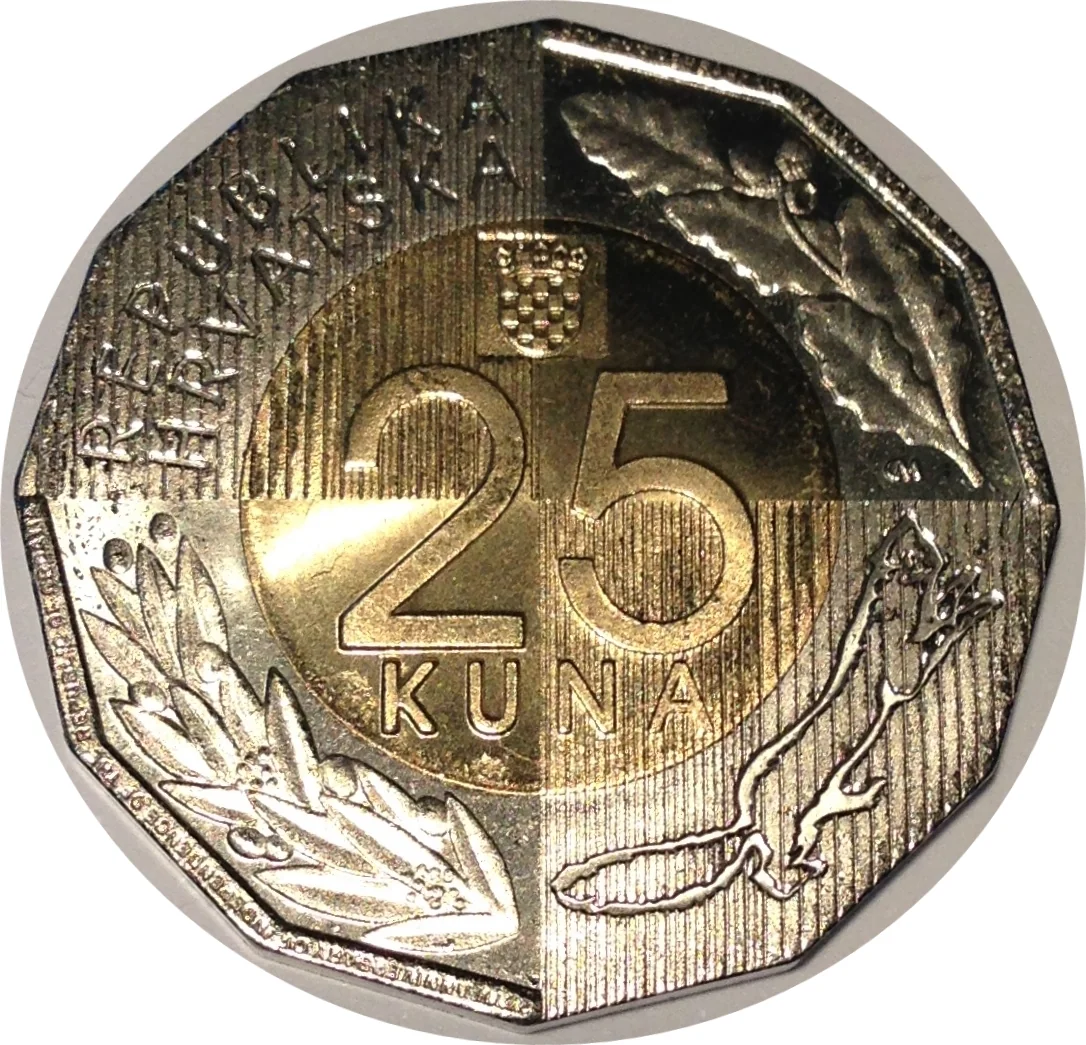
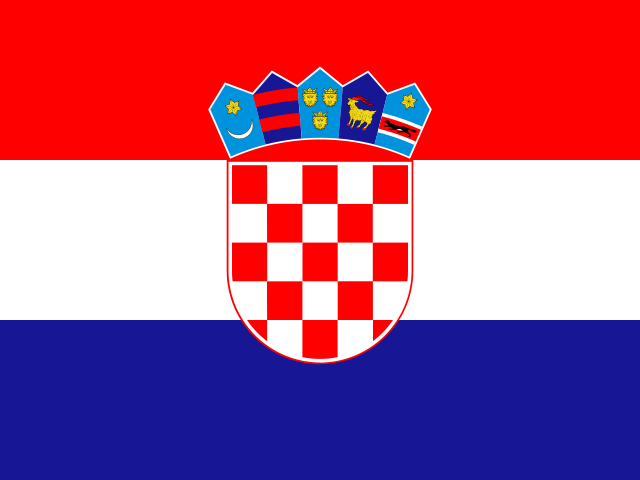
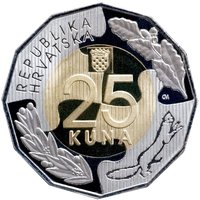
The coin's center shows "25" with Croatia's Coat of Arms above and "KUNA" below. Its surface is divided into alternating matte and lustrous quarters. The matte quarters on the ring feature "REPUBLIKA HRVATSKA" and a right-facing marten. The lustrous quarters show an olive branch and an oak branch with acorns, the latter above the engraver's "DM" signature. The rim bears the mini-inscription "25TH ANNIVERSARY OF INDEPENDENCE OF THE REPUBLIC OF CROATIA".
Inscription:
25TH ANNIVERSARY OF INDEPENDENCE OF THE REPUBLIC OF CROATIA
REPUBLIKA HRVATSKA
25
KUNA
DM
25TH ANNIVERSARY OF INDEPENDENCE OF THE REPUBLIC OF CROATIA
REPUBLIKA HRVATSKA
25
KUNA
DM
25TH ANNIVERSARY OF INDEPENDENCE OF THE REPUBLIC OF CROATIA
Translation:
25TH ANNIVERSARY OF INDEPENDENCE OF THE REPUBLIC OF CROATIA
REPUBLIC OF CROATIA
25
KUNA
REPUBLIC OF CROATIA
25
KUNA
Script: Latin
Engraver: Damir Mataušić
Reverse
Description:
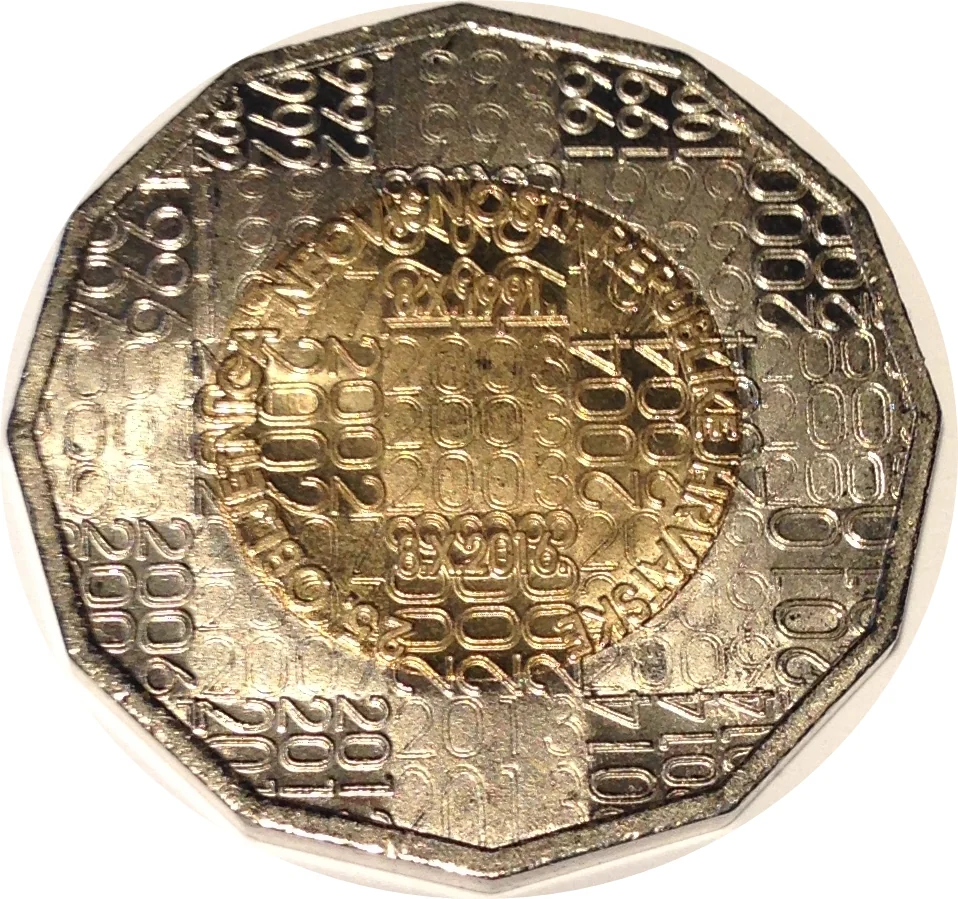
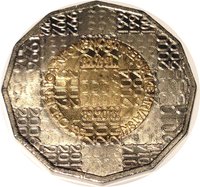
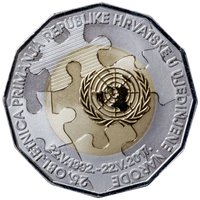
The coin features 25 matte and lustrous squares, each containing a triple inscription of a year, with some squares tilted left or right. They symbolize Croatia's 25 years of independence. The circular inscription reads "25. OBLJETNICA NEOVISNOSTI REPUBLIKE HRVATSKE," with the dates "8.X.1991." and "8.X.2016." above and below the central square.
Inscription:
25. OBLJETNICA NEOVISNOSTI REPUBLIKE HRVATSKE
8.X.1991.
8.X.2016.
8.X.1991.
8.X.2016.
Translation:
TWENTY-FIFTH ANNIVERSARY OF THE INDEPENDENCE OF THE REPUBLIC OF CROATIA
8 OCTOBER 1991
8 OCTOBER 2016
8 OCTOBER 1991
8 OCTOBER 2016
Script: Latin
Language: Croatian
Engraver: Damir Mataušić
Edge
Plain
Categories
| Event> Independence |
Mints
| Name | Mark |
|---|---|
| Croatian Mint | — |
Mintings
| Year | Mint Mark | Mintage | Quality | Collection |
|---|---|---|---|---|
| 2016 | — | 50,000 |
Historical background
In 2016, Croatia was in a period of monetary transition, still operating with the kuna (HRK) as its national currency but with a clear strategic path toward adopting the euro. The country had joined the European Union in July 2013, which legally obligated it to eventually replace the kuna with the single currency once it met the strict convergence criteria (the Maastricht criteria). Throughout 2016, the Croatian National Bank maintained a stable exchange rate regime, managing the kuna within a narrow band against the euro, which acted as its de facto anchor. This stability was crucial for economic confidence, tourism, and foreign investment, but it also limited independent monetary policy tools.
The broader economic context was one of cautious recovery from a prolonged recession. Public debt remained high, exceeding 80% of GDP, which was a significant hurdle on the path to euro adoption. While inflation was low and the budget deficit was being gradually reduced, the government faced the challenge of balancing fiscal consolidation with the need to stimulate growth. The debate within Croatia was less about if the euro would be adopted, but when and under what conditions, with many viewing it as a necessary step for deeper integration and long-term stability.
Consequently, 2016 was a year of preparation and assessment. The government and central bank were actively working on meeting the technical and legal prerequisites for joining the European Exchange Rate Mechanism II (ERM II), the mandatory "waiting room" for euro adoption. Public opinion was divided, with proponents arguing the euro would lower transaction costs, eliminate exchange rate risk, and boost investment, while opponents expressed concerns about loss of sovereignty and potential negative impacts on tourism and exports. The year ultimately set the stage for the more accelerated push toward eurozone entry that would follow in subsequent years.
The broader economic context was one of cautious recovery from a prolonged recession. Public debt remained high, exceeding 80% of GDP, which was a significant hurdle on the path to euro adoption. While inflation was low and the budget deficit was being gradually reduced, the government faced the challenge of balancing fiscal consolidation with the need to stimulate growth. The debate within Croatia was less about if the euro would be adopted, but when and under what conditions, with many viewing it as a necessary step for deeper integration and long-term stability.
Consequently, 2016 was a year of preparation and assessment. The government and central bank were actively working on meeting the technical and legal prerequisites for joining the European Exchange Rate Mechanism II (ERM II), the mandatory "waiting room" for euro adoption. Public opinion was divided, with proponents arguing the euro would lower transaction costs, eliminate exchange rate risk, and boost investment, while opponents expressed concerns about loss of sovereignty and potential negative impacts on tourism and exports. The year ultimately set the stage for the more accelerated push toward eurozone entry that would follow in subsequent years.
🌱 Common