

25 Kuna (Croatia's admission to the United Nations) – Croatia
Circulating commemorative coins
Commemoration: 25th Anniversary of the Admission of the Republic of Croatia to Membership in the United Nations
Croatia
Context
Material
Diameter: 32 mm
Weight: 12.75 g
Thickness: 2.2 mm
Shape: Dodecagonal
Technique: Milled
Alignment: Medal alignment
flip
References
KM: #Click to copy to clipboard112
Numista: #112184
Value
Exchange value: 25 HRK
Obverse
Description:
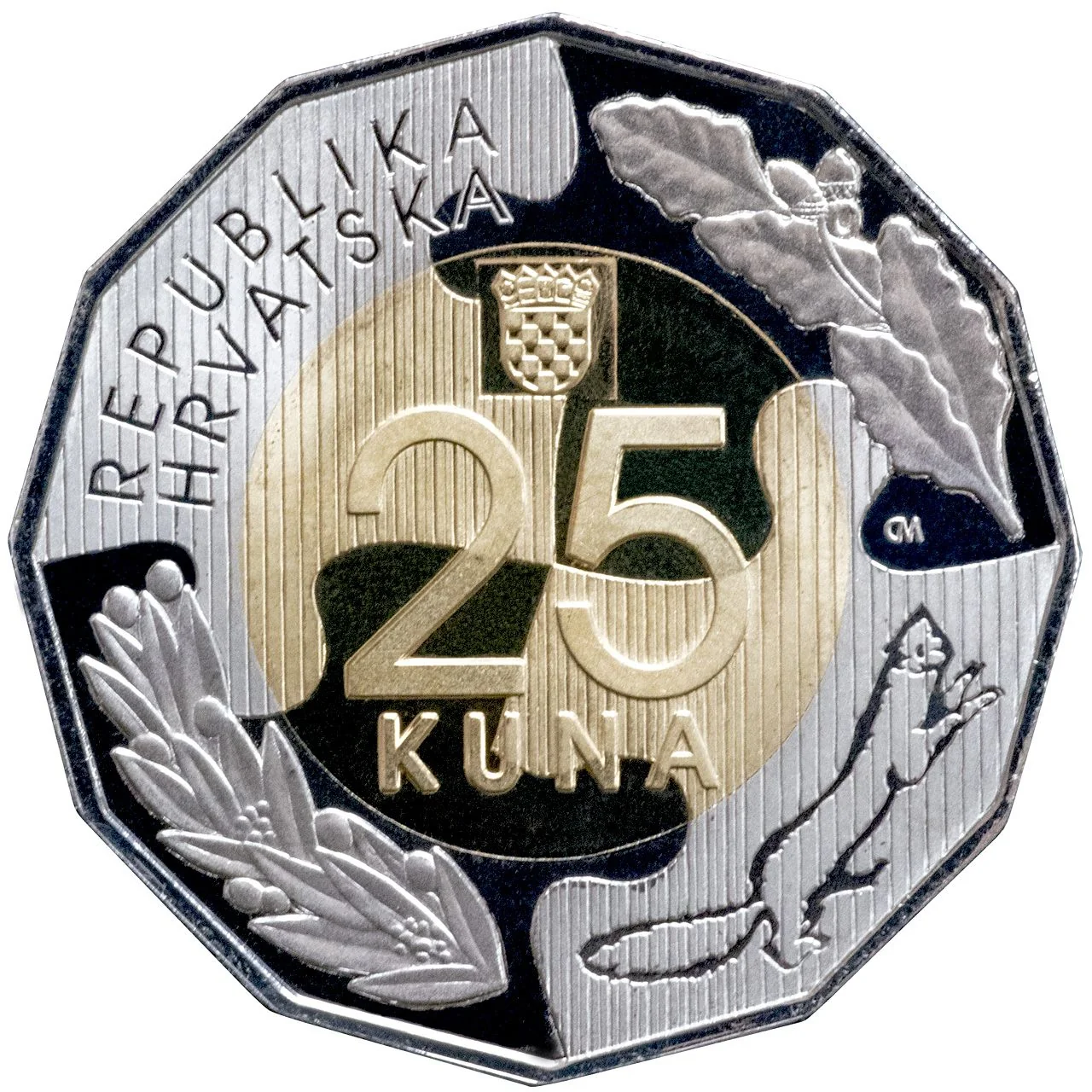
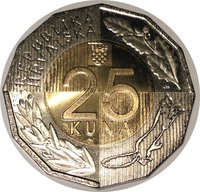
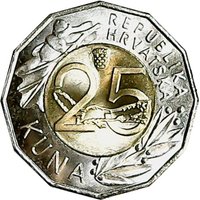
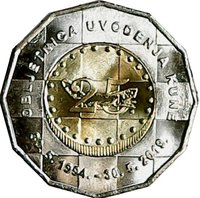
The coin's center displays the numeral "25" with Croatia's Coat of Arms above and "KUNA" below. The puzzle motif represents the state arms: two opposite matte quarters have vertical lines, while the other two are lustrous. The upper left matte ring quarter bears "REPUBLIKA HRVATSKA," opposite a right-facing marten. The lower left lustrous quarter shows a matte olive branch, opposite a matte oak branch with acorns and the engraver's signature "DM."
Inscription:
REPUBLIKA HRVATSKA
25
KUNA
DM
25
KUNA
DM
Translation:
REPUBLIC OF CROATIA
25
KUNA
DM
25
KUNA
DM
Script: Latin
Language: Croatian
Engraver: Damir Mataušić
Reverse
Description:
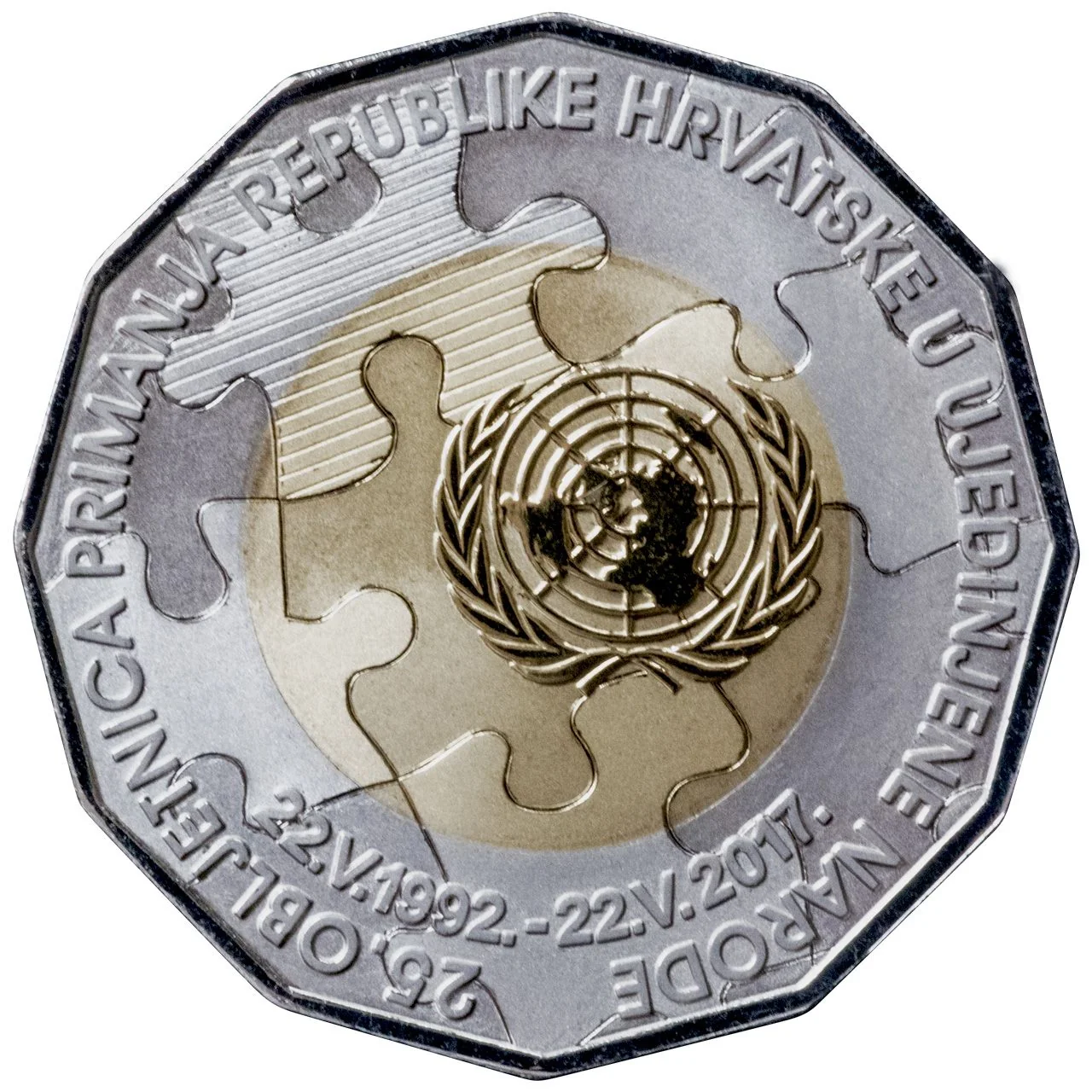
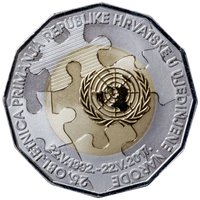
The coin's obverse and reverse feature a jigsaw puzzle motif. This symbolizes the unity of UN member states. One puzzle piece, crossed with lines to form an "H" for "Hrvatska," connects to the UN logo, representing Croatia's membership.
Inscription:
25. OBLJETNICA PRIMANJA REPUBLIKE HRVATSKE U UJEDINJENE NARODE
22.V.1992.-22.V.2017.
22.V.1992.-22.V.2017.
Translation:
25TH ANNIVERSARY OF THE ADMISSION OF THE REPUBLIC OF CROATIA TO THE UNITED NATIONS
22.V.1992.-22.V.2017.
22.V.1992.-22.V.2017.
Script: Latin
Language: Croatian
Engraver: Damir Mataušić
Edge
Plain
Categories
| Organization> United Nations |
Mints
| Name | Mark |
|---|---|
| Croatian Mint | — |
Mintings
| Year | Mint Mark | Mintage | Quality | Collection |
|---|---|---|---|---|
| 2017 | — | 20,000 |
Historical background
In 2017, Croatia's currency situation was defined by its ongoing use of the kuna (HRK) within a framework of careful management by the Croatian National Bank (HNB). The country was not yet a member of the Eurozone, but its long-term strategic goal, as an EU member since 2013, was to adopt the euro. The kuna operated under a managed float regime, meaning its exchange rate was primarily determined by the foreign exchange market, but the HNB would intervene to prevent excessive volatility. This stability was a point of pride, as the kuna had maintained a relatively stable exchange rate against the euro for many years, which was crucial for an economy heavily reliant on tourism and foreign investment.
The year saw a continued focus on meeting the Maastricht convergence criteria necessary for euro adoption. While Croatia had made progress, challenges remained, particularly concerning public debt, which was above the 60% of GDP reference value. Economists and policymakers actively debated the timing and preparedness for joining the Exchange Rate Mechanism (ERM II), the two-year "waiting room" for the euro. There was a consensus that premature entry could be harmful, but also a recognition that prolonged uncertainty could deter investment. Consequently, 2017 was a year of preparation and assessment, with the HNB emphasizing the need for further structural reforms to improve economic resilience before taking the formal step.
For everyday citizens and businesses, the stable kuna-to-euro exchange rate provided predictability, especially important for the crucial tourism sector where many prices were effectively euro-denominated. However, this stability also meant that Croatia did not have the independent monetary policy tool of devaluation to boost competitiveness. The broader context was one of post-recession recovery, with the government working to reduce fiscal deficits and control public debt—key prerequisites for the eventual euro adoption that remained a central, albeit medium-term, pillar of national economic policy.
The year saw a continued focus on meeting the Maastricht convergence criteria necessary for euro adoption. While Croatia had made progress, challenges remained, particularly concerning public debt, which was above the 60% of GDP reference value. Economists and policymakers actively debated the timing and preparedness for joining the Exchange Rate Mechanism (ERM II), the two-year "waiting room" for the euro. There was a consensus that premature entry could be harmful, but also a recognition that prolonged uncertainty could deter investment. Consequently, 2017 was a year of preparation and assessment, with the HNB emphasizing the need for further structural reforms to improve economic resilience before taking the formal step.
For everyday citizens and businesses, the stable kuna-to-euro exchange rate provided predictability, especially important for the crucial tourism sector where many prices were effectively euro-denominated. However, this stability also meant that Croatia did not have the independent monetary policy tool of devaluation to boost competitiveness. The broader context was one of post-recession recovery, with the government working to reduce fiscal deficits and control public debt—key prerequisites for the eventual euro adoption that remained a central, albeit medium-term, pillar of national economic policy.
🌱 Fairly Common