

1 colón – Costa Rica
Add to wishlist
Costa Rica
Context
Year: 1935
Issuer: Costa Rica
Issuing organization: Banco Internacional de Costa Rica
Period:
(1848—1948)
Currency:
(since 1896)
Demonetized: Yes
Total mintage: 350,000
Material
References
KM: #
Numista: #9390
Value
Exchange value: 1 CRC
Obverse
Description:
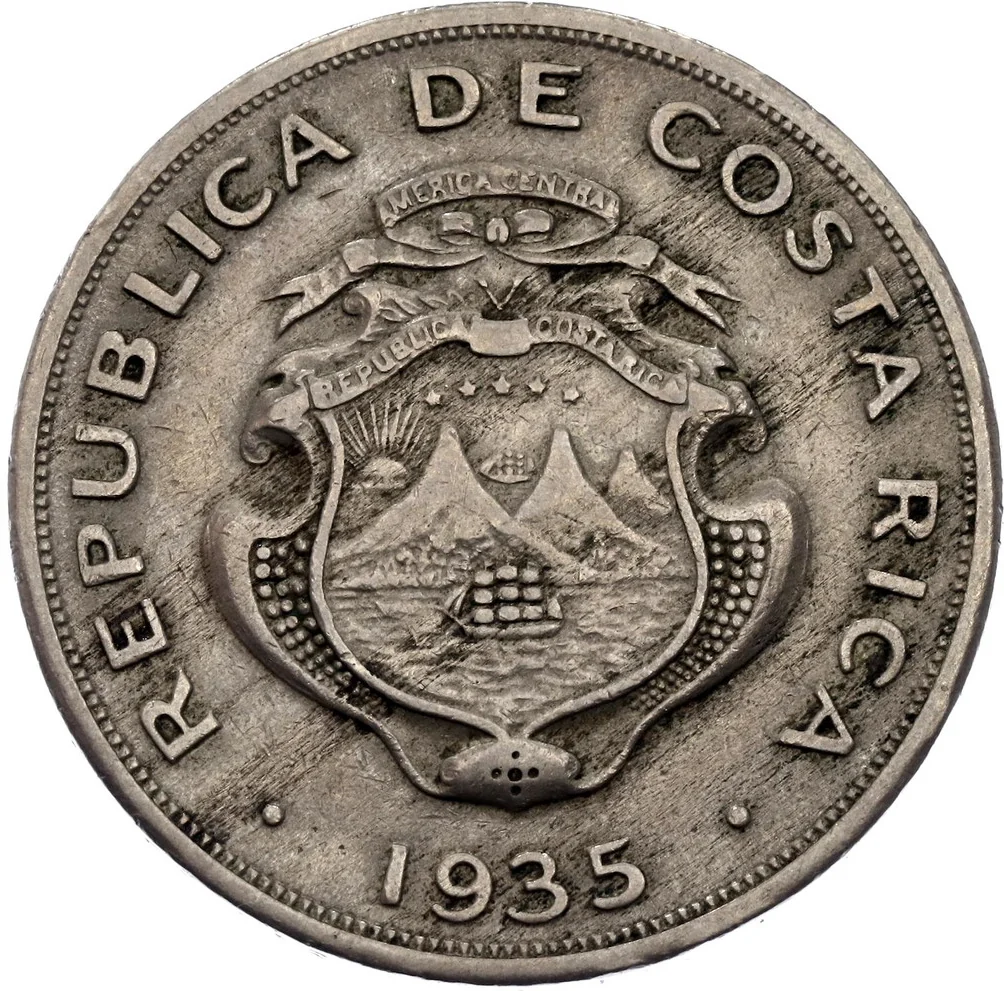
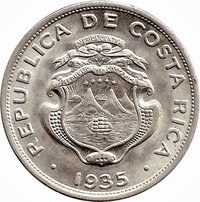
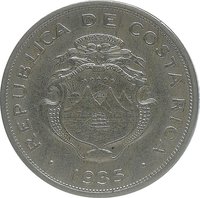
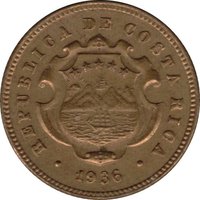
Costa Rica's coat of arms features five stars for its provinces, three volcanoes for its mountain ranges, two ships for its position between oceans, and a sunrise.
Inscription:
· REPUBLICA DE COSTA RICA ·
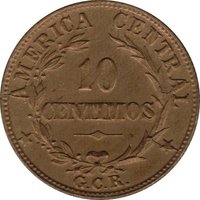
AMERICA CENTRAL
REPUBLICA DE COSTA RICA
1935
AMERICA CENTRAL
REPUBLICA DE COSTA RICA
1935
Translation:
REPUBLIC OF COSTA RICA
CENTRAL AMERICA
REPUBLIC OF COSTA RICA
1935
CENTRAL AMERICA
REPUBLIC OF COSTA RICA
1935
Script: Latin
Language: Spanish
Reverse
Edge
Smooth with incuse lettering
Legend:
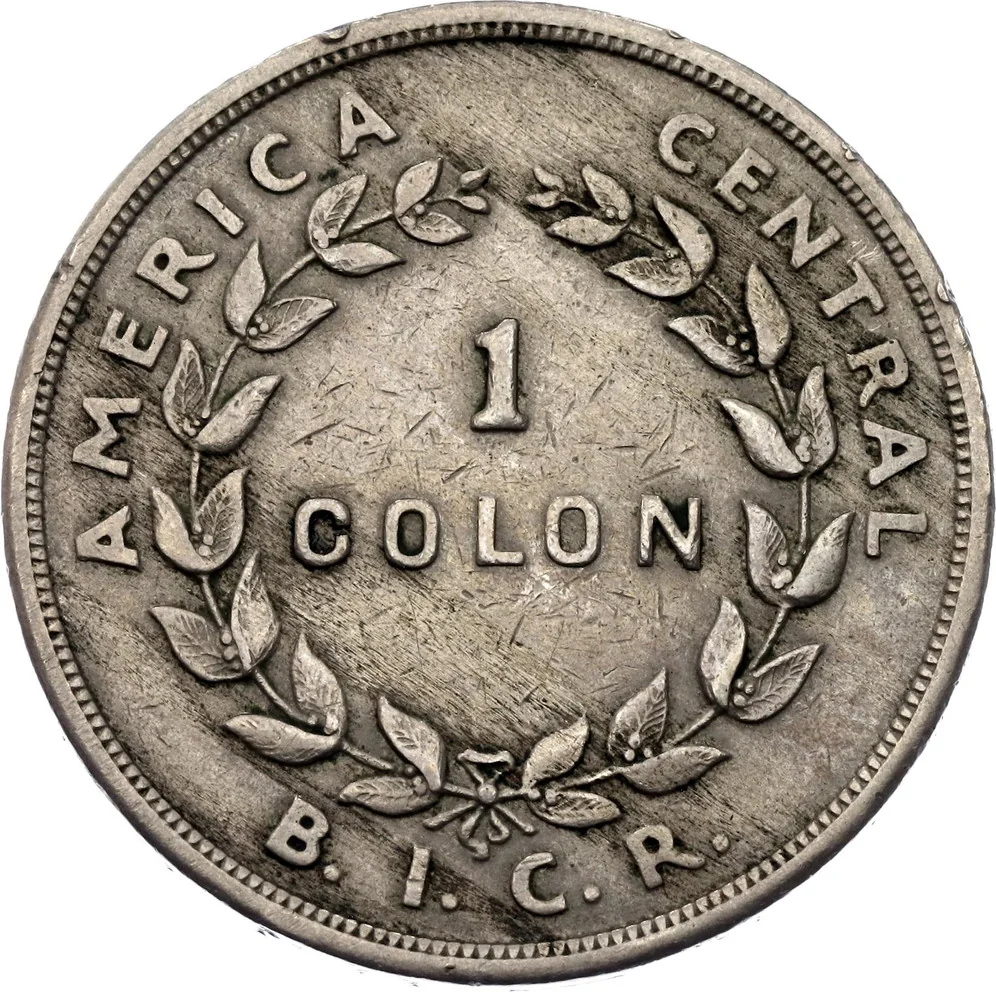
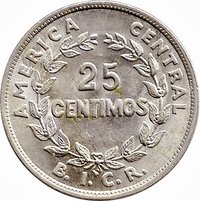
BICR - BICR - BICR - BICR -
Translation:
VICTOR - VICTOR - VICTOR - VICTOR -
Language: Latin
Categories
| Symbols> Coat of Arms |
| Symbol> Wreath |
Mints
| Name | Mark |
|---|---|
| United States Mint of Philadelphia | — |
Mintings
| Year | Mint Mark | Mintage | Quality | Collection |
|---|---|---|---|---|
| 1935 | — | 350,000 |
Historical background
In 1935, Costa Rica's currency situation was characterized by a period of monetary stability under the gold exchange standard, a system it had formally adopted in 1896. The official currency was the colón, which was pegged to the British pound sterling at a fixed rate of 10.625 colones to £1. This link to sterling, and indirectly to gold, provided a stable foundation for international trade and helped control inflation. The physical currency in circulation consisted of banknotes issued by three private commercial banks—the Banco Internacional de Costa Rica, the Banco Anglo-Costarricense, and the Banco de Costa Rica—under government supervision, alongside silver and bronze subsidiary coins.
However, this stability was maintained within a context of limited economic diversification and vulnerability to external shocks. The national economy remained heavily dependent on coffee and banana exports, whose prices on the global market were volatile. The Great Depression of the 1930s had sharply reduced export revenues and caused significant fiscal strain. While the colón's peg held, the government of President Ricardo Jiménez Oreamuno (1932-1936) faced persistent budget deficits and a growing internal debt, which constrained public investment and social spending.
Consequently, the mid-1930s represented a calm before a significant monetary reform. The reliance on multiple private banks for note issuance was increasingly seen as an inefficient system that limited centralized economic policy. This set the stage for the major institutional change that would follow in 1936: the creation of the International Bank of Costa Rica (Banco Internacional de Costa Rica S.A.), which was granted the exclusive right of note issue, effectively centralizing monetary authority and paving the way for the eventual establishment of the Central Bank of Costa Rica in 1950.
However, this stability was maintained within a context of limited economic diversification and vulnerability to external shocks. The national economy remained heavily dependent on coffee and banana exports, whose prices on the global market were volatile. The Great Depression of the 1930s had sharply reduced export revenues and caused significant fiscal strain. While the colón's peg held, the government of President Ricardo Jiménez Oreamuno (1932-1936) faced persistent budget deficits and a growing internal debt, which constrained public investment and social spending.
Consequently, the mid-1930s represented a calm before a significant monetary reform. The reliance on multiple private banks for note issuance was increasingly seen as an inefficient system that limited centralized economic policy. This set the stage for the major institutional change that would follow in 1936: the creation of the International Bank of Costa Rica (Banco Internacional de Costa Rica S.A.), which was granted the exclusive right of note issue, effectively centralizing monetary authority and paving the way for the eventual establishment of the Central Bank of Costa Rica in 1950.
🌱 Fairly Common