

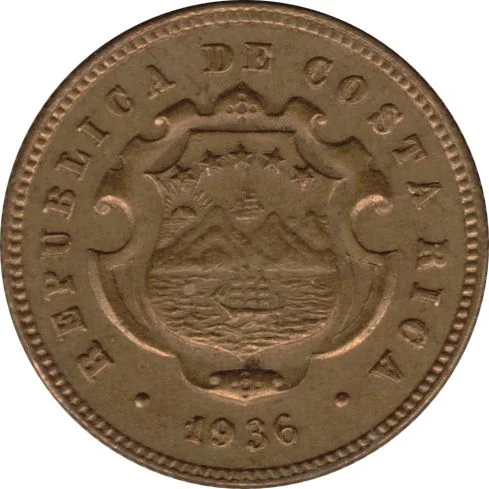
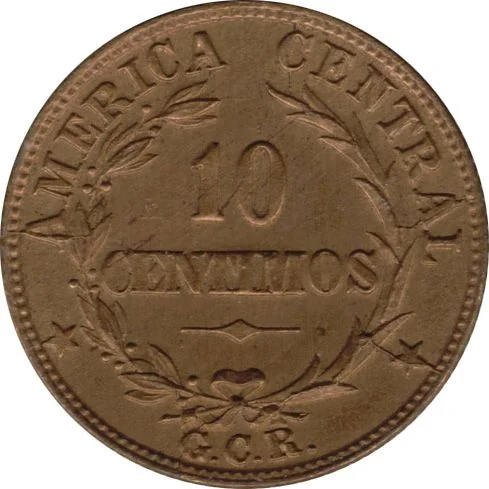
10 Centimos – Costa Rica
Costa Rica
Context
Years: 1936–1941
Issuer: Costa Rica 
Issuing organization: Government of Costa Rica
Period:
(1848—1948)
Currency:
(since 1896)
Demonetized: Yes
Total mintage: 1,250,000
Material
References
KM: #Click to copy to clipboard174
Numista: #8743
Value
Exchange value: 0.10 CRC
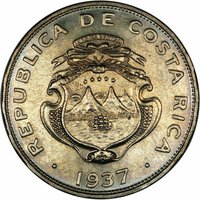
Obverse
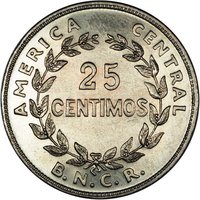
Reverse
Edge
Reeded
Categories
| Symbols> Coat of Arms |
| Symbol> Wreath |
Mints
| Name | Mark |
|---|---|
| Casa Nacional de Moneda de Costa Rica | — |
Mintings
| Year | Mint Mark | Mintage | Quality | Collection |
|---|---|---|---|---|
| 1936 | GCR | 750,000 | ||
| 1941 | GCR | 500,000 |
Historical background
In 1936, Costa Rica's currency situation was defined by the Colón, which had been established as the national currency in 1896, replacing the Costa Rican Peso. However, the system was not one of a freely floating or centrally managed fiat currency. Instead, the country operated under a gold exchange standard, where the value of the Colón was legally pegged to the United States dollar. This peg provided a crucial anchor for stability in international trade, which was vital for an economy heavily dependent on coffee and banana exports. The official exchange rate was set at 1 U.S. dollar = 5.60 colones, a rate that had been maintained since the 1920s.
Despite this formal peg, the era was marked by significant monetary instability and debate. The global economic shocks of the Great Depression had severely impacted Costa Rica's export revenues, creating balance of payments difficulties and putting pressure on the country's gold and foreign currency reserves. This led to a persistent divergence between the official "bank rate" and a higher, unofficial "market rate" for foreign exchange. Businesses and individuals needing dollars often had to pay a premium, creating a two-tier system that reflected the scarcity of hard currency and undermined the practical stability the gold standard was meant to ensure.
Consequently, 1936 fell within a period of intense political and economic discussion about monetary reform. There was growing pressure, particularly from export-oriented agricultural elites and economists, to abandon the rigid gold peg in favor of a managed currency under the control of a central bank. This debate would culminate just a few years later with the creation of the Central Bank of Costa Rica (BCCR) in 1950, which was granted exclusive authority over currency issuance and monetary policy. Thus, the currency situation in 1936 was a transitional phase, characterized by a strained adherence to an international standard that was increasingly seen as ill-suited to the nation's developmental needs.
Despite this formal peg, the era was marked by significant monetary instability and debate. The global economic shocks of the Great Depression had severely impacted Costa Rica's export revenues, creating balance of payments difficulties and putting pressure on the country's gold and foreign currency reserves. This led to a persistent divergence between the official "bank rate" and a higher, unofficial "market rate" for foreign exchange. Businesses and individuals needing dollars often had to pay a premium, creating a two-tier system that reflected the scarcity of hard currency and undermined the practical stability the gold standard was meant to ensure.
Consequently, 1936 fell within a period of intense political and economic discussion about monetary reform. There was growing pressure, particularly from export-oriented agricultural elites and economists, to abandon the rigid gold peg in favor of a managed currency under the control of a central bank. This debate would culminate just a few years later with the creation of the Central Bank of Costa Rica (BCCR) in 1950, which was granted exclusive authority over currency issuance and monetary policy. Thus, the currency situation in 1936 was a transitional phase, characterized by a strained adherence to an international standard that was increasingly seen as ill-suited to the nation's developmental needs.
🌱 Fairly Common