

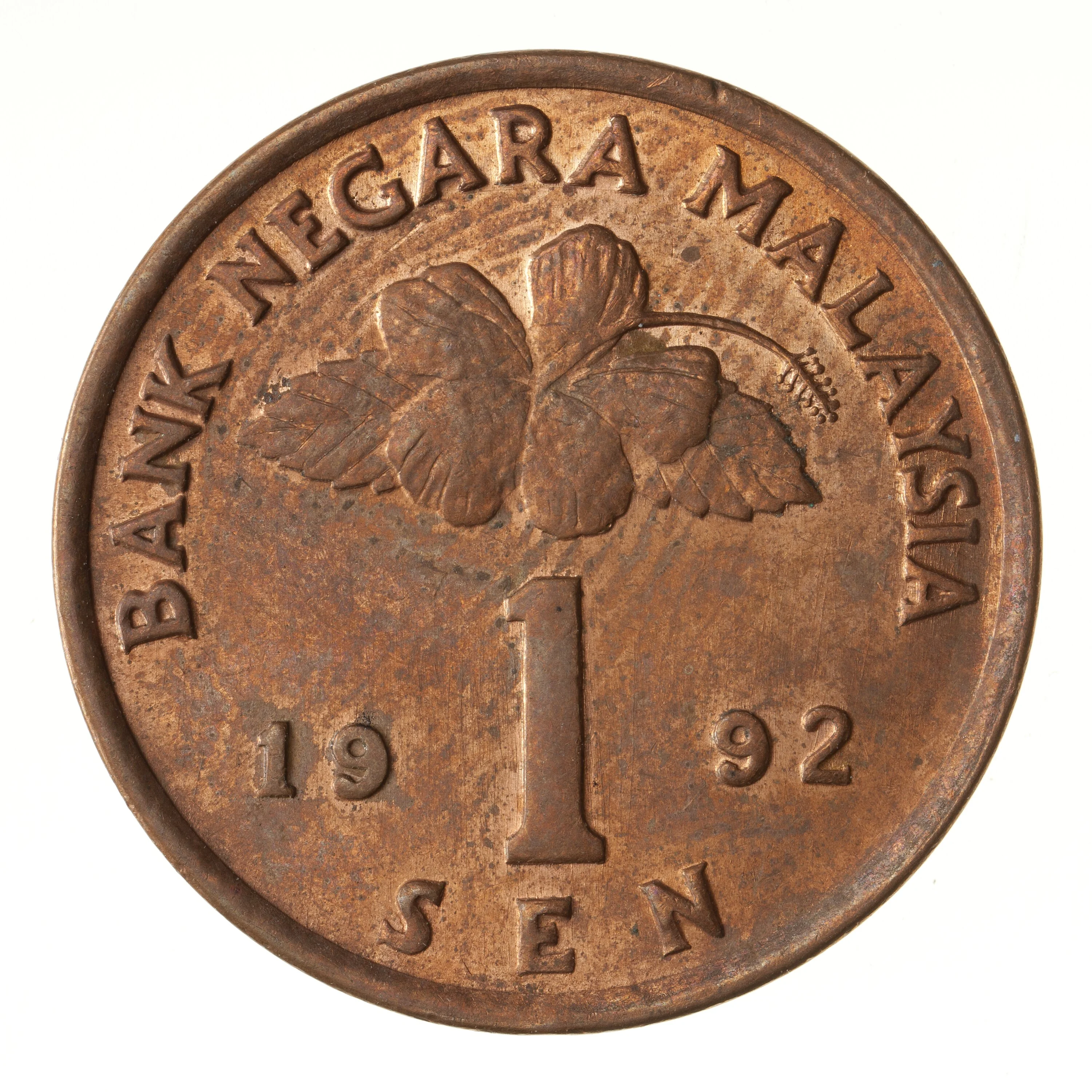
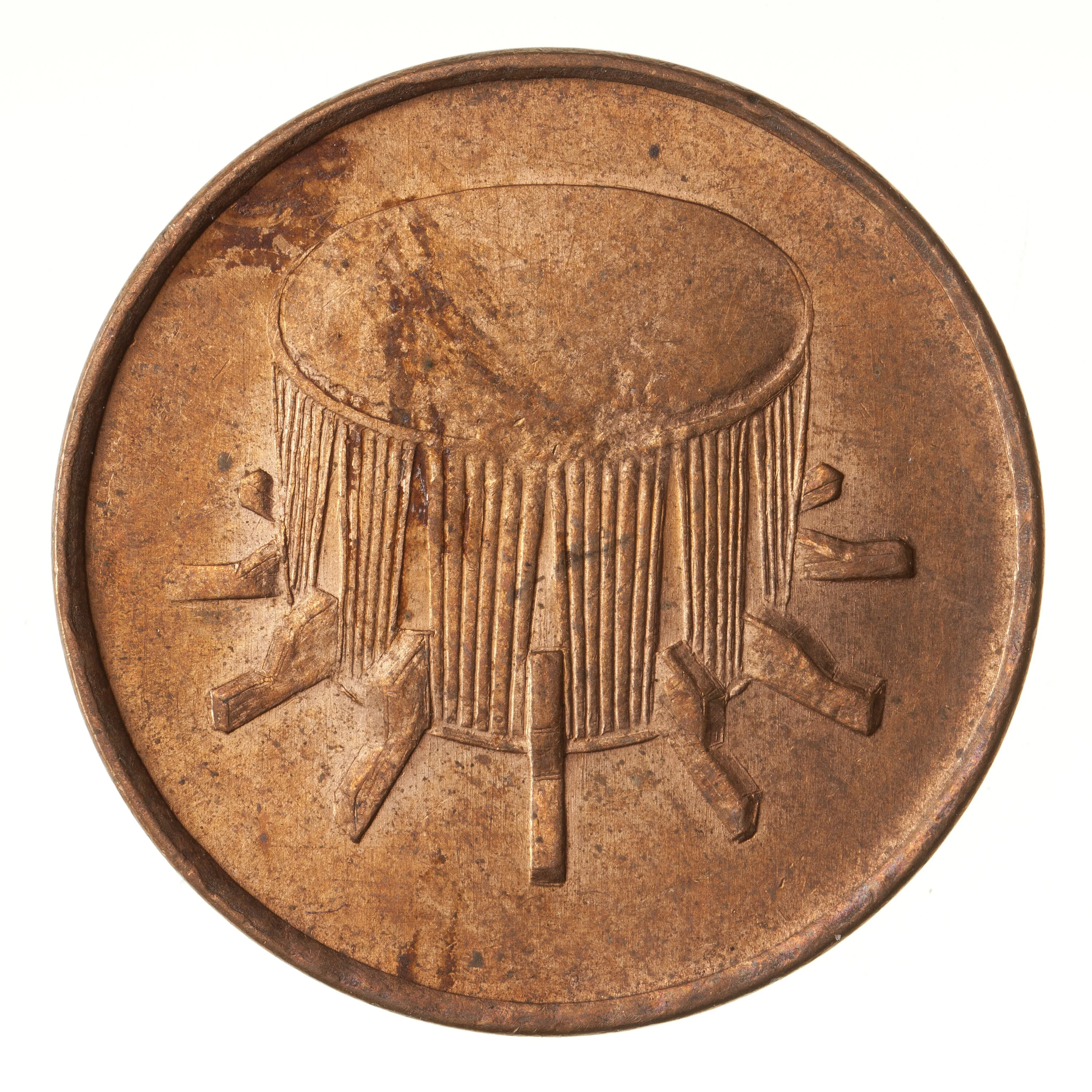
1 Sen – Malaysia
Malaysia
Context
Years: 1989–2008
Issuer: Malaysia 
Issuing organization: Central Bank of Malaysia
Period:
(since 1963)
Currency:
(since 1967)
Total mintage: 5,336,361,128
Material
References
KM: #Click to copy to clipboard49
Numista: #931
Value
Exchange value: 0.01 MYR = $0.00
Obverse
Reverse
Description:
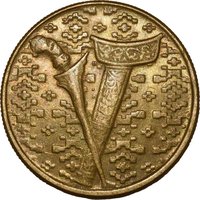
Ubi Rebana Drum
Edge
Plain
Mints
| Name | Mark |
|---|---|
| Shah Alam | — |
Mintings
| Year | Mint Mark | Mintage | Quality | Collection |
|---|---|---|---|---|
| 1989 | — | 28,429,082 | ||
| 1990 | — | 102,539,178 | ||
| 1991 | — | 100,314,734 | ||
| 1992 | — | 122,824,434 | ||
| 1993 | — | 153,805,875 | ||
| 1994 | — | 185,084,682 | ||
| 1995 | — | 208,611,295 | ||
| 1996 | — | 183,272,598 | ||
| 1997 | — | 172,215,681 | ||
| 1998 | — | 1,917,633,834 | ||
| 1999 | — | 265,502,565 | ||
| 2000 | — | 268,762,170 | ||
| 2001 | — | 213,645,000 | ||
| 2002 | — | 185,220,000 | ||
| 2003 | — | 235,350,000 | ||
| 2004 | — | 227,700,000 | ||
| 2005 | — | 437,400,000 | ||
| 2006 | — | 328,050,000 | ||
| 2007 | — | — | ||
| 2008 | — | — |
Historical background
In 1989, Malaysia's currency, the Ringgit (MYR), operated under a managed float system, but its value was effectively pegged to a undisclosed basket of currencies of its major trading partners rather than a single currency like the US Dollar. This system, established in the mid-1970s following the collapse of the Bretton Woods system, provided the central bank, Bank Negara Malaysia, with significant discretionary control to stabilize the Ringgit's exchange rate. The primary focus of monetary policy was on maintaining exchange rate stability to foster a predictable environment for trade and investment, which were crucial drivers of the nation's rapidly industrializing economy.
The period was one of robust economic growth, with Malaysia transitioning from a commodity-dependent economy to an emerging manufacturing hub. This strong macroeconomic performance, fueled by foreign direct investment and booming exports, generally supported the Ringgit. However, Bank Negara was also known for its occasional active and sometimes aggressive interventions in the foreign exchange market during this era, a practice that would later contribute to significant losses for the bank in the early 1990s. There were no severe currency crises in 1989 itself; the environment was relatively calm compared to the volatility that would characterize the mid-1990s leading up to the Asian Financial Crisis of 1997.
Underpinning the currency situation was a broader context of capital controls and a regulated financial system. While the Ringgit was freely convertible for current account transactions (trade), there were still restrictions on capital account transactions, limiting the flow of speculative "hot money." This insulated the currency to some degree from global financial shocks and allowed authorities greater control. Thus, in 1989, the Ringgit was stable, supported by strong economic fundamentals and a managed regime that prioritized control and stability over full market liberalization.
The period was one of robust economic growth, with Malaysia transitioning from a commodity-dependent economy to an emerging manufacturing hub. This strong macroeconomic performance, fueled by foreign direct investment and booming exports, generally supported the Ringgit. However, Bank Negara was also known for its occasional active and sometimes aggressive interventions in the foreign exchange market during this era, a practice that would later contribute to significant losses for the bank in the early 1990s. There were no severe currency crises in 1989 itself; the environment was relatively calm compared to the volatility that would characterize the mid-1990s leading up to the Asian Financial Crisis of 1997.
Underpinning the currency situation was a broader context of capital controls and a regulated financial system. While the Ringgit was freely convertible for current account transactions (trade), there were still restrictions on capital account transactions, limiting the flow of speculative "hot money." This insulated the currency to some degree from global financial shocks and allowed authorities greater control. Thus, in 1989, the Ringgit was stable, supported by strong economic fundamentals and a managed regime that prioritized control and stability over full market liberalization.
Series: 1989 Malaysia circulation coins
🌱 Very Common