

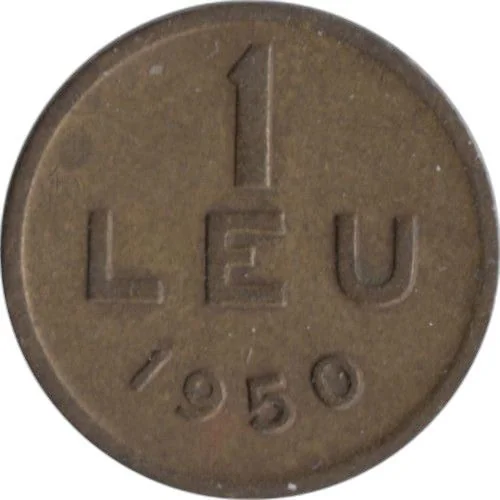
1 leu – Romania
Add to wishlist
Romania
Context
Years: 1949–1951
Issuer: Romania
Period:
(1947—1965)
Currency:
(1947—1952)
Demonetization: 28 January 1952
Material
Diameter: 16 mm
Weight: 1.83 g
Shape: Round
Composition: Nickel brass
Magnetic: No
Technique: Milled
Alignment: Coin alignment
flip
References
KM: #
Numista: #9118
Obverse
Description:
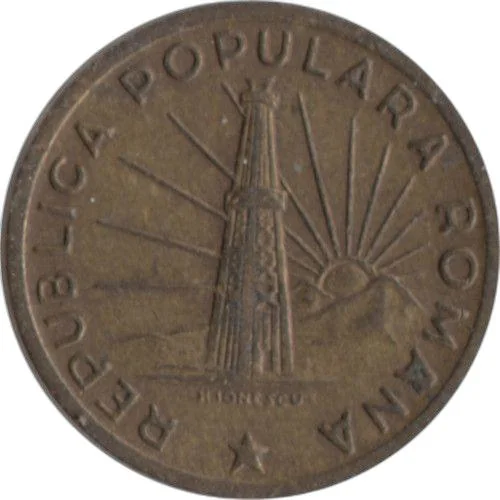
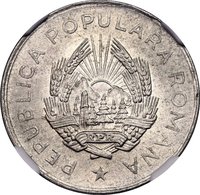
Sunlit rig.
Inscription:
REPUBLICA POPULARA ROMANA
Translation:
ROMANIAN PEOPLE'S REPUBLIC
Script: Latin
Language: Romanian
Engraver: Haralambie Ionescu
Reverse
Edge
Plain
Mintings
| Year | Mint Mark | Mintage | Quality | Collection |
|---|---|---|---|---|
| 1949 | — | — | ||
| 1950 | — | — | ||
| 1951 | — | — |
Historical background
In 1949, Romania's currency situation was defined by the communist regime's aggressive consolidation of power and its alignment with the Soviet economic model. The previous currency, the Romanian Leu (ROL), had been severely destabilized by World War II and hyperinflation. The new government, which had forcibly abolished the monarchy in 1947, used monetary reform as a key tool for social engineering and eliminating the old economic order. The critical move came in January 1949, when the state enacted a drastic currency revaluation.
The reform was not a simple redenomination but a confiscatory measure designed to strip wealth from certain social classes. Old banknotes were exchanged for new ones at wildly discriminatory rates. For instance, small amounts necessary for basic transactions were swapped at a rate of 100 old lei for 1 new leu. However, larger sums held by entrepreneurs, former landowners, and the pre-communist elite were exchanged at rates of 200:1, 400:1, or even 1000:1, effectively wiping out private savings and capital. This deliberate policy aimed to destroy the economic base of the middle and upper classes, facilitating the nationalization of industry and the forced collectivization of agriculture.
Consequently, the 1949 currency reform completed the state's takeover of the economy. It centralized all financial control under the Romanian Communist Party and the Soviet-style National Bank, integrating Romania firmly into the Eastern Bloc's economic sphere. The new leu became a non-convertible instrument of the command economy, with its value administratively set by the state rather than market forces. This event marked the final step in the monetary Sovietization of Romania, cementing a system of chronic shortages, a thriving black market, and suppressed inflation that would characterize the country for the next four decades.
The reform was not a simple redenomination but a confiscatory measure designed to strip wealth from certain social classes. Old banknotes were exchanged for new ones at wildly discriminatory rates. For instance, small amounts necessary for basic transactions were swapped at a rate of 100 old lei for 1 new leu. However, larger sums held by entrepreneurs, former landowners, and the pre-communist elite were exchanged at rates of 200:1, 400:1, or even 1000:1, effectively wiping out private savings and capital. This deliberate policy aimed to destroy the economic base of the middle and upper classes, facilitating the nationalization of industry and the forced collectivization of agriculture.
Consequently, the 1949 currency reform completed the state's takeover of the economy. It centralized all financial control under the Romanian Communist Party and the Soviet-style National Bank, integrating Romania firmly into the Eastern Bloc's economic sphere. The new leu became a non-convertible instrument of the command economy, with its value administratively set by the state rather than market forces. This event marked the final step in the monetary Sovietization of Romania, cementing a system of chronic shortages, a thriving black market, and suppressed inflation that would characterize the country for the next four decades.

🌱 Common