

2 lei – Romania
Add to wishlist
Romania
Context
Years: 1950–1951
Issuer: Romania
Period:
(1947—1965)
Currency:
(1947—1952)
Demonetization: 28 January 1952
Material
Diameter: 18 mm
Weight: 2.44 g
Shape: Round
Composition: Nickel brass
Magnetic: No
Technique: Milled
Alignment: Coin alignment

flip
References
KM: #
Numista: #9117
Obverse
Description:
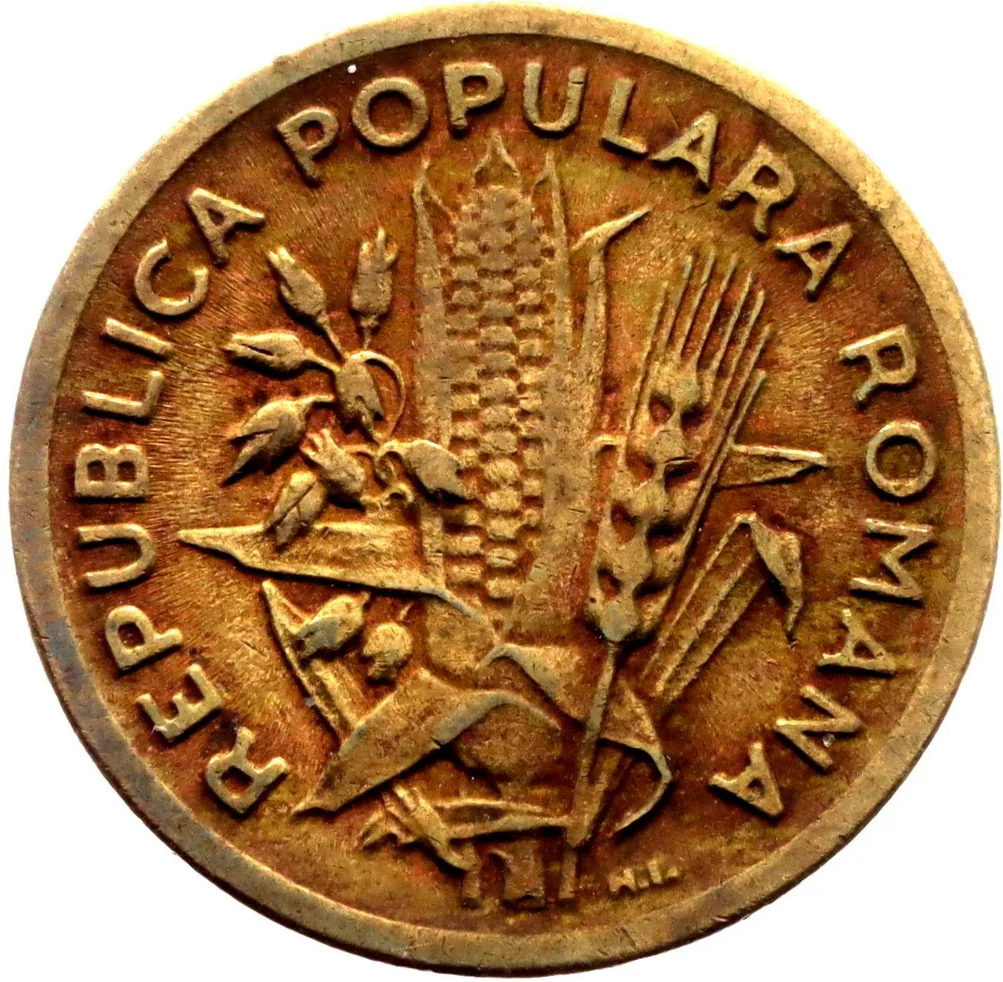
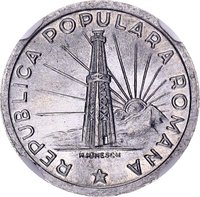
Oats, corn, and wheat. Engraver's initials below. Circular legend: "ROMANIAN PEOPLE'S REPUBLIC".
Inscription:
REPUBLICA POPULARA ROMANA
Translation:
ROMANIAN PEOPLE'S REPUBLIC
Script: Latin
Language: Romanian
Engraver: Haralambie Ionescu
Reverse
Description:
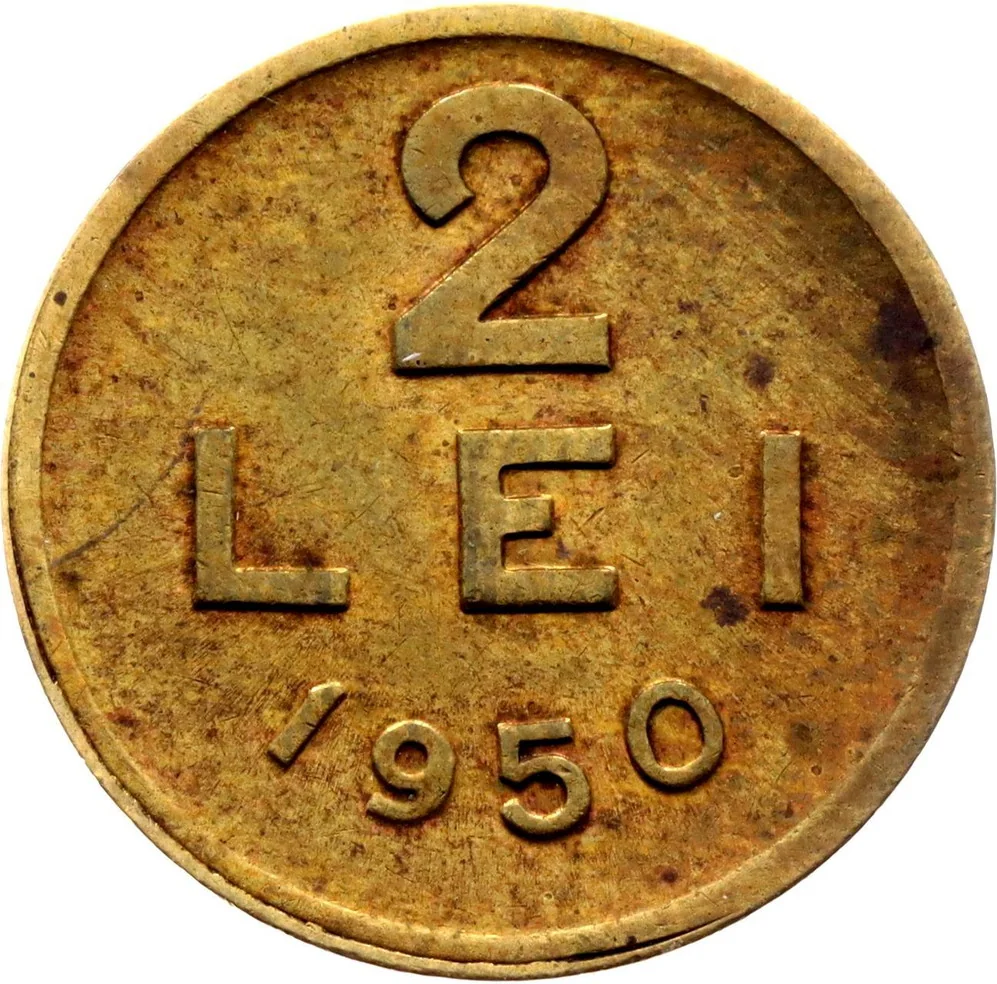
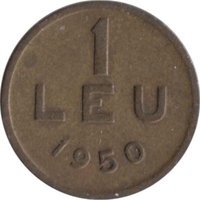
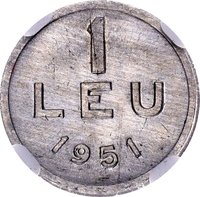
"2 LEI" denomination and year.
Inscription:
2
LEI
1950
LEI
1950
Script: Latin
Engraver: Haralambie Ionescu
Edge
Plain
Mintings
| Year | Mint Mark | Mintage | Quality | Collection |
|---|---|---|---|---|
| 1950 | — | — | ||
| 1951 | — | — |
Historical background
In 1950, Romania's currency situation was defined by a sweeping monetary reform enacted by the communist regime as part of its consolidation of power and transition to a Soviet-style command economy. On January 28, the government announced a drastic revaluation of the leu, introducing a new currency at an exchange rate of 100 old lei for 1 new leu. This was not a simple redenomination; it was a politically charged tool designed to confiscate wealth, destabilize the former bourgeois and peasant classes, and eradicate savings accumulated under the previous economic system. Strict limits were placed on the amount of old currency that could be exchanged, effectively wiping out the financial reserves of many individuals and businesses overnight.
The reform served multiple strategic purposes for Gheorghe Gheorghiu-Dej's regime. Primarily, it aimed to curb inflation and black-market activity that had persisted after World War II, but its deeper objective was to finance the state's ambitious industrialization plans and break economic resistance to collectivization. By invalidating most of the circulating money supply, the state gained direct control over capital, redirecting resources toward heavy industry and state-owned enterprises. The move also severed Romania's remaining financial links to the West, aligning its monetary system entirely with the Soviet bloc and the Council for Mutual Economic Assistance (COMECON).
For the Romanian population, the 1950 reform was a traumatic economic shock that led to widespread destitution and solidified the state's control over all aspects of economic life. It demonstrated the regime's willingness to use monetary policy as a weapon of class warfare and social engineering. The new leu became a symbol of the rigid, centrally planned economy, its value and exchange rates strictly controlled by the state for decades thereafter, isolating Romania from international financial markets and embedding its currency within the sphere of socialist economic management.
The reform served multiple strategic purposes for Gheorghe Gheorghiu-Dej's regime. Primarily, it aimed to curb inflation and black-market activity that had persisted after World War II, but its deeper objective was to finance the state's ambitious industrialization plans and break economic resistance to collectivization. By invalidating most of the circulating money supply, the state gained direct control over capital, redirecting resources toward heavy industry and state-owned enterprises. The move also severed Romania's remaining financial links to the West, aligning its monetary system entirely with the Soviet bloc and the Council for Mutual Economic Assistance (COMECON).
For the Romanian population, the 1950 reform was a traumatic economic shock that led to widespread destitution and solidified the state's control over all aspects of economic life. It demonstrated the regime's willingness to use monetary policy as a weapon of class warfare and social engineering. The new leu became a symbol of the rigid, centrally planned economy, its value and exchange rates strictly controlled by the state for decades thereafter, isolating Romania from international financial markets and embedding its currency within the sphere of socialist economic management.
🌱 Fairly Common