

2½ cents – Netherlands Antilles
Add to wishlist
Netherlands
Context
Years: 1956–1969
Country: Netherlands
Issuer: Netherlands Antilles
Ruler: Juliana
Currency:
(since 1828)
Demonetized: Yes
Total mintage: 2,050,750
Material
References
KM: #
Numista: #8977
Value
Exchange value: 0.025 ANG
Obverse
Description:
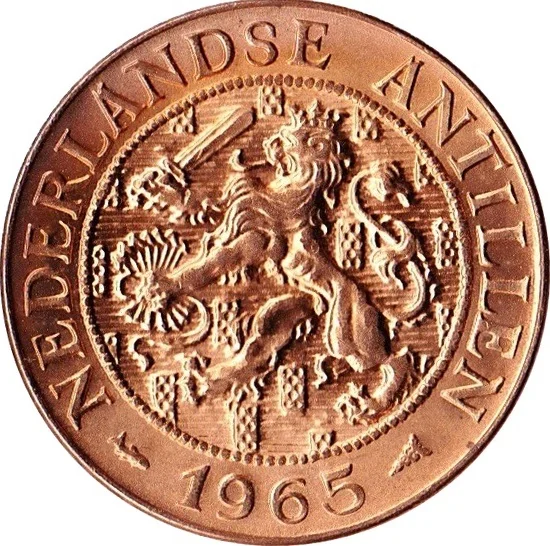
Dutch lion with sword in circle. Date below, between mint and privy marks.
Inscription:
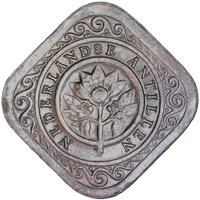
NEDERLANDSE ANTILLEN
1965
1965
Translation:
NETHERLANDS ANTILLES
1965
1965
Script: Latin
Engraver: Johannes Cornelis Wienecke
Reverse
Description:
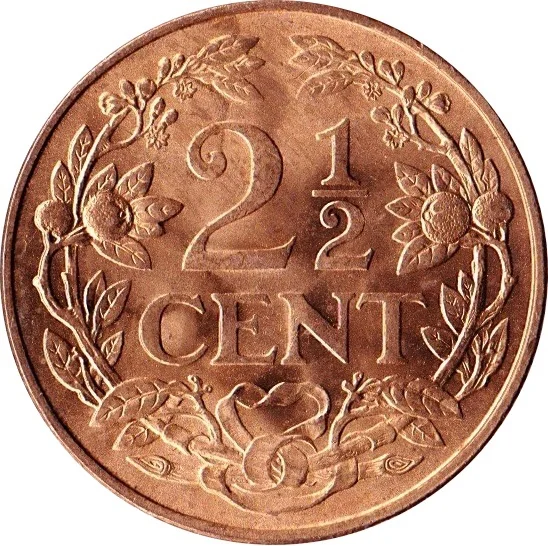
Denomination within wreath.
Inscription:
2½
CENT
CENT
Script: Latin
Engraver: Johannes Cornelis Wienecke
Edge
Reeded
Mints
| Name | Mark |
|---|---|
| Royal Dutch Mint | — |
Mintings
| Year | Mint Mark | Mintage | Quality | Collection |
|---|---|---|---|---|
| 1956 | — | 400,000 | ||
| 1956 | — | 500 | Proof | |
| 1959 | — | 1,000,000 | ||
| 1959 | — | 250 | Proof | |
| 1965 | — | 500,000 | ||
| 1969 | — | — | Proof | |
| 1969 | — | 150,000 |
Historical background
In 1956, the currency situation in the Netherlands Antilles was characterized by stability under a long-established monetary union and a fixed exchange rate regime. The islands used the Netherlands Antillean guilder (NAƒ), which had been pegged to the U.S. dollar since 1971. However, the foundation for this stability was laid much earlier. The currency was issued by the Bank van de Nederlandse Antillen (Central Bank of the Netherlands Antilles), established in 1954, which provided a centralized and modern monetary authority following the dissolution of the Curaçao Bank in 1951. This institutional framework was a direct result of the Charter for the Kingdom of the Netherlands of 1954, which granted the Netherlands Antilles internal autonomy while maintaining close economic and monetary ties with the Netherlands.
Economically, the currency's stability was underpinned by the islands' role as a significant oil refining and transshipment hub, centered on the large refinery in Curaçao (operated by Royal Dutch Shell) and the one in Aruba. This industrial activity generated substantial foreign exchange earnings, primarily in U.S. dollars, which bolstered the central bank's reserves and supported the currency peg. The dollar linkage was crucial for facilitating international trade and the vital petroleum sector. Furthermore, the financial sector, particularly in Curaçao, was beginning to develop as an offshore banking center, attracted by the political and monetary stability provided by the peg and the Kingdom connection.
Therefore, the currency situation in 1956 was one of deliberate post-colonial transition toward managed autonomy. The Netherlands Antillean guilder operated within a structured system that balanced local economic needs—dominated by the dollar-based oil industry—with the broader financial stability guaranteed through the Kingdom relationship. This arrangement provided a predictable monetary environment for the islands' key industries and set a precedent for the managed currency regime that would persist for decades.
Economically, the currency's stability was underpinned by the islands' role as a significant oil refining and transshipment hub, centered on the large refinery in Curaçao (operated by Royal Dutch Shell) and the one in Aruba. This industrial activity generated substantial foreign exchange earnings, primarily in U.S. dollars, which bolstered the central bank's reserves and supported the currency peg. The dollar linkage was crucial for facilitating international trade and the vital petroleum sector. Furthermore, the financial sector, particularly in Curaçao, was beginning to develop as an offshore banking center, attracted by the political and monetary stability provided by the peg and the Kingdom connection.
Therefore, the currency situation in 1956 was one of deliberate post-colonial transition toward managed autonomy. The Netherlands Antillean guilder operated within a structured system that balanced local economic needs—dominated by the dollar-based oil industry—with the broader financial stability guaranteed through the Kingdom relationship. This arrangement provided a predictable monetary environment for the islands' key industries and set a precedent for the managed currency regime that would persist for decades.
🌱 Very Common