

5 Cents – Netherlands Antilles
Netherlands
Context
Years: 1957–1970
Country: Netherlands 
Issuer: Netherlands Antilles
Ruler: Juliana
Currency:
(since 1828)
Demonetized: Yes
Total mintage: 2,700,450
Material
Weight: 4.5 g
Thickness: 1.8 mm
Shape: Square with rounded corners
Technique: Milled
Alignment: Coin alignment
flip
References
KM: #Click to copy to clipboard6
Numista: #2934
Value
Exchange value: 0.05 ANG
Obverse
Description:
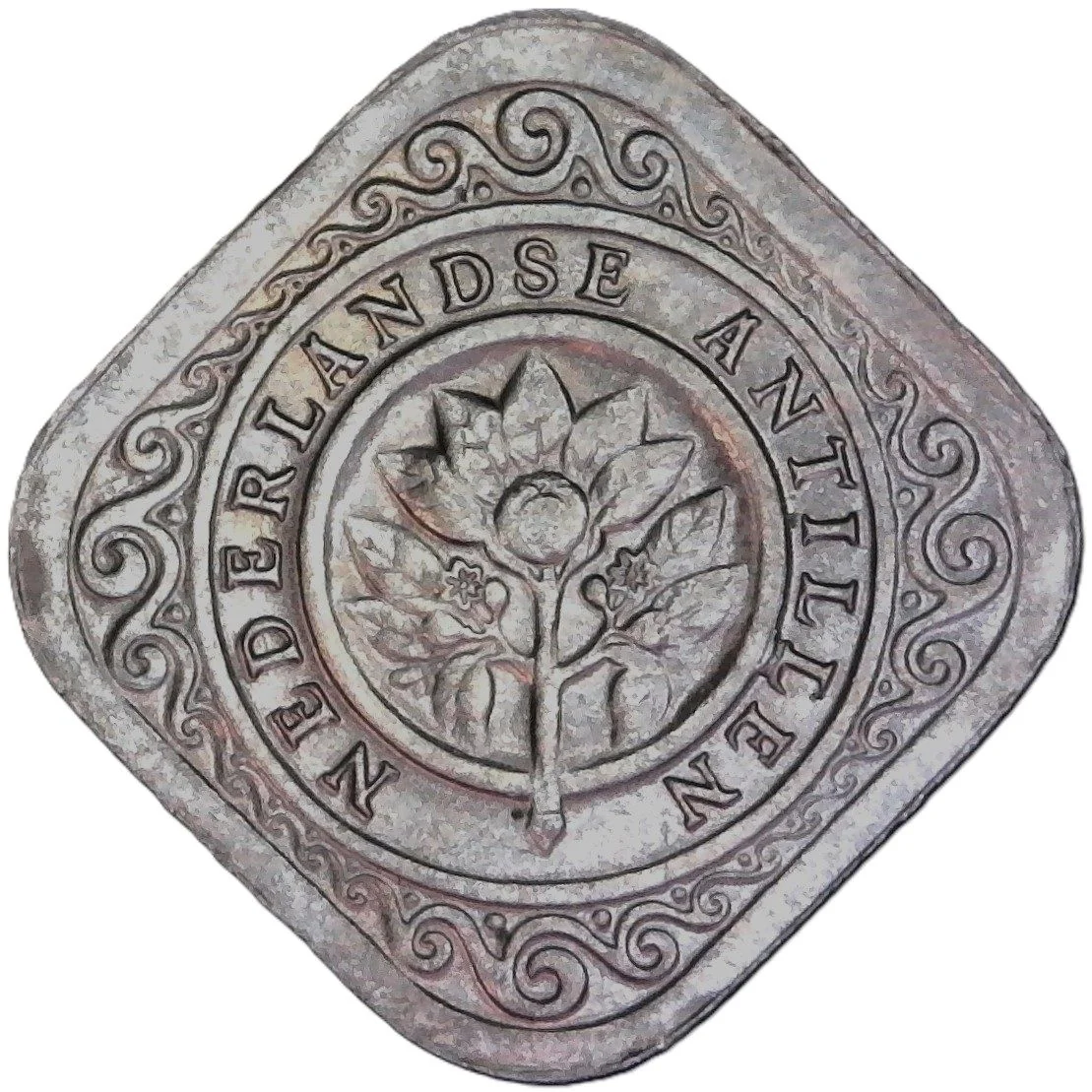
Orange blossom in circle, country name encircling, stylized wave border.
Inscription:
NEDERLANDSE ANTILLEN
Translation:
Netherlands Antilles
Script: Latin
Language: Dutch
Engraver: Johannes Cornelis Wienecke
Reverse
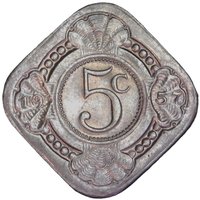
Description:
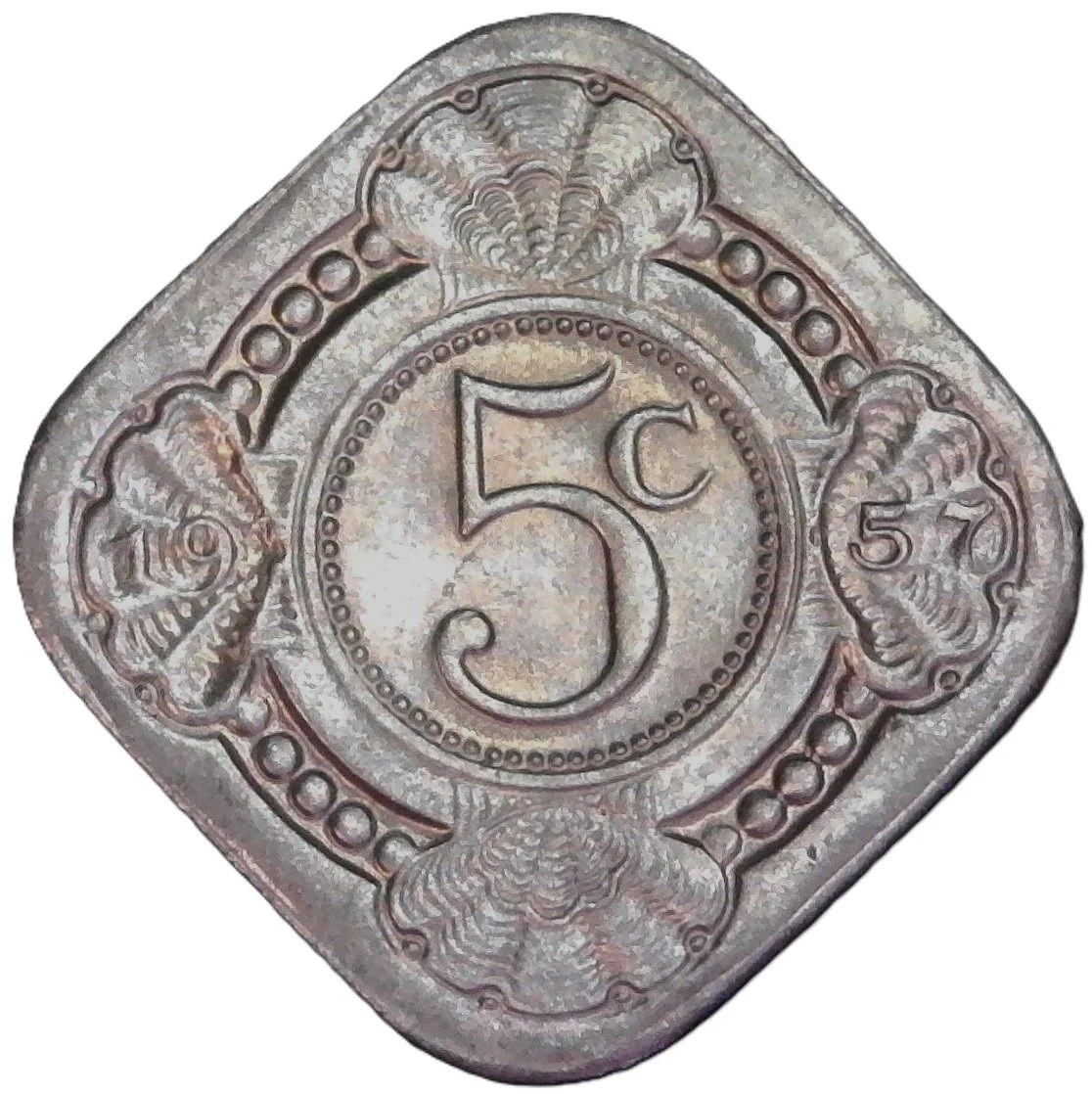
Beaded circle encloses date, bordered by pearls and shells at corners.
Inscription:
1957
5c
5c
Script: Latin
Engraver: Johannes Cornelis Wienecke
Edge
Plain
Mints
| Name | Mark |
|---|---|
| Royal Dutch Mint | — |
Mintings
| Year | Mint Mark | Mintage | Quality | Collection |
|---|---|---|---|---|
| 1957 | — | 500,000 | ||
| 1957 | — | 250 | Proof | |
| 1962 | — | 250,000 | ||
| 1962 | — | 200 | Proof | |
| 1963 | — | 400,000 | ||
| 1963 | — | — | Proof | |
| 1965 | — | 500,000 | ||
| 1965 | — | — | Proof | |
| 1967 | — | 600,000 | ||
| 1967 | — | — | Proof | |
| 1970 | — | — | Proof | |
| 1970 | — | 450,000 |
Historical background
In 1957, the currency situation in the Netherlands Antilles was defined by its status as an autonomous country within the Kingdom of the Netherlands, utilizing the Netherlands Antillean guilder (NAƒ). This currency was pegged to the U.S. dollar at a fixed rate of 1.88585 guilders to one dollar, a stability mechanism crucial for the territory's open, trade-dependent economy. The peg, managed by the central bank of Curaçao (Bank van de Nederlandse Antillen, established in 1828), provided a reliable anchor for both domestic commerce and the vital sectors of international shipping, oil refining, and burgeoning tourism.
The monetary system itself was a legacy of colonial administration but had evolved to serve local needs. Banknotes and coins were issued specifically for the Antilles, often featuring distinct local iconography, though the monetary policy remained closely aligned with Dutch oversight. The U.S. dollar peg was a pragmatic choice, reflecting the islands' strong economic and geographic ties to the Americas, particularly through the large Royal Dutch Shell refinery in Curaçao which processed Venezuelan crude, and the region's growing financial services sector.
This period represented a time of relative monetary stability within a framework of political change. The dissolution of the Charter for the Kingdom of the Netherlands in 1954 had granted the Netherlands Antilles internal self-government, yet currency and foreign affairs remained Kingdom responsibilities. Consequently, while the guilder's day-to-day management was local, its fundamental parity and international standing were underpinned by the broader financial credibility and reserves of the Kingdom, ensuring confidence in the currency during a decade of significant economic transition.
The monetary system itself was a legacy of colonial administration but had evolved to serve local needs. Banknotes and coins were issued specifically for the Antilles, often featuring distinct local iconography, though the monetary policy remained closely aligned with Dutch oversight. The U.S. dollar peg was a pragmatic choice, reflecting the islands' strong economic and geographic ties to the Americas, particularly through the large Royal Dutch Shell refinery in Curaçao which processed Venezuelan crude, and the region's growing financial services sector.
This period represented a time of relative monetary stability within a framework of political change. The dissolution of the Charter for the Kingdom of the Netherlands in 1954 had granted the Netherlands Antilles internal self-government, yet currency and foreign affairs remained Kingdom responsibilities. Consequently, while the guilder's day-to-day management was local, its fundamental parity and international standing were underpinned by the broader financial credibility and reserves of the Kingdom, ensuring confidence in the currency during a decade of significant economic transition.
🌱 Very Common