

¼ gulden – Netherlands Antilles
Add to wishlist
Netherlands
Context
Years: 1954–1970
Country: Netherlands
Issuer: Netherlands Antilles
Ruler: Juliana
Currency:
(since 1828)
Demonetized: Yes
Total mintage: 2,541,450
Material
References
KM: #
Numista: #7662
Value
Exchange value: ¼ ANG
Bullion value: $5.85
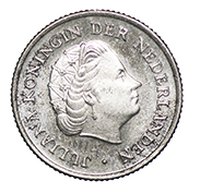
Obverse
Description:
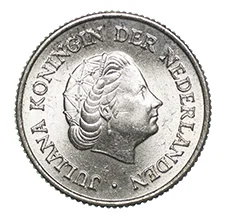
Queen Juliana facing right
Inscription:
JULIANA KONINGIN DER NEDERLANDEN
Translation:
Juliana Queen of the Netherlands
Script: Latin
Language: Dutch
Engraver: Ludwig Oswald Wenckebach
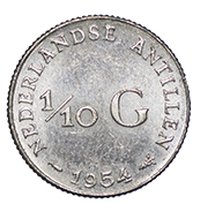
Reverse
Description:
Different privy marks.
Inscription:
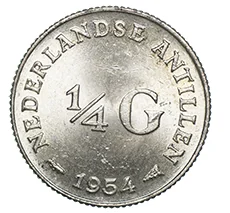
NEDERLANDSE ANTILLEN
¼ G
1963
¼ G
1963
Translation:
Netherlands Antilles
Quarter Gulden
Quarter Gulden
Script: Latin
Languages: Dutch, Papiamento
Engraver: Ludwig Oswald Wenckebach
Edge
Reeded
Mints
| Name | Mark |
|---|---|
| Royal Dutch Mint | — |
Mintings
| Year | Mint Mark | Mintage | Quality | Collection |
|---|---|---|---|---|
| 1954 | — | 200,000 | ||
| 1954 | — | 200 | Proof | |
| 1956 | — | 200,000 | ||
| 1956 | — | 500 | Proof | |
| 1957 | — | 200,000 | ||
| 1957 | — | 250 | Proof | |
| 1960 | — | 240,000 | ||
| 1960 | — | 300 | Proof | |
| 1962 | — | 200 | Proof | |
| 1962 | — | 240,000 | ||
| 1963 | — | — | Proof | |
| 1963 | — | 300,000 | ||
| 1965 | — | 500,000 | ||
| 1965 | — | — | Proof | |
| 1967 | — | 310,000 | ||
| 1969 | — | — | Proof | |
| 1969 | — | 200,000 | ||
| 1970 | — | — | Proof | |
| 1970 | — | 150,000 |
Historical background
Following the dissolution of the Netherlands Antilles in 2010, it is important to clarify that the currency situation in 1954 pertained to the then-existing federated entity. That year marked a pivotal constitutional change with the enactment of the Charter for the Kingdom of the Netherlands, which granted the Netherlands Antilles (comprising Curaçao, Aruba, Bonaire, Saba, Sint Eustatius, and Sint Maarten) internal autonomy as a country within the Kingdom. However, this political shift did not immediately alter the monetary system, which remained firmly under the influence of the Netherlands.
The official currency in 1954 was the Netherlands Antillean guilder (ANG), which had been introduced in 1947 to replace the Curaçaoan guilder. It was pegged at a fixed rate to the U.S. dollar, a linkage established in 1971 but with roots in the immediate post-war economic order. This dollar peg was a strategic choice, reflecting the islands' heavy economic dependence on trade, oil refining (particularly at the Shell refinery in Curaçao), and a growing tourism sector largely financed by and catering to the United States. The peg provided crucial stability for import-dependent economies and fostered investor confidence.
Monetary policy and issuance were managed by the Bank of the Netherlands Antilles (Central Bank van de Nederlandse Antillen), established in 1954 itself. While autonomous in day-to-day operations, the bank's policies were closely aligned with Dutch financial oversight as part of the Kingdom's framework. Thus, in 1954, the currency situation was characterized by a stable, dollar-anchored guilder managed by a newly formed central bank, operating within the context of the islands' newly acquired political autonomy but still within the broader economic and monetary orbit of the Kingdom of the Netherlands.
The official currency in 1954 was the Netherlands Antillean guilder (ANG), which had been introduced in 1947 to replace the Curaçaoan guilder. It was pegged at a fixed rate to the U.S. dollar, a linkage established in 1971 but with roots in the immediate post-war economic order. This dollar peg was a strategic choice, reflecting the islands' heavy economic dependence on trade, oil refining (particularly at the Shell refinery in Curaçao), and a growing tourism sector largely financed by and catering to the United States. The peg provided crucial stability for import-dependent economies and fostered investor confidence.
Monetary policy and issuance were managed by the Bank of the Netherlands Antilles (Central Bank van de Nederlandse Antillen), established in 1954 itself. While autonomous in day-to-day operations, the bank's policies were closely aligned with Dutch financial oversight as part of the Kingdom's framework. Thus, in 1954, the currency situation was characterized by a stable, dollar-anchored guilder managed by a newly formed central bank, operating within the context of the islands' newly acquired political autonomy but still within the broader economic and monetary orbit of the Kingdom of the Netherlands.
🌱 Very Common