

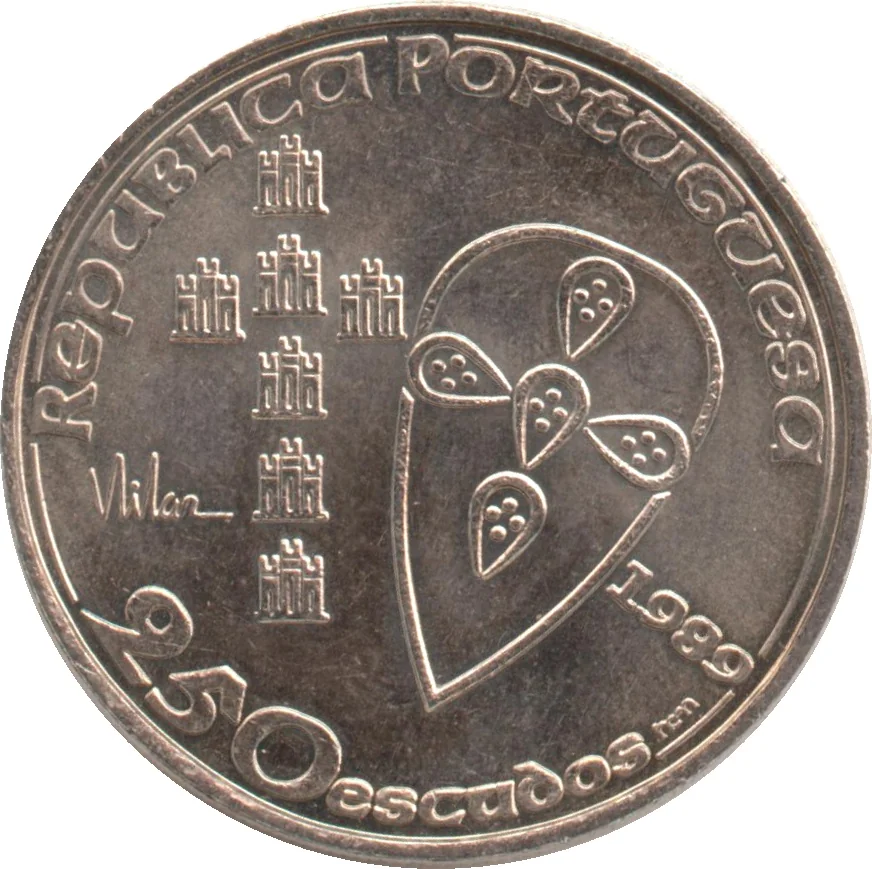
250 Escudos (Foundation of Portugal) – Portugal
Circulating commemorative coins
Commemoration: 850th Anniversary of the Foundation of Portugal
Series: System 1981-2001
Portugal
Context
Year: 1989
Issuer: Portugal 
Period:
(since 1974)
Currency:
(1911—2001)
Demonetization: 28 February 2002
Total mintage: 750,000
Material
Diameter: 37 mm
Weight: 23.1 g
Thickness: 2.8 mm
Shape: Round
Composition: Copper-nickel
Technique: Milled
Alignment: Coin alignment
flip
References
KM: #Click to copy to clipboard650
Numista: #8952
Value
Exchange value: 250 PTE
Inflation-adjusted value: 857.19 PTE
Obverse
Reverse
Description:
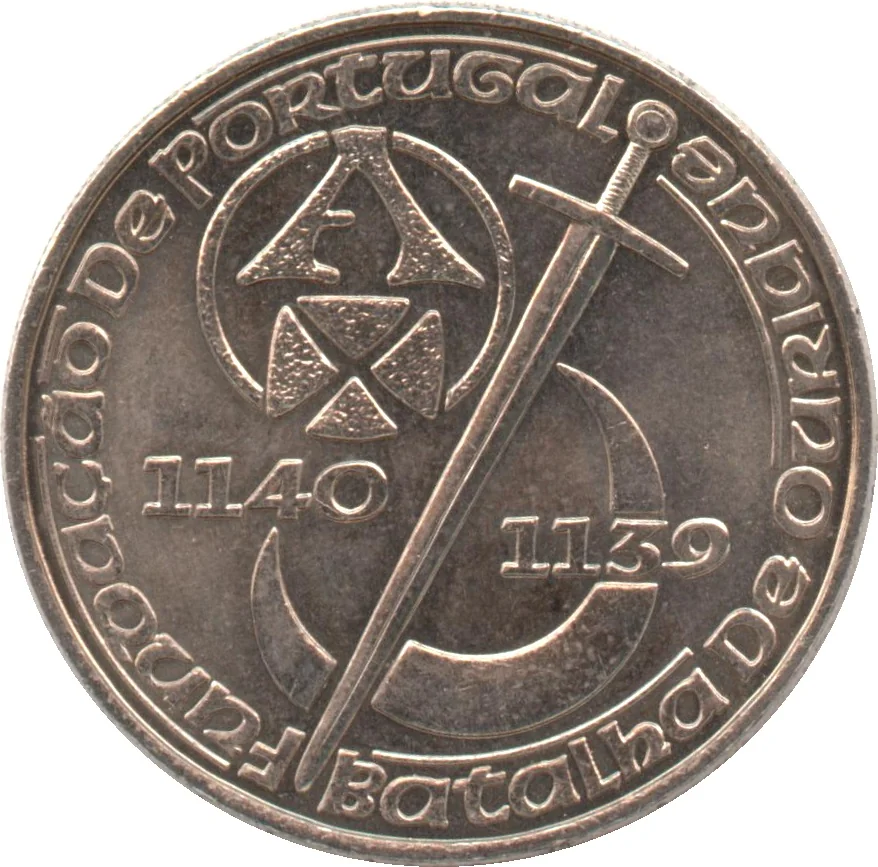
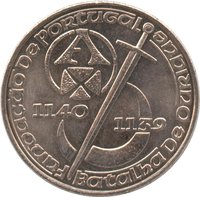
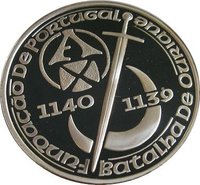
Afonso Henriques' cipher and a sword splitting a crescent moon.
Inscription:
Fundação De Portugal
1140 1139
Batalha De Ourique
1140 1139
Batalha De Ourique
Translation:
Foundation of Portugal
1140 1139
Battle of Ourique
1140 1139
Battle of Ourique
Script: Latin
Language: Portuguese
Edge
Reeded
Mints
| Name | Mark |
|---|---|
| Imprensa Nacional - Casa da Moeda | incm |
Mintings
| Year | Mint Mark | Mintage | Quality | Collection |
|---|---|---|---|---|
| 1989 | incm | 750,000 |
Historical background
In 1989, Portugal's currency situation was characterized by its integration into the European Monetary System (EMS) and the ongoing struggle to stabilize the escudo after a period of high inflation and economic transformation. Following the 1974 Carnation Revolution, the country experienced significant political and economic turmoil, leading to rampant inflation, which peaked at nearly 30% in the mid-1980s. By the late 1980s, under a stabilization program and with its 1986 entry into the European Economic Community (EEC), Portugal was committed to aligning its economy with European partners. The escudo was part of the EMS Exchange Rate Mechanism (ERM), but within its wider fluctuation band of ±6%, reflecting the currency's relative fragility compared to core European currencies like the Deutsche Mark.
The primary focus for monetary authorities was the battle against inflation, which remained in double digits (around 12-13% in 1989), and defending the escudo's parity within the EMS. This required maintaining high interest rates and tight monetary policy, which posed a challenge to economic growth. The escudo faced periodic speculative pressures, leading to several negotiated devaluations within the EMS framework—notably in 1987 and again in 1990—to restore competitiveness and account for Portugal's higher inflation rate relative to its trading partners. These adjustments were seen as necessary steps in the gradual convergence process.
Overall, the 1989 currency landscape was one of managed transition. The escudo was not yet a strong or fully stable currency, but it was on a defined path toward European integration. The policies of the time, emphasizing disinflation and exchange rate stability, were foundational steps toward the ultimate goal of joining a future single European currency, a process that would culminate a decade later with Portugal's adoption of the euro in 1999.
The primary focus for monetary authorities was the battle against inflation, which remained in double digits (around 12-13% in 1989), and defending the escudo's parity within the EMS. This required maintaining high interest rates and tight monetary policy, which posed a challenge to economic growth. The escudo faced periodic speculative pressures, leading to several negotiated devaluations within the EMS framework—notably in 1987 and again in 1990—to restore competitiveness and account for Portugal's higher inflation rate relative to its trading partners. These adjustments were seen as necessary steps in the gradual convergence process.
Overall, the 1989 currency landscape was one of managed transition. The escudo was not yet a strong or fully stable currency, but it was on a defined path toward European integration. The policies of the time, emphasizing disinflation and exchange rate stability, were foundational steps toward the ultimate goal of joining a future single European currency, a process that would culminate a decade later with Portugal's adoption of the euro in 1999.
Series: System 1981-2001
🌱 Very Common