

100 Escudos (Portuguese Independence) – Portugal
Non-circulating coins
Commemoration: 350th Anniversary - Restoration of Portuguese Independence
Series: System 1981-2001
Portugal
Obverse
Description:
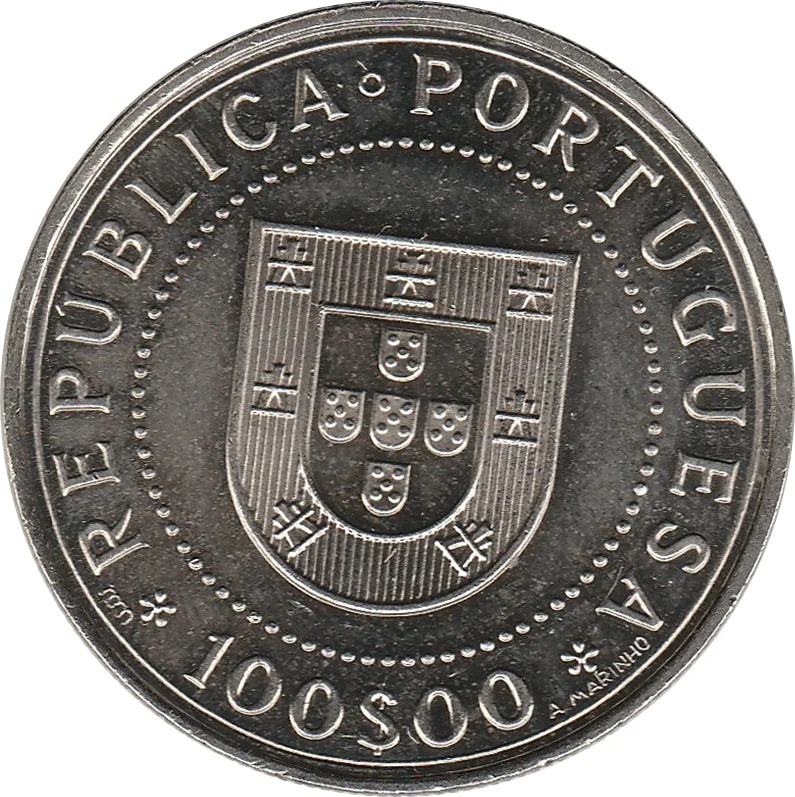
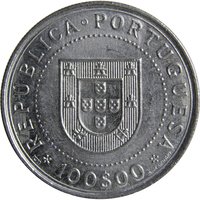
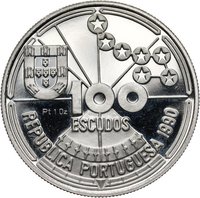
The national coat of arms, encircled by pearls and the inscription, is at the coin's center.
Inscription:
REPÚBLICA PORTUGUESA
100$00
100$00
Translation:
Portuguese Republic
One hundred escudos
One hundred escudos
Script: Latin
Language: Portuguese
Engraver: António Marinho
Reverse
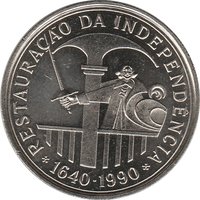
Description:
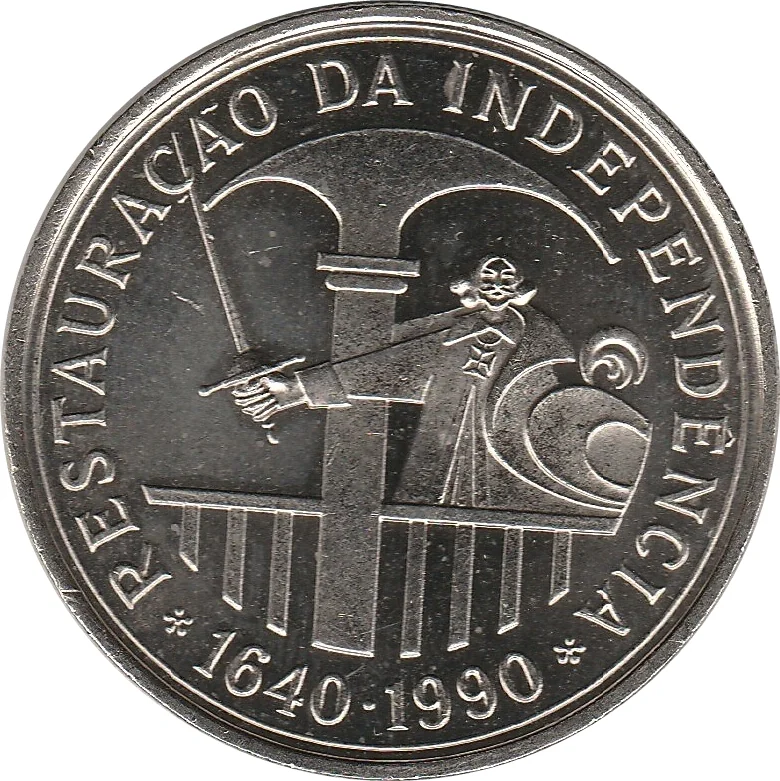
A kind man stands at a podium, holding a sword.
Inscription:
RESTAURACÃO DA INDEPENDÊNCIA
1640 . 1990
INCM
A.MARINHO
1640 . 1990
INCM
A.MARINHO
Translation:
Restoration of the Independence
1640 . 1990
INCM
A.Marinho
1640 . 1990
INCM
A.Marinho
Script: Latin
Language: Portuguese
Engraver: Antonio Marinho
Edge
Milled
Mints
| Name | Mark |
|---|---|
| Imprensa Nacional - Casa da Moeda | incm |
Historical background
In 1990, Portugal's currency situation was defined by its participation in the European Monetary System (EMS) and its Exchange Rate Mechanism (ERM), which it had joined in April of that year. The Portuguese escudo (PTE) was pegged within a narrow band (±2.25%) against a basket of European currencies, primarily weighted towards the Deutsche Mark. This move was a strategic and political commitment to align with core European economies, signaling Portugal's dedication to monetary stability and European integration following its accession to the European Economic Community in 1986. The primary objective was to import credibility for the escudo, taming the high inflation that had plagued the economy in the previous decades.
Domestically, this policy required strict discipline from the Banco de Portugal. To maintain the escudo's parity, the central bank had to maintain high interest rates and intervene in foreign exchange markets, which constrained economic growth and fiscal policy. While successful in reducing inflation from double-digit levels, it came at a cost of slower economic expansion and higher unemployment in the short term. The economy was undergoing significant liberalization and modernization, and the fixed exchange rate served as an anchor, but it also limited the country's ability to use devaluation as a tool to boost competitiveness.
Overall, the 1990 currency framework represented a transitional phase. Portugal was firmly on a path toward eventual Economic and Monetary Union (EMU) and the adoption of the euro, a goal explicitly stated in the Maastricht Treaty negotiations underway at the time. The ERM membership was the essential proving ground, requiring Portugal to converge its macroeconomic policies with stricter European standards. While challenging, this period laid the necessary groundwork for the eventual replacement of the escudo with the euro in 1999.
Domestically, this policy required strict discipline from the Banco de Portugal. To maintain the escudo's parity, the central bank had to maintain high interest rates and intervene in foreign exchange markets, which constrained economic growth and fiscal policy. While successful in reducing inflation from double-digit levels, it came at a cost of slower economic expansion and higher unemployment in the short term. The economy was undergoing significant liberalization and modernization, and the fixed exchange rate served as an anchor, but it also limited the country's ability to use devaluation as a tool to boost competitiveness.
Overall, the 1990 currency framework represented a transitional phase. Portugal was firmly on a path toward eventual Economic and Monetary Union (EMU) and the adoption of the euro, a goal explicitly stated in the Maastricht Treaty negotiations underway at the time. The ERM membership was the essential proving ground, requiring Portugal to converge its macroeconomic policies with stricter European standards. While challenging, this period laid the necessary groundwork for the eventual replacement of the escudo with the euro in 1999.
Series: System 1981-2001
⭐ Rare