


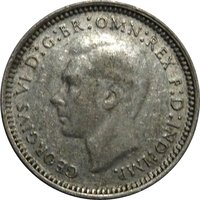
Obverse
Description:
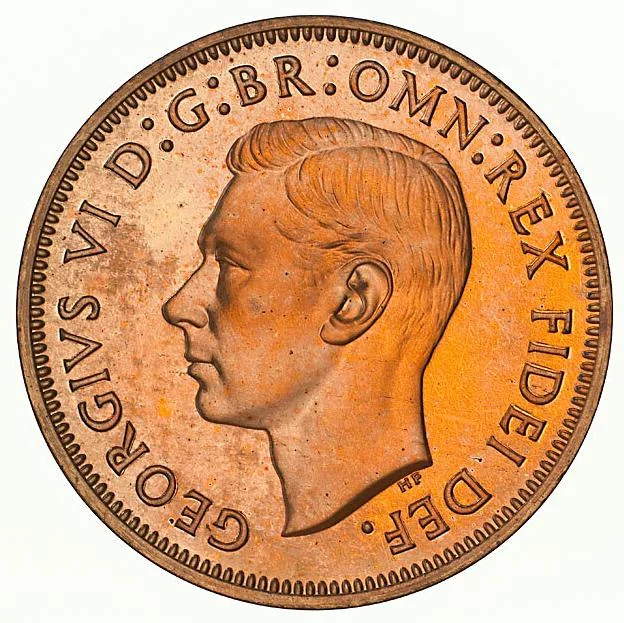
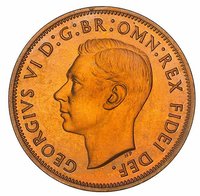
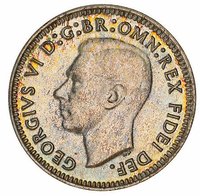
King George VI left-facing portrait, engraver's initials below.
Inscription:
GEORGIVS VI D:G:BR:OMN:REX FIDEI DEF.
HP
HP
Translation:
George VI by the Grace of God King of all the Britains Defender of the Faith.
Script: Latin
Language: Latin
Engraver: Thomas Humphrey Paget
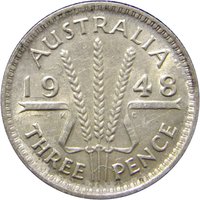
Reverse
Description:
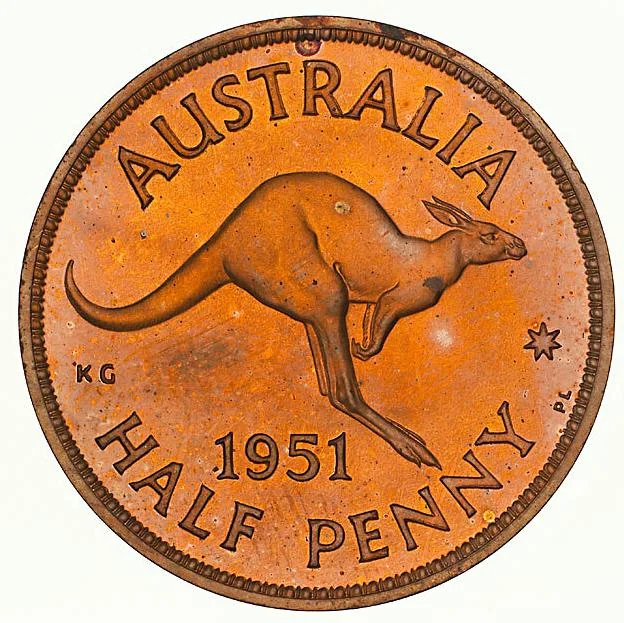
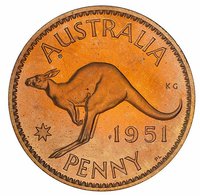
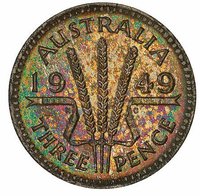
Kangaroo leaping right, country above, year above denomination.
Inscription:
AUSTRALIA
KG
1949
HALF PENNY .
KG
1949
HALF PENNY .
Script: Latin
Engraver: George Kruger Gray
Edge
Plain
Mints
| Name | Mark |
|---|---|
| Perth Mint | — |
| Royal Mint | — |
| Perth Mint | . |
| Heaton and Sons / The Mint Birmingham | PL |
| Royal Mint (Tower Hill) | PL |
Mintings
Historical background
In 1949, Australia's currency situation was fundamentally defined by its position within the Sterling Area and the Bretton Woods system of fixed exchange rates. The Australian pound was pegged to the British pound sterling at a rate of A£1 = £1 sterling, which was in turn fixed to the US dollar. This arrangement facilitated trade with Britain, Australia's dominant economic partner, but also meant monetary policy was heavily influenced by London's decisions and the need to maintain sterling reserves. Domestically, the post-war economy was characterised by inflationary pressures, import controls, and a complex system of banking regulations administered by the Commonwealth Bank, the precursor to the Reserve Bank.
A pivotal event occurred in September 1949, when the incoming Chifley Labor government, facing a severe balance of payments crisis and dwindling sterling reserves, made the dramatic decision to devalue the Australian pound. Following the UK's own devaluation of sterling against the US dollar, Australia devalued by 30%, moving from parity with sterling to a new rate of A£1 = 16 US dollars (equivalent to £1 5s. sterling). This was a strategic move to protect export income, particularly for key sectors like wool and wheat, and to curb a growing current account deficit by making imports more expensive and exports more competitive on world markets.
The 1949 devaluation was politically contentious, occurring just two months before a federal election. It sparked debate over economic sovereignty and management, with opponents criticising the timing and the government's broader controls-based approach. The decision underscored Australia's vulnerable position as a primary producer dependent on commodity prices and its ongoing economic alignment with Britain. While it provided short-term relief for the balance of payments, it also contributed to domestic inflation, setting the stage for the economic challenges that would confront the new Menzies government elected later that year.
A pivotal event occurred in September 1949, when the incoming Chifley Labor government, facing a severe balance of payments crisis and dwindling sterling reserves, made the dramatic decision to devalue the Australian pound. Following the UK's own devaluation of sterling against the US dollar, Australia devalued by 30%, moving from parity with sterling to a new rate of A£1 = 16 US dollars (equivalent to £1 5s. sterling). This was a strategic move to protect export income, particularly for key sectors like wool and wheat, and to curb a growing current account deficit by making imports more expensive and exports more competitive on world markets.
The 1949 devaluation was politically contentious, occurring just two months before a federal election. It sparked debate over economic sovereignty and management, with opponents criticising the timing and the government's broader controls-based approach. The decision underscored Australia's vulnerable position as a primary producer dependent on commodity prices and its ongoing economic alignment with Britain. While it provided short-term relief for the balance of payments, it also contributed to domestic inflation, setting the stage for the economic challenges that would confront the new Menzies government elected later that year.
🌱 Very Common