

1 real – Buenos Aires
Add to wishlist
Argentina
Context
Year: 1854
Country: Argentina
Issuer: Buenos Aires
Period:
(1853—1861)
Currency:
(1822—1861)
Demonetized: Yes
Material
References
KM: #
Numista: #89397
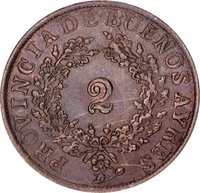
Obverse
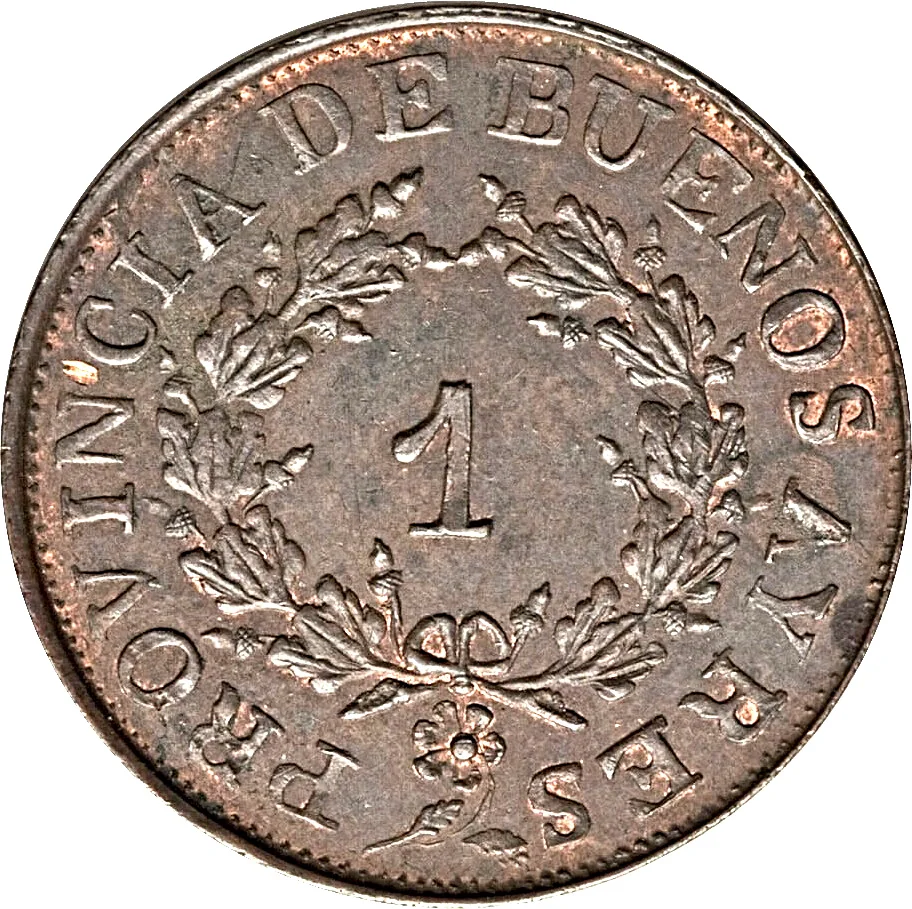
Description:
Value in wreath. Legend divided by flower.
Inscription:
PROVINCIA DE BUENOS AYRES
1
1
Script: Latin
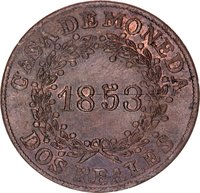
Reverse
Description:
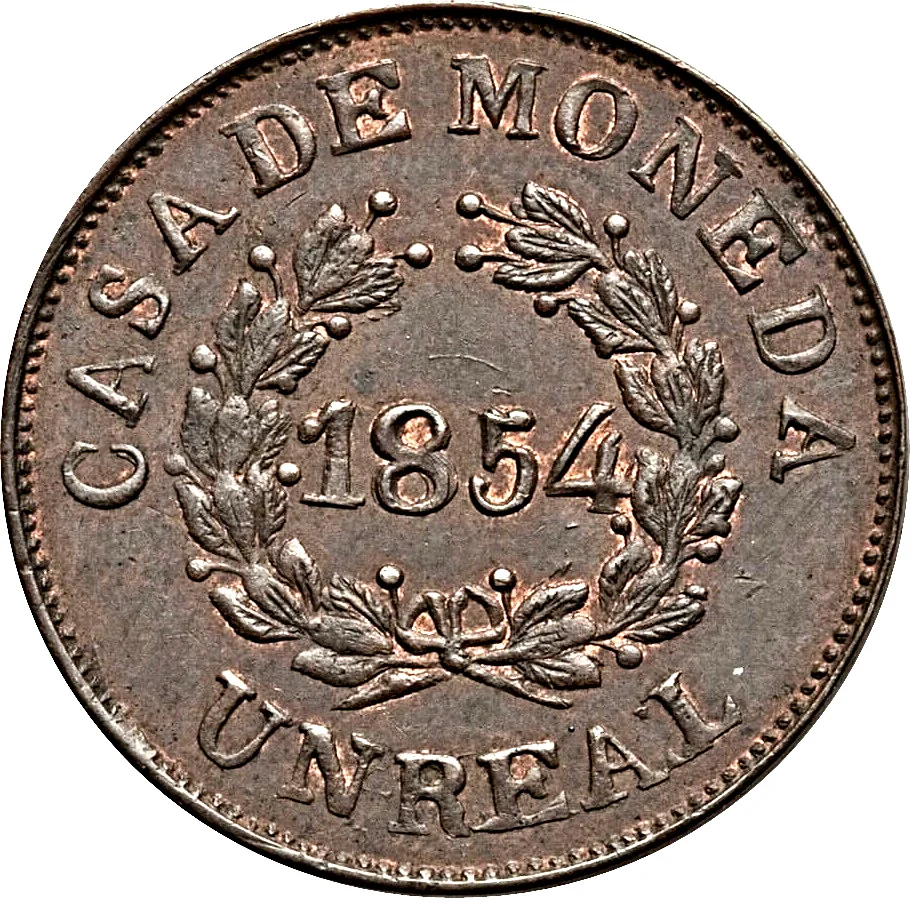
Date in wreath, value in letters below.
Inscription:
CASA DE MONEDA
1854
UN REAL
1854
UN REAL
Script: Latin
Edge
Plain
Mintings
| Year | Mint Mark | Mintage | Quality | Collection |
|---|---|---|---|---|
| 1854 | — | — |
Historical background
In 1854, Buenos Aires existed as an independent state, separate from the Argentine Confederation following the 1852 overthrow of Juan Manuel de Rosas. This political separation created a distinct and chaotic monetary environment within the city and its province. The state treasury, operating as the Banco de la Provincia de Buenos Aires, issued its own paper money, but these bills were not backed by specie (gold or silver) and rapidly depreciated due to over-issuance to fund public works and administrative costs. This fiat currency, known as pesos moneda corriente, circulated at a steep discount to both the silver peso and the currencies of foreign merchants.
The port city was a hub of international trade, leading to a complex multi-currency system in daily use. Alongside the devalued local paper, hard currencies like Spanish-American silver reales, French francs, British sovereigns, and Brazilian reis were commonly used for significant transactions, especially in import and export. This created a dual economy: domestic affairs were conducted in unstable paper, while international trade and banking relied on metallic currencies. Merchants and pulperías (general stores) routinely published exchange lists, and the fluctuating daily value of the peso moneda corriente against specie was a standard feature of commercial life.
This monetary instability was a direct reflection of Buenos Aires's contested sovereignty and its economic strategy. The state used currency emission as a crucial tool for public finance in the absence of robust taxation, effectively imposing an inflation tax on its citizens. The situation fostered a climate of speculation and commercial uncertainty, which would persist until the political reunification of Argentina with Buenos Aires as the capital in 1862, after which a national effort to unify and stabilize the currency could begin in earnest.
The port city was a hub of international trade, leading to a complex multi-currency system in daily use. Alongside the devalued local paper, hard currencies like Spanish-American silver reales, French francs, British sovereigns, and Brazilian reis were commonly used for significant transactions, especially in import and export. This created a dual economy: domestic affairs were conducted in unstable paper, while international trade and banking relied on metallic currencies. Merchants and pulperías (general stores) routinely published exchange lists, and the fluctuating daily value of the peso moneda corriente against specie was a standard feature of commercial life.
This monetary instability was a direct reflection of Buenos Aires's contested sovereignty and its economic strategy. The state used currency emission as a crucial tool for public finance in the absence of robust taxation, effectively imposing an inflation tax on its citizens. The situation fostered a climate of speculation and commercial uncertainty, which would persist until the political reunification of Argentina with Buenos Aires as the capital in 1862, after which a national effort to unify and stabilize the currency could begin in earnest.
💎 Very Rare