

20 kroner (Norges Bank) – Norway
Add to wishlist
Circulating commemorative coins
Commemoration: Norges Bank Bicentenary
Norway
Context
Material
References
KM: #
Numista: #89253
Value
Exchange value: 20 NOK
Inflation-adjusted value: 27.20 NOK
Obverse
Description:
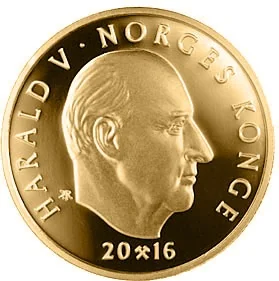
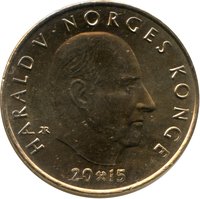
Bust of King Harald V facing right, with engraver's initials behind it. Inscription surrounds the bust, and a mintmark divides the date below. Solid ring on the rim.
Inscription:
HARALD V · NORGES KONGE
IAR
20 ⚒ 16
IAR
20 ⚒ 16
Translation:
HARALD V · NORWAY'S KING
IAR
20 ⚒ 16
IAR
20 ⚒ 16
Script: Latin
Engraver: Ingrid Austlid Rise
Reverse
Description:
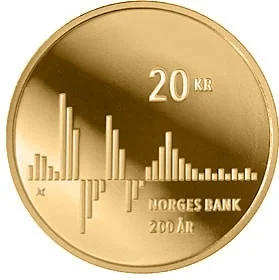
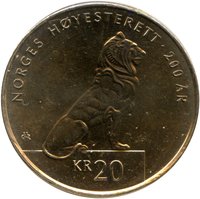
Norwegian inflation and deflation history. Value above. Designer initials left. Two-line inscription bottom right. Solid rim ring.
Inscription:
20 KR
KA
NORGES BANK
200 ÅR
KA
NORGES BANK
200 ÅR
Translation:
20 KR
KA
NORGES BANK
200 YEARS
KA
NORGES BANK
200 YEARS
Script: Latin
Engraver: Ingrid Austlid Rise
Designer: Kjersti M. Austdal
Edge
Plain
Mints
| Name | Mark |
|---|---|
| Norwegian Mint | — |
Mintings
| Year | Mint Mark | Mintage | Quality | Collection |
|---|---|---|---|---|
| 2016 | — | 1,955,000 | ||
| 2016 | — | 3,450 | Proof |
Historical background
In 2016, Norway's currency situation was dominated by the prolonged downturn in global oil prices, which began in mid-2014. As a major petroleum exporter, Norway's economy and its currency, the krone (NOK), are highly sensitive to oil price movements. Throughout 2016, Brent crude traded at historically low levels, averaging around $45 per barrel, which significantly reduced national export revenues and government income. This sustained pressure led to a notably weak krone, which traded at multi-year lows against both the euro and the US dollar, benefiting non-oil exporters but increasing import costs and household expenses.
In response, Norges Bank, the country's central bank, maintained an expansionary monetary policy to cushion the economic slowdown. The key policy rate was cut twice in 2016, reaching a historic low of 0.5% by year's end. This rate-cutting cycle, which began in late 2014, aimed to stimulate domestic demand and counter rising unemployment, particularly in oil-related industries. However, the low rates also contributed to keeping the krone weak, as they reduced the currency's yield appeal for international investors.
Despite the oil sector slump, Norway's economic fundamentals remained robust compared to many other nations, supported by its massive sovereign wealth fund (the Government Pension Fund Global). The weak krone provided a substantial boost to other export-oriented sectors like tourism, seafood, and manufacturing, helping to diversify the economy. Consequently, while 2016 was a period of significant adjustment and currency weakness, it also highlighted the Norwegian economy's underlying resilience and its structured response to terms-of-trade shocks.
In response, Norges Bank, the country's central bank, maintained an expansionary monetary policy to cushion the economic slowdown. The key policy rate was cut twice in 2016, reaching a historic low of 0.5% by year's end. This rate-cutting cycle, which began in late 2014, aimed to stimulate domestic demand and counter rising unemployment, particularly in oil-related industries. However, the low rates also contributed to keeping the krone weak, as they reduced the currency's yield appeal for international investors.
Despite the oil sector slump, Norway's economic fundamentals remained robust compared to many other nations, supported by its massive sovereign wealth fund (the Government Pension Fund Global). The weak krone provided a substantial boost to other export-oriented sectors like tourism, seafood, and manufacturing, helping to diversify the economy. Consequently, while 2016 was a period of significant adjustment and currency weakness, it also highlighted the Norwegian economy's underlying resilience and its structured response to terms-of-trade shocks.
🌱 Common