

2 Bu – Japan
Japan
Context
Material
Weight: 5.62 g
Gold weight: 1.14 g
Shape: Irregular rectangular
Magnetic: No
Technique: Hammered
Alignment: Medal alignment
flip
References
Numista: #88798
Value
Bullion value: $188.99
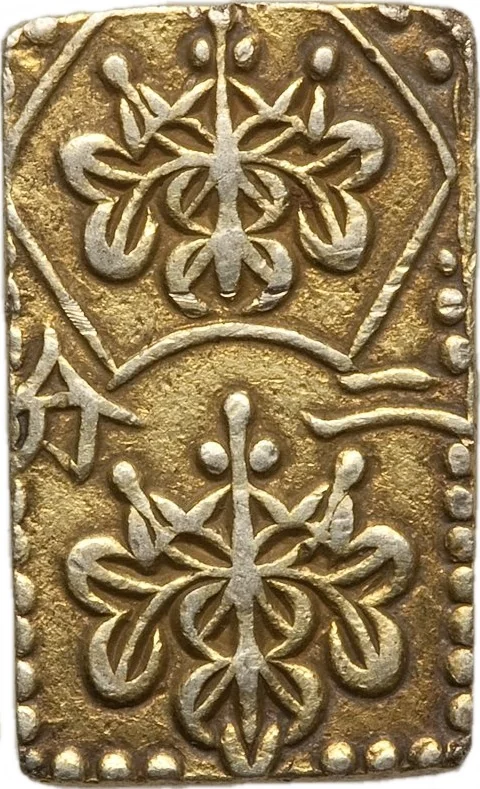
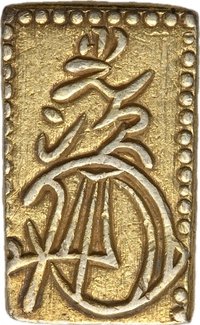
Obverse
Description:
Kiri crests above and below the central value.
Inscription:
分 二
Translation:
Two Fen
Language: Chinese
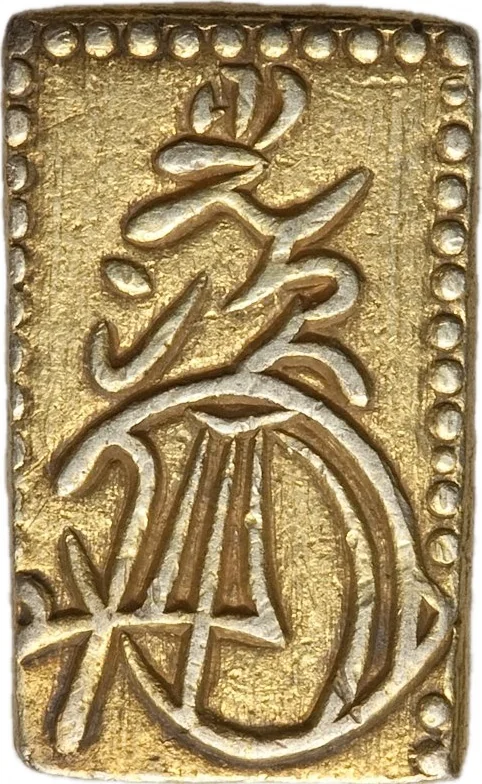
Reverse
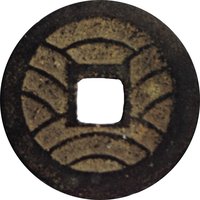
Description:
The Mint Official and his signature.
Inscription:
光
次
次
Translation:
Guangci
Language: Chinese
Edge
Mints
| Name | Mark |
|---|---|
| Kinza, Edo | — |
Mintings
| Year | Mint Mark | Mintage | Quality | Collection |
|---|---|---|---|---|
| — | — | 7,103,200 |
Historical background
In 1856, Japan’s monetary system was a complex and fragmented patchwork of feudal currencies, operating under the isolationist policies of the Tokugawa shogunate. The nation was officially on a gold and silver standard, but in practice, the central shogunate in Edo (Tokyo) minted its own coins (such as the koban gold oval and ichibu silver coins), while approximately 250 semi-autonomous domains (han) issued their own paper scrip, known as hansatsu. These domain notes were not universally convertible and typically circulated only within their issuing region, leading to a chaotic and inefficient economy. Furthermore, decades of debasement to finance domain debts had eroded the value and trust in the currency, creating significant price instability and hampering inter-regional trade.
This fragile system existed under the looming threat of Western pressure, intensified by Commodore Matthew Perry’s forced opening of Japan in 1853-54. The Treaty of Kanagawa (1854) and subsequent agreements began to impose foreign economic demands, including the problematic issue of exchange rates. The shogunate’s fixed rate between gold and silver (at a ratio of about 1:5) was drastically different from the global market rate (around 1:15), creating an arbitrage opportunity that foreign merchants quickly exploited. They used Mexican silver dollars to purchase undervalued Japanese gold, leading to a massive and destabilizing outflow of gold bullion from the country in what became known as the "gold drain."
Consequently, by 1856, Japan’s currency situation was one of internal weakness and external vulnerability. The shogunate, facing a fiscal crisis and loss of specie, resorted to further debasement of its own coinage to stem the gold outflow, which only fueled inflation and social discontent. This monetary turmoil exposed the fundamental economic weaknesses of the Tokugawa regime and became a critical factor undermining its authority, setting the stage for the profound economic and political reforms that would follow the Meiji Restoration just over a decade later.
This fragile system existed under the looming threat of Western pressure, intensified by Commodore Matthew Perry’s forced opening of Japan in 1853-54. The Treaty of Kanagawa (1854) and subsequent agreements began to impose foreign economic demands, including the problematic issue of exchange rates. The shogunate’s fixed rate between gold and silver (at a ratio of about 1:5) was drastically different from the global market rate (around 1:15), creating an arbitrage opportunity that foreign merchants quickly exploited. They used Mexican silver dollars to purchase undervalued Japanese gold, leading to a massive and destabilizing outflow of gold bullion from the country in what became known as the "gold drain."
Consequently, by 1856, Japan’s currency situation was one of internal weakness and external vulnerability. The shogunate, facing a fiscal crisis and loss of specie, resorted to further debasement of its own coinage to stem the gold outflow, which only fueled inflation and social discontent. This monetary turmoil exposed the fundamental economic weaknesses of the Tokugawa regime and became a critical factor undermining its authority, setting the stage for the profound economic and political reforms that would follow the Meiji Restoration just over a decade later.
⭐ Rare