

1 Franc CFA – Central African States
Context
Years: 1969–1971
Issuer: Central African States
Issuing organization: Central Bank of Equatorial African States and Cameroon
Currency:
(1961—1973)
Demonetized: Yes
Total mintage: 5,500,000
Material
References
KM: #Click to copy to clipboard6
Numista: #8877
Value
Exchange value: 1 FCFA
Obverse
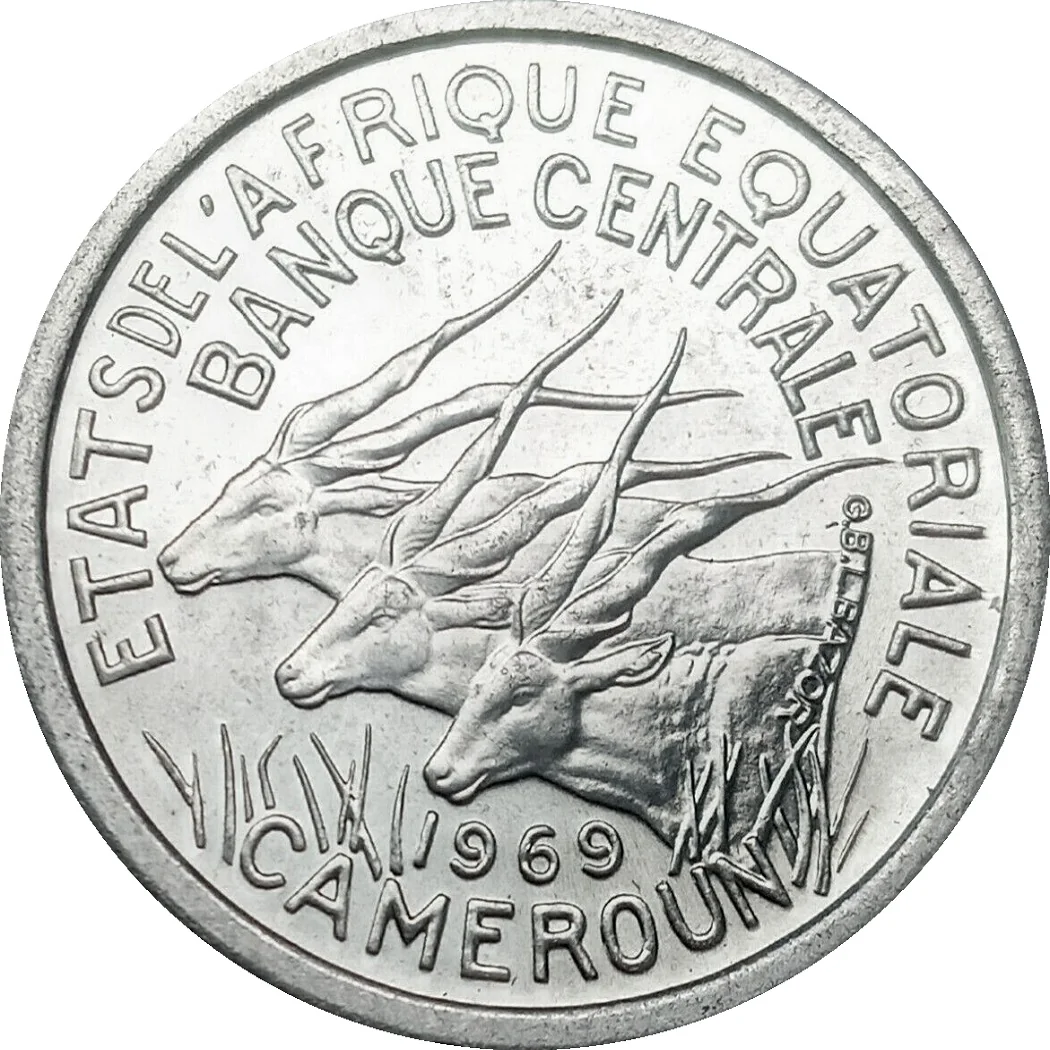
Description:
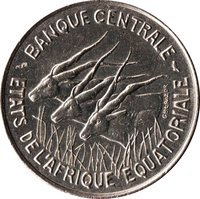
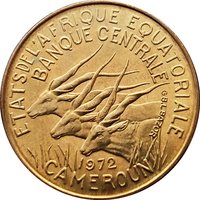
Three giant elands remain.
Inscription:
ETATS DE L'AFRIQUE EQUATORIALE
BANQUE CENTRALE
G.B.L.BAZOR
1969
CAMEROUN
BANQUE CENTRALE
G.B.L.BAZOR
1969
CAMEROUN
Translation:
States of Equatorial Africa
Central Bank
G.B.L.BAZOR
1969
Cameroon
Central Bank
G.B.L.BAZOR
1969
Cameroon
Script: Latin
Language: French
Engravers: Gabriel Bernard, Lucien Bazor
Reverse
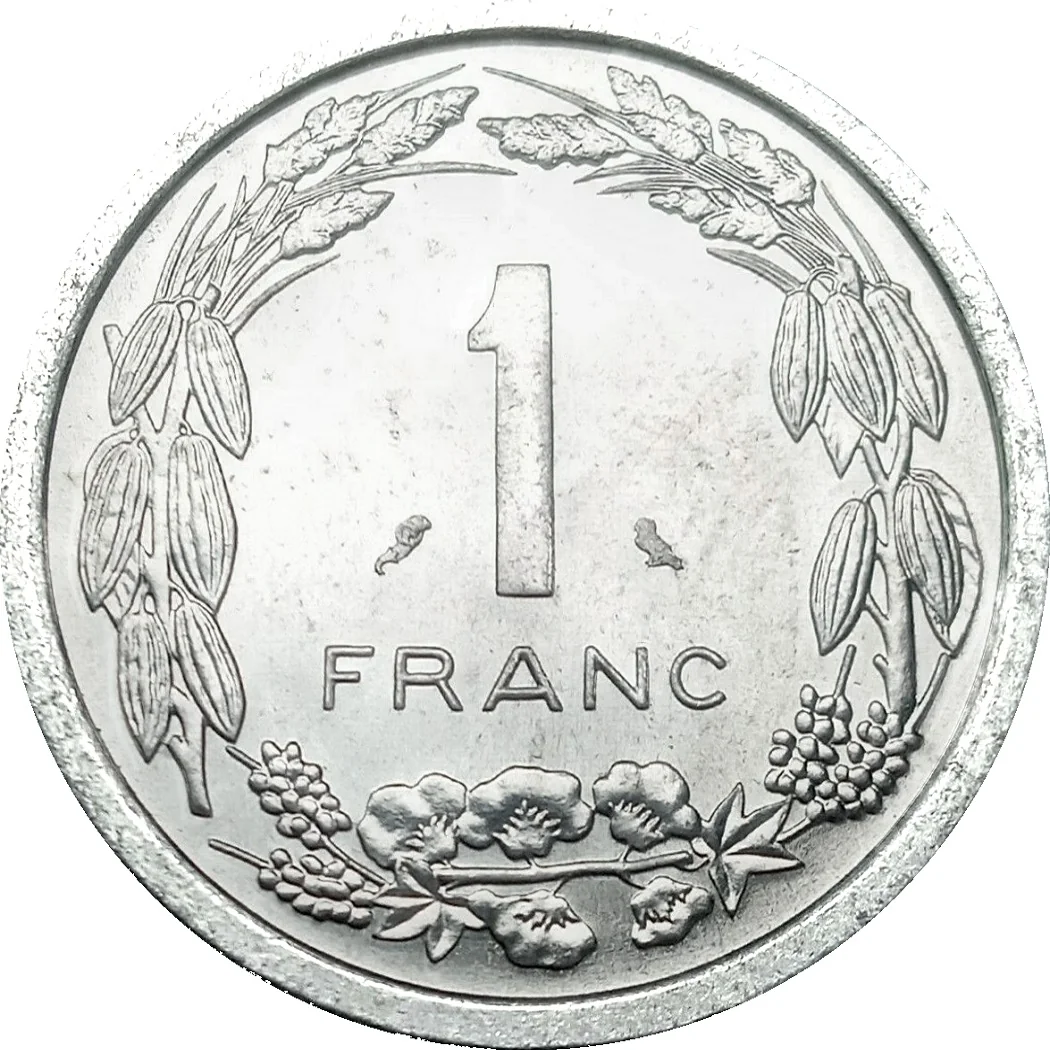
Description:
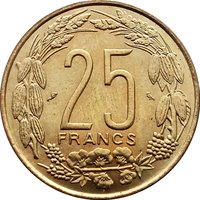
Wreath of major Cameroonian crops: cotton, coffee, cocoa, and grains.
Inscription:
1
FRANC
FRANC
Script: Latin
Engravers: Gabriel Bernard, Lucien Bazor
Edge
Plain
Categories
| Symbol> Wreath |
| Agriculture |
Mints
| Name | Mark |
|---|---|
| Monnaie de Paris | — |
Mintings
| Year | Mint Mark | Mintage | Quality | Collection |
|---|---|---|---|---|
| 1969 | — | 2,500,000 | ||
| 1971 | — | 3,000,000 |
Historical background
In 1969, the currency situation in the Central African States was defined by the operations of the Central African Monetary Union (UMAC) and the shared use of the CFA franc. This currency, created in 1945 as the Colonies Françaises d'Afrique franc, was by this time officially known as the Communauté Financière Africaine franc. It was a stable, convertible currency pegged to the French franc at a fixed rate of 1 CFA franc = 0.02 French francs (or 50 CFA francs = 1 French franc). This arrangement provided monetary stability and facilitated trade with France, but it also meant monetary policy was largely directed from Paris, with the French Treasury guaranteeing the currency's convertibility.
The issuing authority was the Banque Centrale des États de l'Afrique Équatoriale et du Cameroun (BCEAEC), headquartered in Paris. Established in 1959, it served the five member states of the Customs and Economic Union of Central Africa (UDEAC): Chad, the Central African Republic, the Republic of the Congo, Gabon, and Cameroon. While the currency was uniform, each member state's notes featured distinct national designs, symbolizing a balance between regional monetary integration and national identity.
The economic context of 1969 was one of post-independence nation-building, with the CFA franc system offering both advantages and constraints. For the newly independent states, it provided a shield against inflation and a reliable framework for international transactions. However, the fixed peg and the requirement to deposit a significant portion of foreign reserves with the French Treasury limited national control over monetary policy and economic leverage. This period thus represented a continuation of a managed monetary system, where financial stability was prioritized, but within a framework that reflected enduring post-colonial economic linkages.
The issuing authority was the Banque Centrale des États de l'Afrique Équatoriale et du Cameroun (BCEAEC), headquartered in Paris. Established in 1959, it served the five member states of the Customs and Economic Union of Central Africa (UDEAC): Chad, the Central African Republic, the Republic of the Congo, Gabon, and Cameroon. While the currency was uniform, each member state's notes featured distinct national designs, symbolizing a balance between regional monetary integration and national identity.
The economic context of 1969 was one of post-independence nation-building, with the CFA franc system offering both advantages and constraints. For the newly independent states, it provided a shield against inflation and a reliable framework for international transactions. However, the fixed peg and the requirement to deposit a significant portion of foreign reserves with the French Treasury limited national control over monetary policy and economic leverage. This period thus represented a continuation of a managed monetary system, where financial stability was prioritized, but within a framework that reflected enduring post-colonial economic linkages.
🌱 Common