

25 francs cfa – Central African States
Add to wishlist
Context
Years: 1970–1972
Issuer: Central African States
Issuing organization: Central Bank of Equatorial African States and Cameroon
Currency:
(1961—1973)
Total mintage: 8,035,200
Material
Diameter: 27 mm
Weight: 8 g
Thickness: 2 mm
Shape: Round
Composition: Aluminium-nickel-bronze
Technique: Milled
Alignment: Coin alignment
flip
References
KM: #
Numista: #8785
Value
Exchange value: 25 FCFA
Obverse
Description:
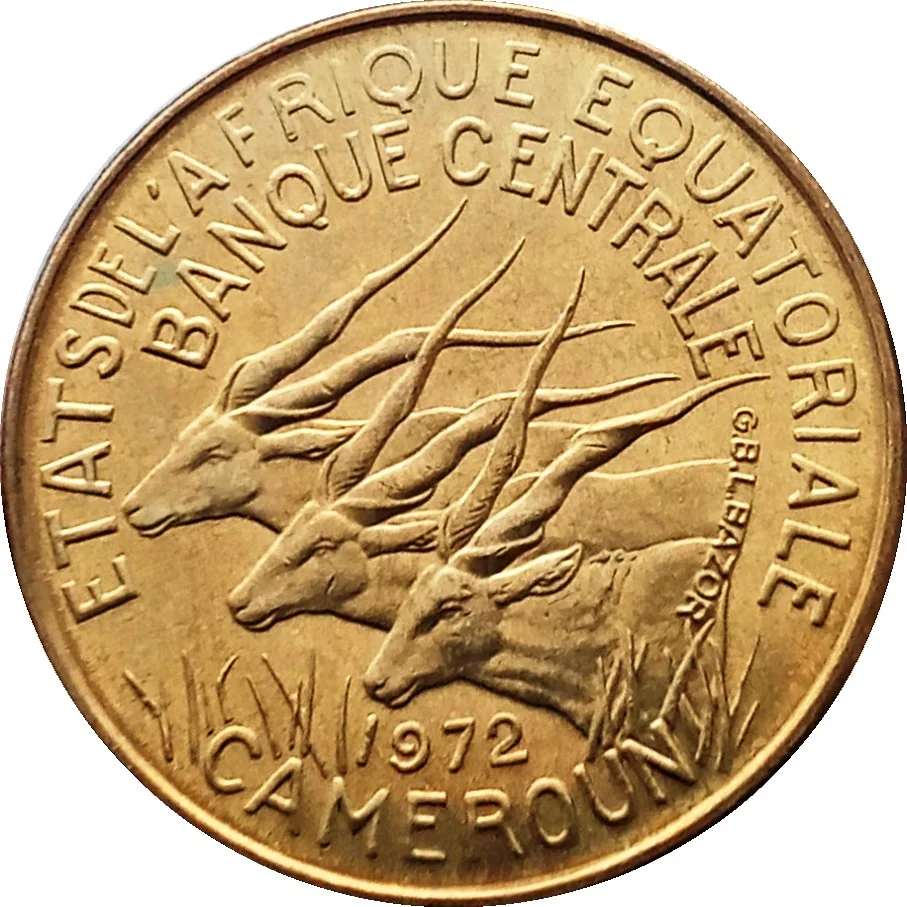
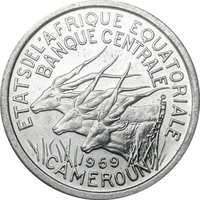
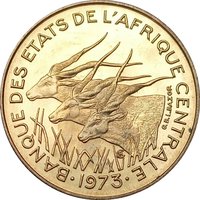
Three giant elands remain.
Inscription:
ETATS DE L'AFRIQUE EQUATORIALE
BANQUE CENTRALE
G.B.L.BAZOR
1972
CAMEROUN
BANQUE CENTRALE
G.B.L.BAZOR
1972
CAMEROUN
Translation:
STATES OF EQUATORIAL AFRICA
CENTRAL BANK
G.B.L.BAZOR
1972
CAMEROON
CENTRAL BANK
G.B.L.BAZOR
1972
CAMEROON
Script: Latin
Language: French
Engravers: Gabriel Bernard, Lucien Bazor
Reverse
Description:
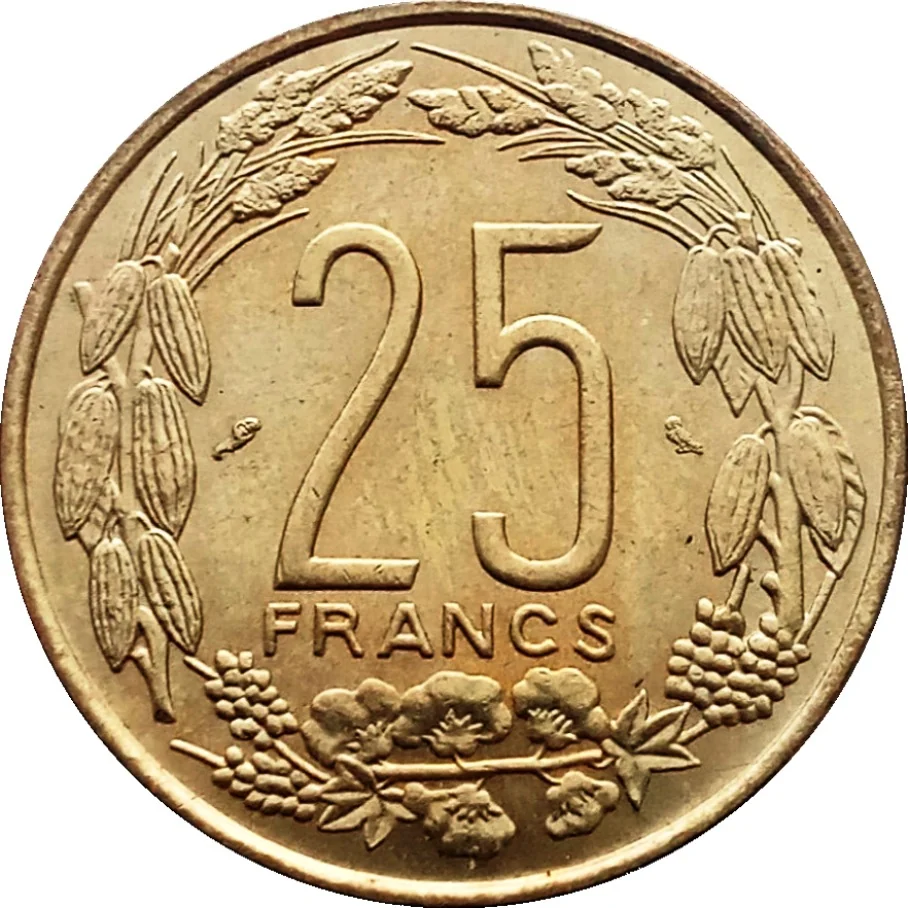
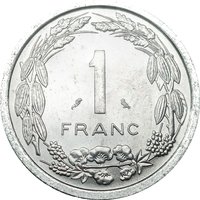
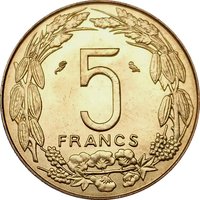
Wreath of major Cameroonian crops: cotton, coffee, cocoa, and grains.
Inscription:
25
FRANCS
FRANCS
Script: Latin
Engravers: Gabriel Bernard, Lucien Bazor
Edge
Plain
Categories
| Agriculture |
| Symbol> Wreath |
Mints
| Name | Mark |
|---|---|
| Monnaie de Paris | — |
Mintings
| Year | Mint Mark | Mintage | Quality | Collection |
|---|---|---|---|---|
| 1970 | — | 3,019,200 | ||
| 1972 | — | 5,016,000 |
Historical background
In 1970, the currency situation in the Central African States was defined by the newly established Central African CFA franc (XAF), which had come into existence just a decade earlier. This currency was created in 1959 as the franc of the Communauté Financière Africaine for the newly independent former French colonies of the region: Chad, the Central African Republic, the Congo (Brazzaville), and Gabon (with Cameroon joining shortly after). The key feature of this monetary system was its fixed parity and guaranteed convertibility, as the CFA franc was pegged to the French franc at a rate of 1 French franc = 50 CFA francs. This arrangement provided monetary stability and facilitated trade with France, but it also meant that monetary policy was effectively outsourced, with the issuing bank, the Banque Centrale des États de l'Afrique Équatoriale et du Cameroun (BCEAEC), operating under strict rules regarding foreign exchange reserves held in the French Treasury.
The year 1970 fell within a period of relative stability for the currency, but it was also a time of underlying political and economic tension regarding sovereignty. The fixed peg, while ensuring low inflation and access to hard currency, limited the member states' ability to use devaluation as a tool to boost competitiveness. Furthermore, the system required the pooling of foreign reserves, which led to disputes among members with differing economic fortunes—notably between oil-rich Gabon and the poorer, landlocked nations like Chad and the Central African Republic. The institutional framework itself was in a state of evolution, as the BCEAEC was soon to be replaced in 1973 by the Banque des États de l'Afrique Centrale (BEAC), reflecting a desire for greater regional management, though the essential guarantee from France remained.
Thus, the currency situation in 1970 was one of a stable but externally anchored monetary union. It provided a crucial framework for these young nations, shielding them from the volatility experienced by some of their neighbors, but it also embedded a enduring economic dependency on France. The system fostered regional integration among the member states, yet the debates over monetary sovereignty and equitable benefits that began in this era would continue for decades to come.
The year 1970 fell within a period of relative stability for the currency, but it was also a time of underlying political and economic tension regarding sovereignty. The fixed peg, while ensuring low inflation and access to hard currency, limited the member states' ability to use devaluation as a tool to boost competitiveness. Furthermore, the system required the pooling of foreign reserves, which led to disputes among members with differing economic fortunes—notably between oil-rich Gabon and the poorer, landlocked nations like Chad and the Central African Republic. The institutional framework itself was in a state of evolution, as the BCEAEC was soon to be replaced in 1973 by the Banque des États de l'Afrique Centrale (BEAC), reflecting a desire for greater regional management, though the essential guarantee from France remained.
Thus, the currency situation in 1970 was one of a stable but externally anchored monetary union. It provided a crucial framework for these young nations, shielding them from the volatility experienced by some of their neighbors, but it also embedded a enduring economic dependency on France. The system fostered regional integration among the member states, yet the debates over monetary sovereignty and equitable benefits that began in this era would continue for decades to come.
🌱 Common