

50 Pence – United Kingdom
United Kingdom
Context
Years: 1969–1981
Issuer: United Kingdom 
Ruler: Elizabeth II
Currency:
(since 1971)
Demonetization: 28 February 1998
Total mintage: 596,320,400
Material
Diameter: 30 mm
Weight: 13.5 g
Thickness: 2.45 mm
Shape: Equilateral curve heptagon
Technique: Milled
Alignment: Medal alignment
flip
References
KM: #Click to copy to clipboard913
Numista: #880
Value
Exchange value: 0.50 GBP = $0.68
Inflation-adjusted value: 11.08 GBP
Obverse
Description:
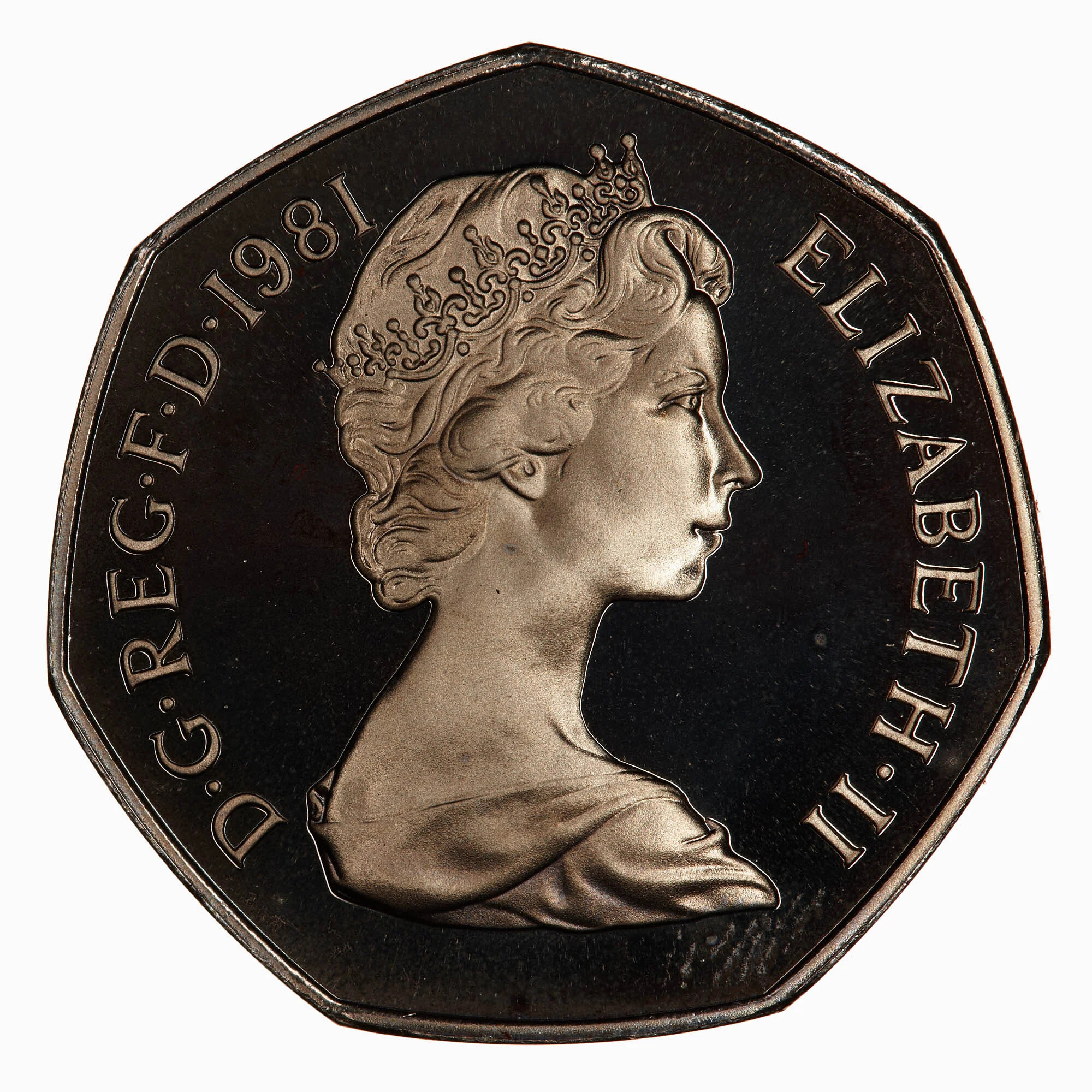
Queen Elizabeth II facing right, wearing the Girls of Great Britain and Ireland tiara.
Inscription:
ELIZABETH·II D·G·REG·F·D·1969
Translation:
Elizabeth the Second, by the Grace of God, Queen, Defender of the Faith, 1969
Script: Latin
Language: Latin
Designer: Arnold Machin
Reverse
Description:
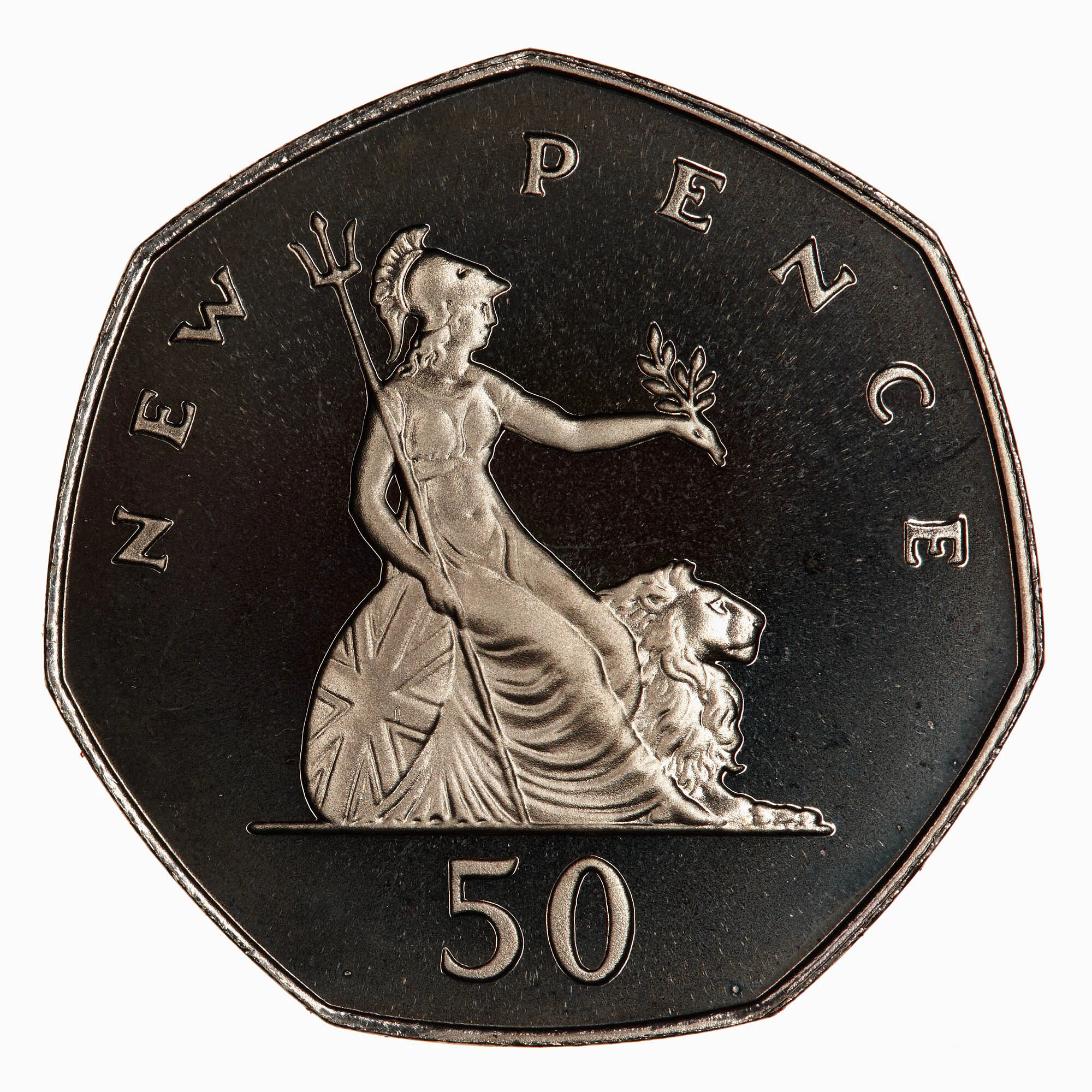
Britannia seated beside a lion, holding a trident and olive branch, with a shield at her side. Denomination below, legend above.
Inscription:
NEW PENCE
50
50
Script: Latin
Designer: Christopher Ironside
Edge
Plain
Mints
| Name | Mark |
|---|---|
| Royal Mint (Tower Hill) | — |
| Royal Mint | — |
Mintings
| Year | Mint Mark | Mintage | Quality | Collection |
|---|---|---|---|---|
| 1969 | — | 188,400,000 | ||
| 1970 | — | 19,461,000 | ||
| 1971 | — | 350,000 | Proof | |
| 1972 | — | 150,000 | Proof | |
| 1974 | — | 100,000 | Proof | |
| 1975 | — | 100,000 | Proof | |
| 1976 | — | 43,746,500 | ||
| 1976 | — | 100,000 | Proof | |
| 1977 | — | 49,536,000 | ||
| 1977 | — | 193,000 | Proof | |
| 1978 | — | 72,005,500 | ||
| 1978 | — | 86,100 | Proof | |
| 1979 | — | 58,680,000 | ||
| 1979 | — | 81,000 | Proof | |
| 1980 | — | 89,086,000 | ||
| 1980 | — | 143,000 | Proof | |
| 1981 | — | 74,002,000 | ||
| 1981 | — | 100,300 | Proof |
Historical background
In 1969, the United Kingdom’s currency situation was dominated by the protracted defence of the sterling exchange rate and the ongoing consequences of the 1967 devaluation. The pound had been devalued from $2.80 to $2.40 in November 1967, a humiliating moment for the Labour government under Harold Wilson, which had long pledged to avoid such a move. The primary goal throughout 1969 was to restore international confidence in sterling, achieve a balance of payments surplus, and rebuild the nation's depleted foreign exchange reserves. This was pursued through a policy of severe fiscal austerity and tight credit, overseen by Chancellor of the Exchequer Roy Jenkins, who implemented significant spending cuts and tax increases to curb domestic demand and reduce the import bill.
The year saw intense pressure from the sterling balances—large holdings of pounds by foreign governments and institutions, particularly within the Commonwealth. These balances represented a constant threat of sudden withdrawal that could trigger another crisis. To manage this vulnerability, the UK government relied heavily on a network of central bank swap lines and a standing credit facility from the International Monetary Fund (IMF), creating a fragile safety net. Domestically, the stringent economic policies succeeded in generating a modest current account surplus by year's end, but at a high social cost, contributing to rising unemployment and industrial unrest.
Ultimately, 1969 was a year of painful consolidation, marking a transitional phase between the shock of devaluation and the hoped-for stability. While the immediate balance of payments crisis was alleviated, the underlying structural weaknesses of the UK economy—including comparative industrial decline and the sterling's role as a reserve currency—remained unresolved. The temporary stability achieved set the stage for the sterling's eventual float in 1972 and the broader move towards decimalisation, which was legislated for and actively prepared for throughout 1969 ahead of its implementation in 1971.
The year saw intense pressure from the sterling balances—large holdings of pounds by foreign governments and institutions, particularly within the Commonwealth. These balances represented a constant threat of sudden withdrawal that could trigger another crisis. To manage this vulnerability, the UK government relied heavily on a network of central bank swap lines and a standing credit facility from the International Monetary Fund (IMF), creating a fragile safety net. Domestically, the stringent economic policies succeeded in generating a modest current account surplus by year's end, but at a high social cost, contributing to rising unemployment and industrial unrest.
Ultimately, 1969 was a year of painful consolidation, marking a transitional phase between the shock of devaluation and the hoped-for stability. While the immediate balance of payments crisis was alleviated, the underlying structural weaknesses of the UK economy—including comparative industrial decline and the sterling's role as a reserve currency—remained unresolved. The temporary stability achieved set the stage for the sterling's eventual float in 1972 and the broader move towards decimalisation, which was legislated for and actively prepared for throughout 1969 ahead of its implementation in 1971.
🌱 Very Common