

½ Penny – United Kingdom
United Kingdom
Context
Years: 1971–1981
Issuer: United Kingdom 
Ruler: Elizabeth II
Currency:
(since 1971)
Demonetization: 31 December 1984
Total mintage: 3,337,482,860
Material
References
KM: #Click to copy to clipboard914
Numista: #856
Value
Exchange value: 0.005 GBP = $0.01
Inflation-adjusted value: 0.10 GBP
Obverse
Description:
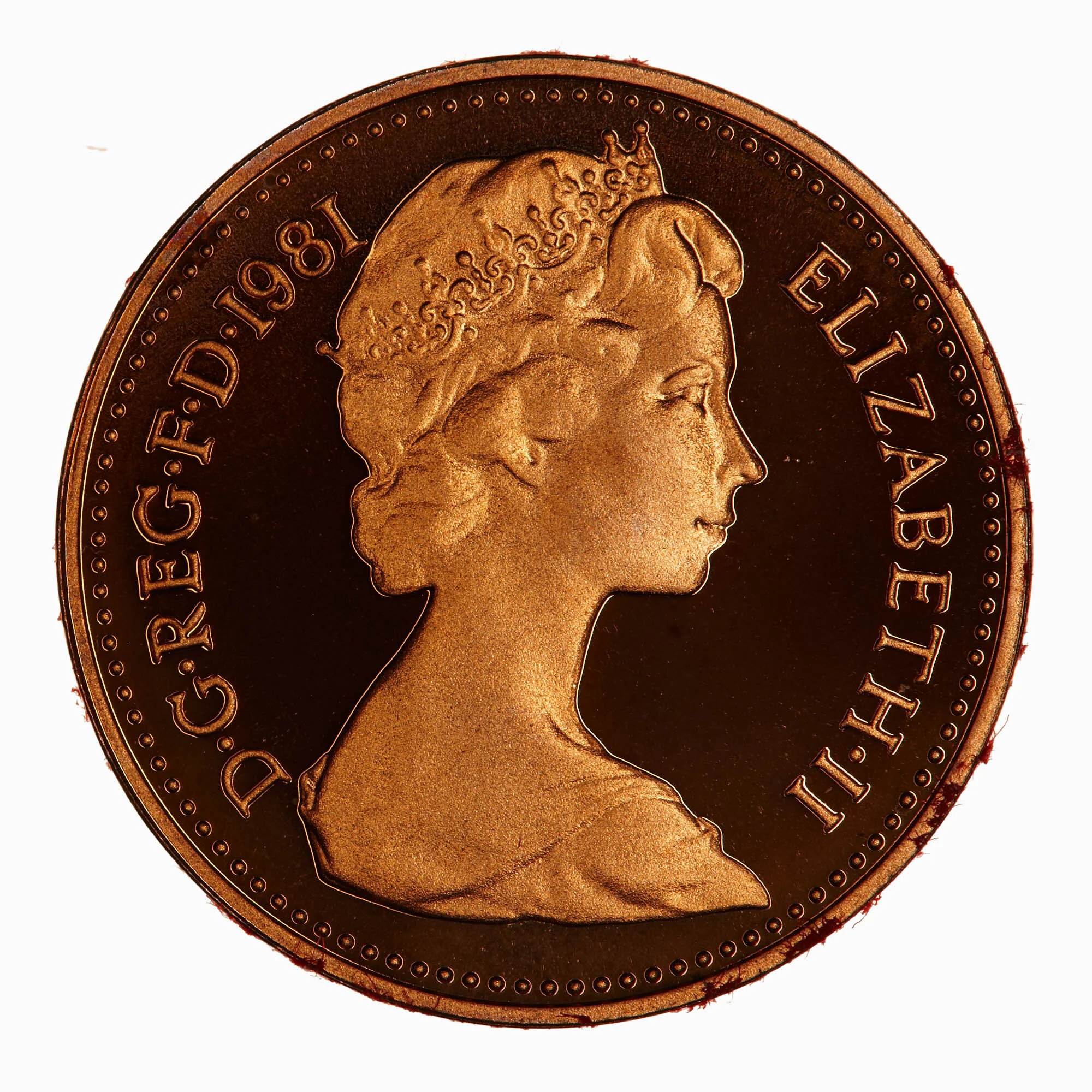
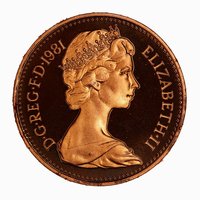
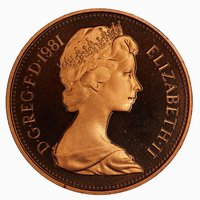
Queen Elizabeth II facing right, wearing the Girls of Great Britain and Ireland tiara.
Inscription:
ELIZABETH·II D·G·REG·F·D·1971
Translation:
Elizabeth II, by the Grace of God, Queen, Defender of the Faith, 1971
Script: Latin
Language: Latin
Designer: Arnold Machin
Reverse
Description:
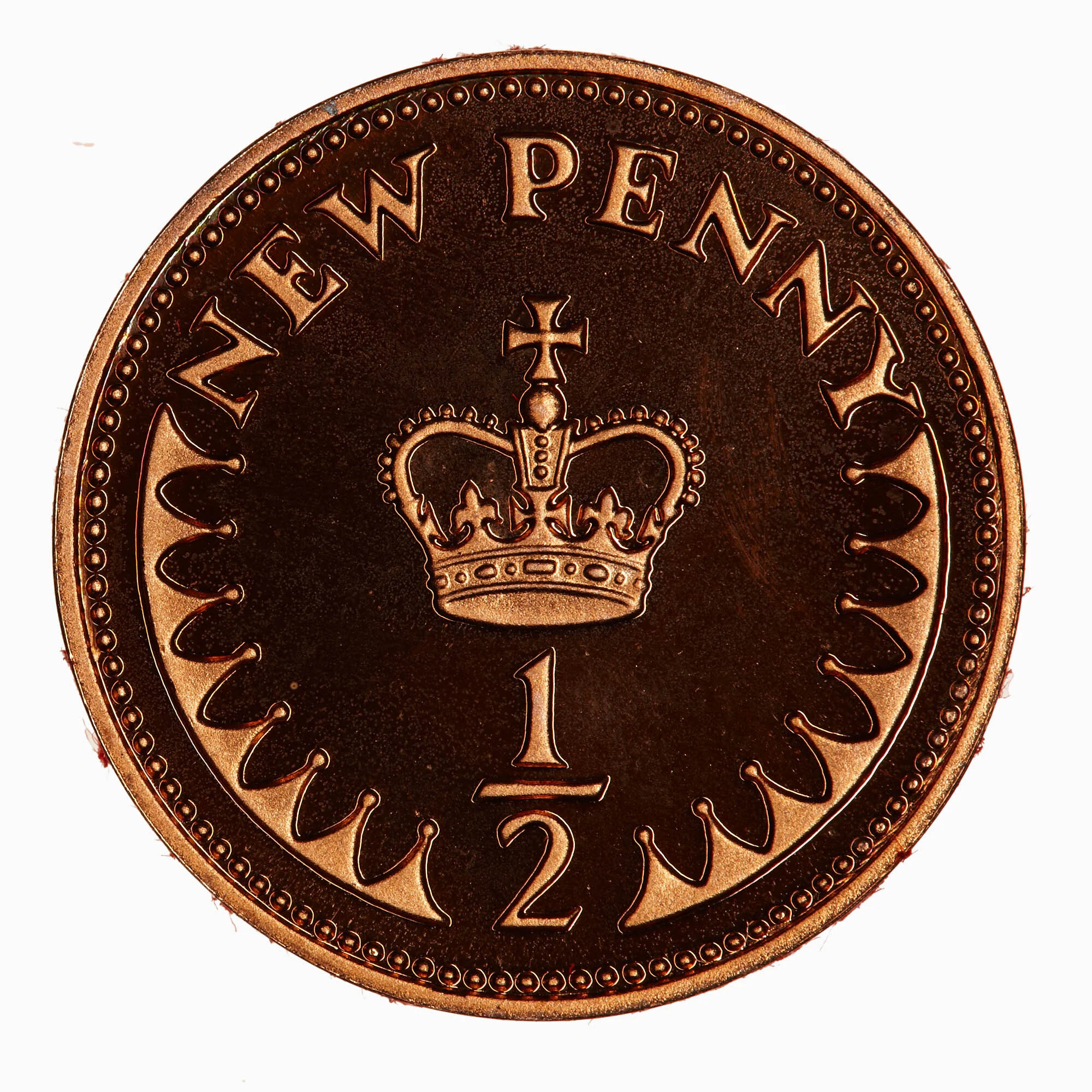
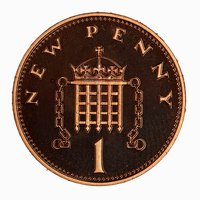
St. Edward's Crown, with lettered denomination above and numerals below.
Inscription:
NEW PENNY
½
½
Script: Latin
Designer: Christopher Ironside
Edge
Plain
Mints
| Name | Mark |
|---|---|
| Royal Mint | — |
Mintings
| Year | Mint Mark | Mintage | Quality | Collection |
|---|---|---|---|---|
| 1971 | — | 1,394,188,250 | ||
| 1971 | — | 6,323,210 | BU | |
| 1971 | — | 350,000 | Proof | |
| 1972 | — | 150,000 | Proof | |
| 1973 | — | 100,000 | Proof | |
| 1973 | — | 365,680,000 | ||
| 1974 | — | 365,448,000 | ||
| 1974 | — | 100,000 | Proof | |
| 1975 | — | 197,600,000 | ||
| 1975 | — | 100,000 | Proof | |
| 1976 | — | 412,172,000 | ||
| 1976 | — | 100,000 | Proof | |
| 1977 | — | 193,000 | Proof | |
| 1977 | — | 66,368,000 | ||
| 1978 | — | 59,532,000 | ||
| 1978 | — | 86,100 | Proof | |
| 1979 | — | 219,132,000 | ||
| 1979 | — | 81,000 | Proof | |
| 1980 | — | 143,000 | Proof | |
| 1980 | — | 202,788,000 | ||
| 1981 | — | 46,748,000 | ||
| 1981 | — | 100,300 | Proof |
Historical background
In 1971, the United Kingdom stood at a pivotal moment in its monetary history, transitioning from a complex and archaic system to a modern decimal currency. For centuries, the nation had used the £sd system (pounds, shillings, and pence), where one pound equalled 20 shillings and one shilling equalled 12 pence. This system, while deeply ingrained in British life, was cumbersome for calculation and out of step with the decimal systems used by most of the world and its major trading partners. The move towards decimalisation had been formally planned since the 1960s, with the Decimal Currency Act of 1969 setting the stage for a complete changeover.
The long-anticipated change, known as "Decimal Day" or "D-Day," arrived on 15 February 1971. On this day, the new decimal pound was introduced, divided into 100 new pence. The familiar shilling was phased out, and a range of new coins entered circulation, including the ½p, 1p, 2p, 5p, 10p, and 50p pieces. The transition was a massive logistical undertaking, involving the banking sector, retailers, and the public, and was supported by a major public information campaign. Notably, the new 5p and 10p coins were initially identical in size and value to the old shilling and two-shilling (florin) coins to aid acceptance.
The broader economic context of 1971 was one of significant strain. The UK was grappling with persistent inflation, rising unemployment, and industrial unrest. The Bretton Woods system of fixed exchange rates was collapsing, and in August 1971, US President Nixon suspended the dollar's convertibility to gold, triggering global monetary instability. Domestically, the decimal changeover itself was suspected by some of contributing to price inflation, as many businesses were accused of using the conversion as an opportunity to round prices up. Thus, the currency reform of 1971 occurred against a backdrop of both modernising ambition and profound economic uncertainty.
The long-anticipated change, known as "Decimal Day" or "D-Day," arrived on 15 February 1971. On this day, the new decimal pound was introduced, divided into 100 new pence. The familiar shilling was phased out, and a range of new coins entered circulation, including the ½p, 1p, 2p, 5p, 10p, and 50p pieces. The transition was a massive logistical undertaking, involving the banking sector, retailers, and the public, and was supported by a major public information campaign. Notably, the new 5p and 10p coins were initially identical in size and value to the old shilling and two-shilling (florin) coins to aid acceptance.
The broader economic context of 1971 was one of significant strain. The UK was grappling with persistent inflation, rising unemployment, and industrial unrest. The Bretton Woods system of fixed exchange rates was collapsing, and in August 1971, US President Nixon suspended the dollar's convertibility to gold, triggering global monetary instability. Domestically, the decimal changeover itself was suspected by some of contributing to price inflation, as many businesses were accused of using the conversion as an opportunity to round prices up. Thus, the currency reform of 1971 occurred against a backdrop of both modernising ambition and profound economic uncertainty.
🌱 Very Common