

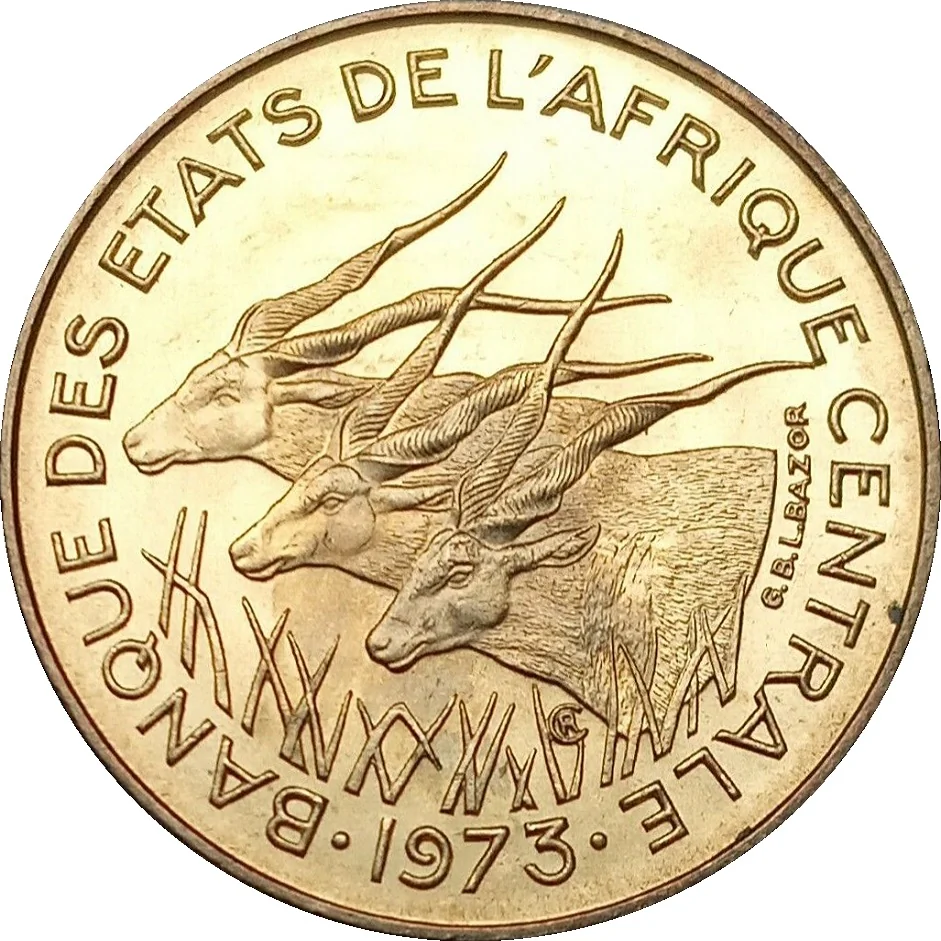
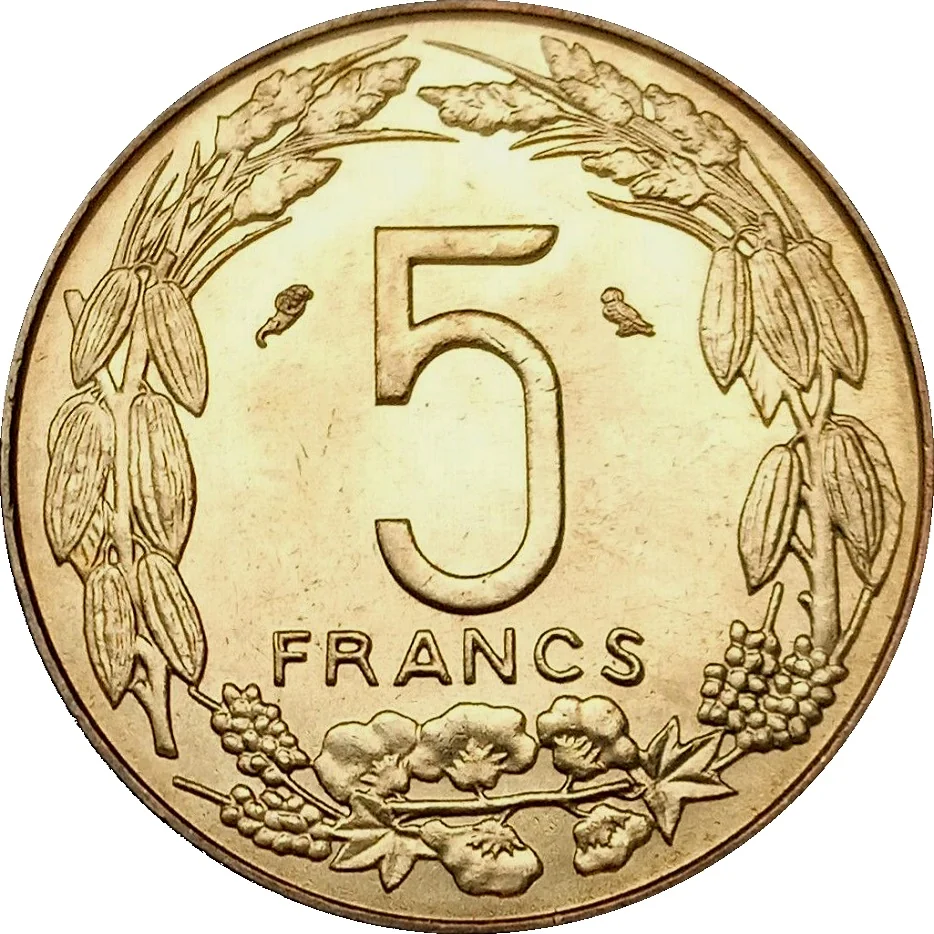
5 francs cfa – Central African States
Add to wishlist
Context
Years: 1973–2003
Issuer: Central African States
Issuing organization: Bank of Central African States
Currency:
(since 1973)
Total mintage: 220,710,000
Material
Diameter: 20 mm
Weight: 3 g
Thickness: 1.47 mm
Shape: Round
Composition: Aluminium bronze
Magnetic: No
Technique: Milled
Alignment: Coin alignment
flip
References
KM: #
Numista: #1803
Value
Exchange value: 5 XAF
Obverse
Reverse
Edge
Plain
Categories
| Agriculture |
| Animal> Cow |
Mints
| Name | Mark |
|---|---|
| Monnaie de Paris | — |
Mintings
| Year | Mint Mark | Mintage | Quality | Collection |
|---|---|---|---|---|
| 1973 | — | 26,000,000 | ||
| 1975 | — | 26,010,000 | ||
| 1976 | — | 6,000,000 | ||
| 1977 | — | 8,000,000 | ||
| 1978 | — | 13,300,000 | ||
| 1979 | — | 8,700,000 | ||
| 1980 | — | 1,000,000 | ||
| 1981 | — | 9,500,000 | ||
| 1982 | — | 7,000,000 | ||
| 1983 | — | 37,000,000 | ||
| 1984 | — | 16,200,000 | ||
| 1985 | — | 17,000,000 | ||
| 1992 | — | 8,500,000 | ||
| 1996 | — | 3,500,000 | ||
| 1998 | — | 13,000,000 | ||
| 2003 | — | 20,000,000 |
Historical background
In 1973, the currency situation in the Central African States was defined by the operations of the Central African Monetary Union (UMAC) and its shared currency, the CFA franc. This currency, created in 1945 as the "Colonies Françaises d'Afrique" franc, was by this time used by five member states: Chad, the Central African Republic, Congo-Brazzaville, Gabon, and Cameroon (though Cameroon had a separate issuing bank, the two currencies were technically interchangeable). The system was fundamentally underpinned by a fixed and guaranteed parity with the French franc, set at 1 French franc = 50 CFA francs. This arrangement provided monetary stability and facilitated trade with France, but it also meant that the member states ceded control over their monetary policy to France, which held the foreign exchange reserves and guaranteed convertibility.
The year 1973 was particularly significant as it marked a major institutional reform with the signing of the Treaty establishing the Monetary Cooperation with France on November 23. This treaty replaced the original 1960 accords and led to the creation of the Bank of Central African States (BEAC) in 1974, which took over from the older Central Bank of Equatorial Africa and Cameroon. While the fixed parity and guarantee from the French Treasury remained, the reform aimed to give member states greater, though still limited, administrative influence within the new central bank's governance. The CFA franc zone was thus reaffirmed and modernized during this period, solidifying its structure for decades to come.
Economically, the currency's fixed parity and free convertibility were double-edged swords. It provided a shield against inflation and attracted foreign investment, particularly benefiting resource-exporting members like Gabon and Congo. However, it also constrained the region's ability to devalue its currency to boost competitiveness, locking its economies into a framework aligned with French economic priorities. Furthermore, the requirement to deposit a significant portion of foreign reserves with the French Treasury was a point of contention, criticized by some as a continuation of colonial-era financial control. Thus, in 1973, the currency situation was one of entrenched stability and dependency, undergoing a key administrative transition while its core controversial principles remained firmly intact.
The year 1973 was particularly significant as it marked a major institutional reform with the signing of the Treaty establishing the Monetary Cooperation with France on November 23. This treaty replaced the original 1960 accords and led to the creation of the Bank of Central African States (BEAC) in 1974, which took over from the older Central Bank of Equatorial Africa and Cameroon. While the fixed parity and guarantee from the French Treasury remained, the reform aimed to give member states greater, though still limited, administrative influence within the new central bank's governance. The CFA franc zone was thus reaffirmed and modernized during this period, solidifying its structure for decades to come.
Economically, the currency's fixed parity and free convertibility were double-edged swords. It provided a shield against inflation and attracted foreign investment, particularly benefiting resource-exporting members like Gabon and Congo. However, it also constrained the region's ability to devalue its currency to boost competitiveness, locking its economies into a framework aligned with French economic priorities. Furthermore, the requirement to deposit a significant portion of foreign reserves with the French Treasury was a point of contention, criticized by some as a continuation of colonial-era financial control. Thus, in 1973, the currency situation was one of entrenched stability and dependency, undergoing a key administrative transition while its core controversial principles remained firmly intact.
🌱 Very Common