

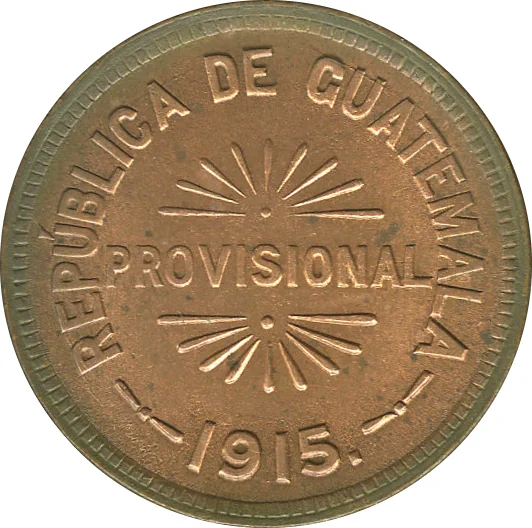
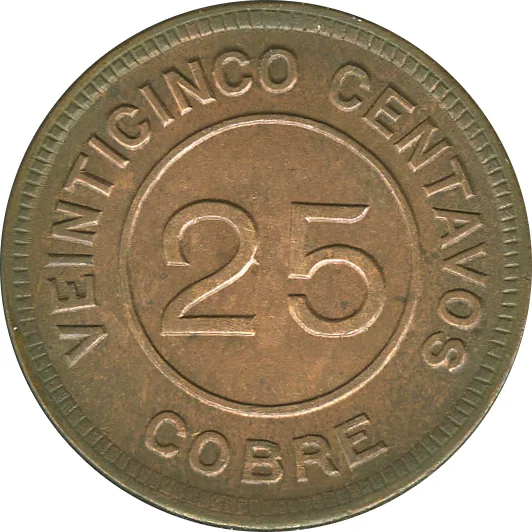
25 Centavos – Guatemala
Guatemala
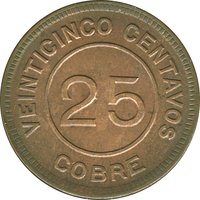
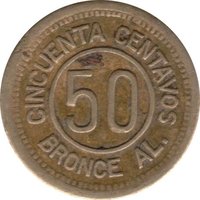
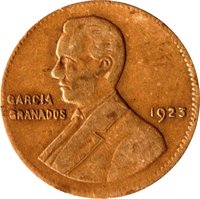
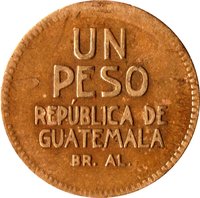
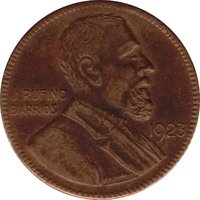
Obverse
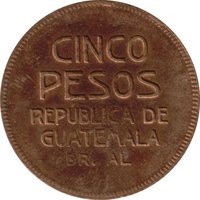
Reverse
Edge
Plain
Mints
| Name | Mark |
|---|---|
| Casa de Moneda de Guatemala | — |
Mintings
| Year | Mint Mark | Mintage | Quality | Collection |
|---|---|---|---|---|
| 1915 | — | 4,000,000 |
Historical background
In 1915, Guatemala’s currency situation was defined by a dual system of silver and paper money, a legacy of the late 19th century. The primary unit was the silver peso, which was subdivided into 100 centavos. However, the nation's monetary landscape was dominated by the paper peso, issued by private banks, most notably the Banco de Guatemala (a private institution, not the modern central bank) and the Banco Internacional. These banknotes were not fully backed by specie, leading to a fluctuating and often discounted value against the silver coin. This created a persistent public distrust in paper money, as its worth was unstable and dependent on the issuing bank's credibility.
The system was fundamentally unstable due to a lack of centralized control and insufficient metallic reserves. The government of President Manuel Estrada Cabrera (in power since 1898) operated under a liberal economic model that favored private banks, but it failed to enforce strict regulations on note issuance. Consequently, the paper peso circulated at a significant discount to the silver peso, sometimes as high as 50%, causing price distortions and complicating trade. This disparity effectively created two parallel economies: one for hard currency used in foreign trade and large transactions, and another for depreciating paper used in everyday local commerce.
This fragmented monetary environment posed significant challenges for both the domestic economy and international trade. Guatemala's key exports, coffee and bananas, were traded on global markets requiring stable currency for exchange. The silver peso, tied to the international silver standard, provided this stability, but its physical scarcity was a constant problem. The situation in 1915 was therefore one of transition and pressure, setting the stage for future reforms. It would ultimately lead, years later, to the creation of a national central bank (the Banco Central de Guatemala in 1926) and the introduction of a new gold-standard currency, the quetzal, in 1925 to unify and stabilize the monetary system.
The system was fundamentally unstable due to a lack of centralized control and insufficient metallic reserves. The government of President Manuel Estrada Cabrera (in power since 1898) operated under a liberal economic model that favored private banks, but it failed to enforce strict regulations on note issuance. Consequently, the paper peso circulated at a significant discount to the silver peso, sometimes as high as 50%, causing price distortions and complicating trade. This disparity effectively created two parallel economies: one for hard currency used in foreign trade and large transactions, and another for depreciating paper used in everyday local commerce.
This fragmented monetary environment posed significant challenges for both the domestic economy and international trade. Guatemala's key exports, coffee and bananas, were traded on global markets requiring stable currency for exchange. The silver peso, tied to the international silver standard, provided this stability, but its physical scarcity was a constant problem. The situation in 1915 was therefore one of transition and pressure, setting the stage for future reforms. It would ultimately lead, years later, to the creation of a national central bank (the Banco Central de Guatemala in 1926) and the introduction of a new gold-standard currency, the quetzal, in 1925 to unify and stabilize the monetary system.
Series: Provisional Series

🌟 Uncommon