

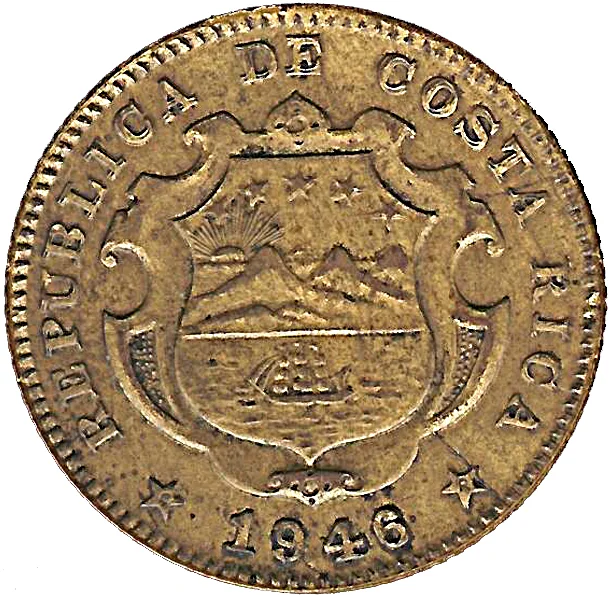
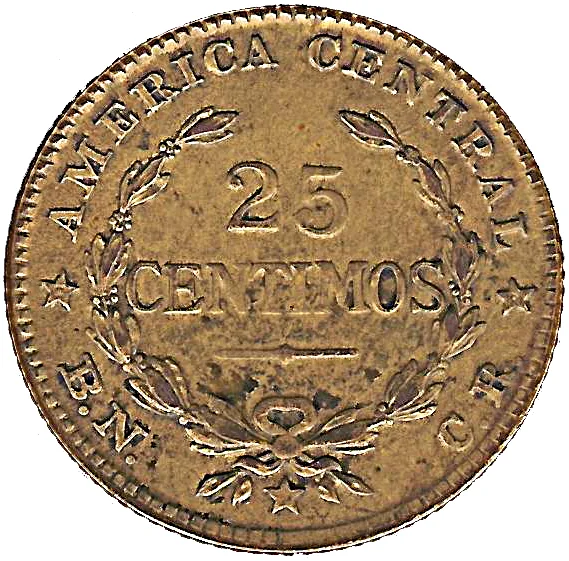
25 centimos – Costa Rica
Add to wishlist
Costa Rica
Context
Years: 1944–1946
Issuer: Costa Rica
Issuing organization: Banco National de Costa Rica
Period:
(1848—1948)
Currency:
(since 1896)
Demonetized: Yes
Total mintage: 3,200,000
Material
References
KM: #
Numista: #8749
Value
Exchange value: 0.25 CRC
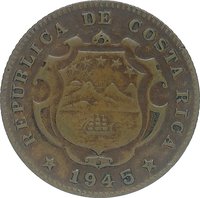
Obverse
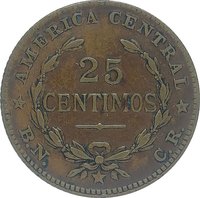
Reverse
Edge
Categories
| Symbols> Coat of Arms |
| Symbol> Wreath |
Mints
| Name | Mark |
|---|---|
| Casa Nacional de Moneda de Costa Rica | — |
Mintings
| Year | Mint Mark | Mintage | Quality | Collection |
|---|---|---|---|---|
| 1944 | BN | 800,000 | ||
| 1945 | BN | 1,200,000 | ||
| 1946 | BN | 1,200,000 |
Historical background
In 1944, Costa Rica's currency situation was characterized by the dominance of the colón, which had been established as the national currency in 1896, replacing the Costa Rican peso. The colón was pegged to the British pound sterling until 1932, after which it was pegged to the United States dollar at a fixed rate of 5.60 colones to 1 USD. This dollar peg, managed by the International Banking Department (a precursor to the Central Bank), provided a degree of stability during the volatile war years. However, this stability was somewhat artificial and maintained through exchange controls and restrictions on foreign currency transactions, as global economic conditions were heavily disrupted by World War II.
The wartime economy created significant pressures. Costa Rica, like other Latin American nations, experienced inflationary pressures due to increased demand for its agricultural exports (like coffee and bananas) and simultaneous shortages of imported manufactured goods. While export earnings grew, the scarcity of consumer and capital goods led to rising domestic prices. The government's adherence to the fixed exchange rate, while stabilizing for trade accounting, strained foreign reserves and limited monetary policy tools to address internal economic imbalances. Furthermore, the reliance on the U.S. dollar as an anchor tied Costa Rica's monetary conditions directly to those of the United States.
This period set the stage for major post-war financial reform. The limitations of the existing system, combined with a regional trend toward stronger economic institutions, culminated in the creation of the Central Bank of Costa Rica (BCCR) in 1950. The reforms of the late 1940s and early 1950s were a direct response to the constraints experienced in the 1940s, seeking to provide the country with a more autonomous and flexible monetary authority to better manage the currency, reserves, and credit in pursuit of national development goals. Thus, 1944 represents a point within a controlled but strained pre-central banking system on the cusp of significant change.
The wartime economy created significant pressures. Costa Rica, like other Latin American nations, experienced inflationary pressures due to increased demand for its agricultural exports (like coffee and bananas) and simultaneous shortages of imported manufactured goods. While export earnings grew, the scarcity of consumer and capital goods led to rising domestic prices. The government's adherence to the fixed exchange rate, while stabilizing for trade accounting, strained foreign reserves and limited monetary policy tools to address internal economic imbalances. Furthermore, the reliance on the U.S. dollar as an anchor tied Costa Rica's monetary conditions directly to those of the United States.
This period set the stage for major post-war financial reform. The limitations of the existing system, combined with a regional trend toward stronger economic institutions, culminated in the creation of the Central Bank of Costa Rica (BCCR) in 1950. The reforms of the late 1940s and early 1950s were a direct response to the constraints experienced in the 1940s, seeking to provide the country with a more autonomous and flexible monetary authority to better manage the currency, reserves, and credit in pursuit of national development goals. Thus, 1944 represents a point within a controlled but strained pre-central banking system on the cusp of significant change.
🌱 Fairly Common