

10 Centavos – Costa Rica
Costa Rica
Context
Year: 1875
Issuer: Costa Rica 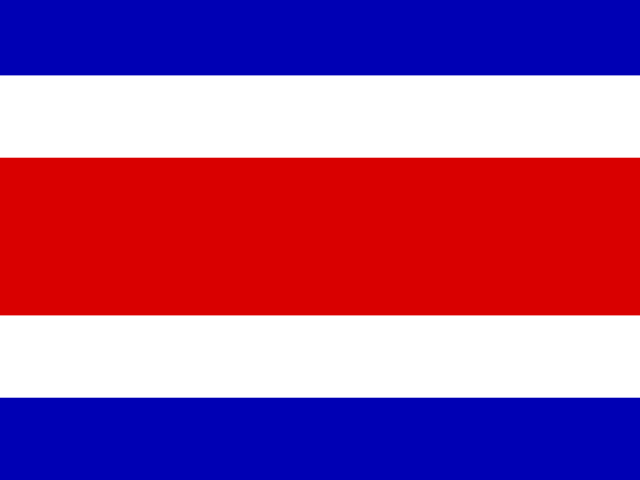
Period:
(1848—1948)
Currency:
(1863—1896)
Demonetization: 24 October 1896
Total mintage: 266,486
Material
References
KM: #Click to copy to clipboard121
Numista: #8745
Value
Bullion value: $5.36
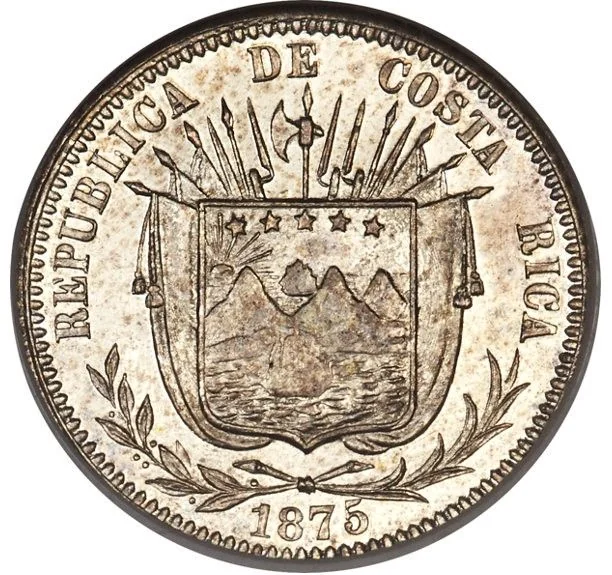
Obverse
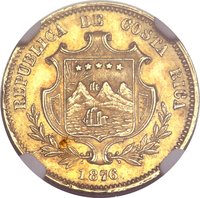
Description:
Coat of arms with wreath, legend above and date below.
Inscription:
REPUBLICA DE COSTA RICA
1875
1875
Translation:
REPUBLIC OF COSTA RICA
1875
1875
Script: Latin
Language: Spanish
Engraver: Guillermo Witting
Reverse
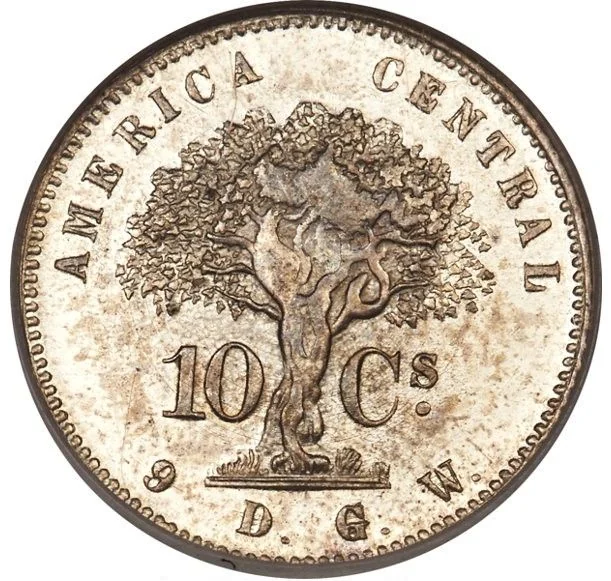
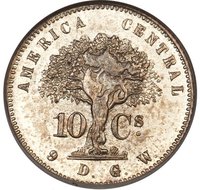
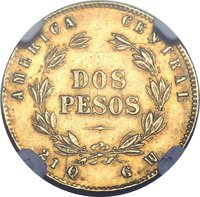
Description:
Tree divides value.
Legend above.
Fineness and initials below.
Legend above.
Fineness and initials below.
Inscription:
AMERICA CENTRAL
10 CS.
9 D. G. W.
10 CS.
9 D. G. W.
Translation:
UNITED STATES OF CENTRAL AMERICA
10 Centavos
By the Grace of God and the Constitution
10 Centavos
By the Grace of God and the Constitution
Script: Latin
Language: Spanish
Engraver: Guillermo Witting
Edge
Categories
| Symbols> Coat of Arms |
| Plant> Tree |
Mints
| Name | Mark |
|---|---|
| Casa Nacional de Moneda de Costa Rica | — |
Mintings
| Year | Mint Mark | Mintage | Quality | Collection |
|---|---|---|---|---|
| 1875 | — | 266,486 |
Historical background
In 1875, Costa Rica's currency system was in a state of transition and confusion, characterized by the circulation of multiple, often devalued, foreign coins alongside limited domestic minting. The primary legal tender was the silver peso, divided into 8 reales, but the most commonly used coin in daily transactions was the peso fuerte, a silver coin of varying foreign origin. However, the most impactful currency in circulation was the Chilean peso, a debased silver coin that had flooded Central America. Its intrinsic silver content was lower than its face value, leading to Gresham's Law in action: "bad money drives out good." People hoarded the older, purer silver coins, while the inferior Chilean pesos circulated widely, causing inflation and undermining public confidence in the monetary system.
This chaotic situation was a direct legacy of Costa Rica's colonial past and its early post-independence economic policies. Following independence, the country lacked its own mint until 1835, and even then, production was sporadic. Consequently, it relied heavily on a mix of Spanish colonial coins, coins from other Latin American nations, and even French francs and British sovereigns. The government attempted to assign official exchange rates (tasaciones) to this bewildering array of coins, but these official rates often diverged from market reality. By 1875, the instability was a significant hindrance to both domestic commerce and the critical coffee-export economy, which required stable financial instruments for international trade.
Recognizing the urgent need for reform, the government of President Tomás Guardia was laying the groundwork for a fundamental overhaul. The 1875 period was a precursor to the major monetary reform that would come just two years later, in 1877. That reform would establish the Costa Rican gold colón (named after Christopher Columbus, Cristóbal Colón), pegging it to the gold standard and definitively replacing the silver-based peso system. Thus, the situation in 1875 represents the final, problematic chapter of the old silver peso era, with authorities actively seeking a modern, uniform, and stable national currency to support the country's growing export-oriented economy.
This chaotic situation was a direct legacy of Costa Rica's colonial past and its early post-independence economic policies. Following independence, the country lacked its own mint until 1835, and even then, production was sporadic. Consequently, it relied heavily on a mix of Spanish colonial coins, coins from other Latin American nations, and even French francs and British sovereigns. The government attempted to assign official exchange rates (tasaciones) to this bewildering array of coins, but these official rates often diverged from market reality. By 1875, the instability was a significant hindrance to both domestic commerce and the critical coffee-export economy, which required stable financial instruments for international trade.
Recognizing the urgent need for reform, the government of President Tomás Guardia was laying the groundwork for a fundamental overhaul. The 1875 period was a precursor to the major monetary reform that would come just two years later, in 1877. That reform would establish the Costa Rican gold colón (named after Christopher Columbus, Cristóbal Colón), pegging it to the gold standard and definitively replacing the silver-based peso system. Thus, the situation in 1875 represents the final, problematic chapter of the old silver peso era, with authorities actively seeking a modern, uniform, and stable national currency to support the country's growing export-oriented economy.
⭐ Rare