

2 Pesos – Costa Rica
Costa Rica
Context
Year: 1876
Issuer: Costa Rica 
Period:
(1848—1948)
Currency:
(1863—1896)
Demonetization: 14 August 1900
Total mintage: 2,161
Material
References
KM: #Click to copy to clipboard122
Numista: #49163
Value
Bullion value: $340.99
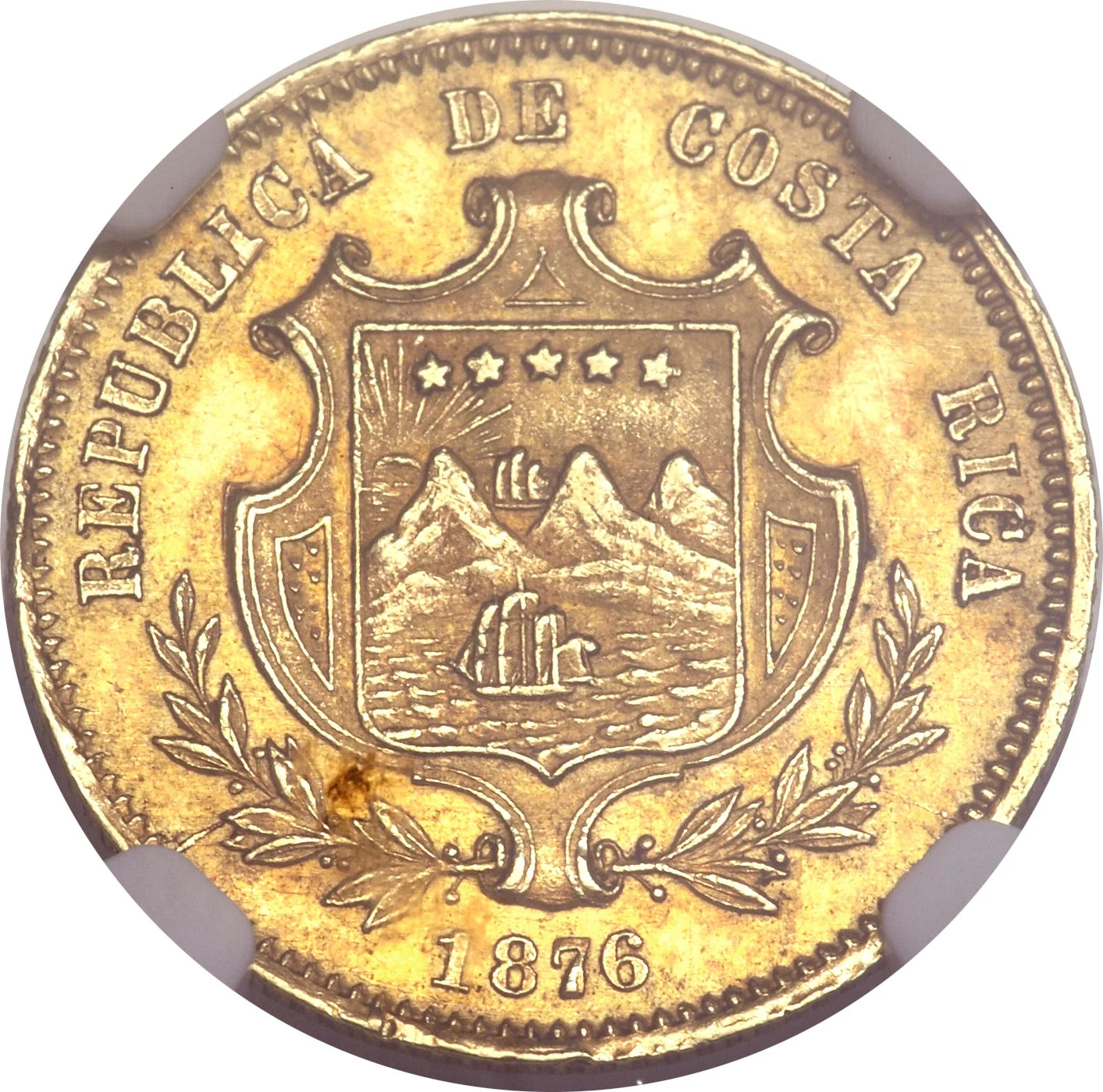
Obverse
Description:
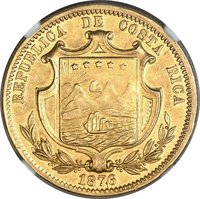
Coat of arms, legend above, date below.
Inscription:
REPUBLICA DE COSTA RICA
1876
1876
Translation:
REPUBLIC OF COSTA RICA
1876
1876
Script: Latin
Language: Spanish
Engraver: Guillermo Witting
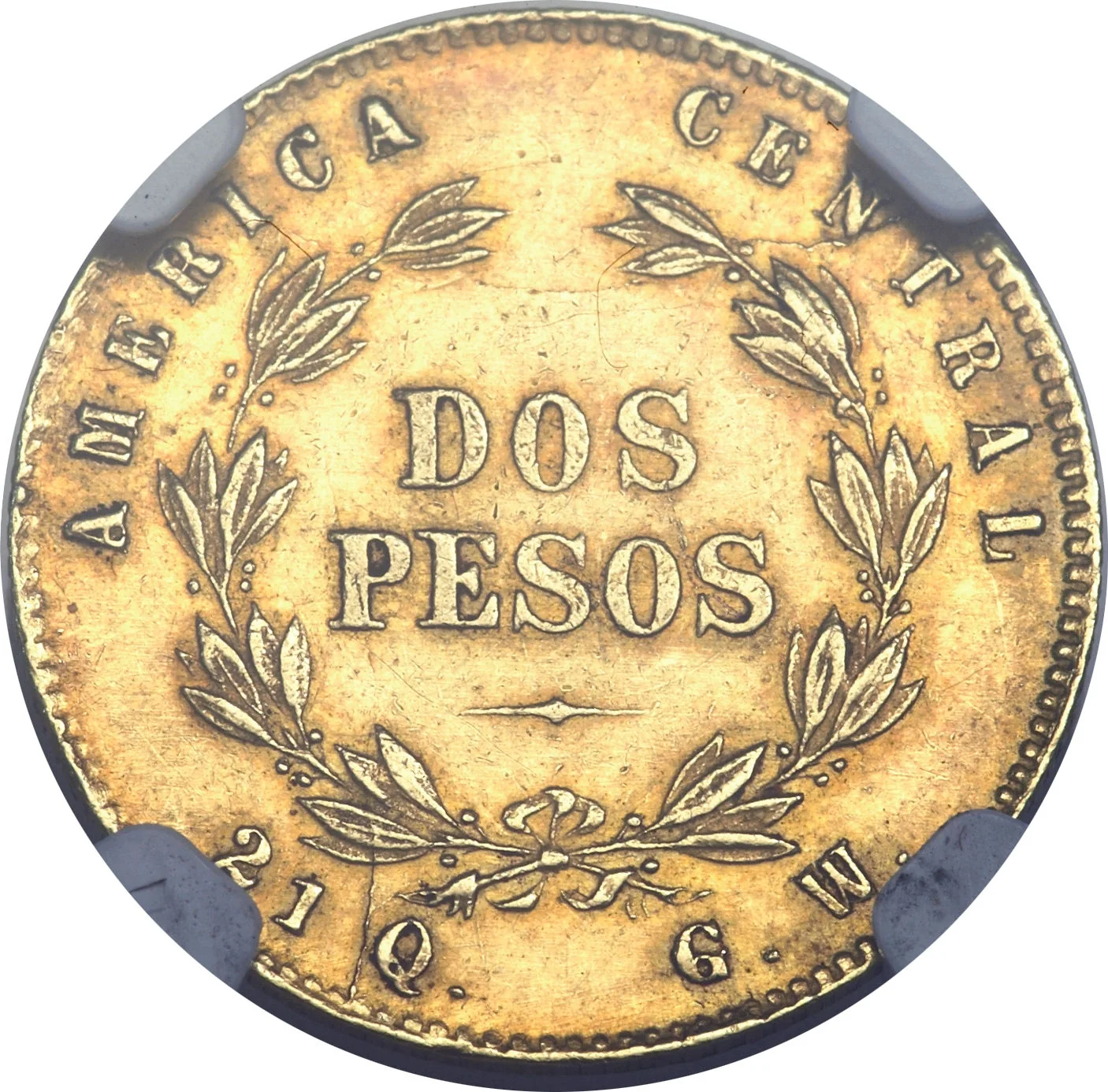
Reverse
Description:
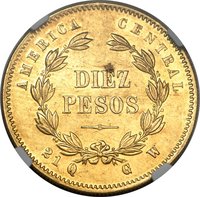
Wreath with value. Top: legend. Bottom: fineness and assayer's initials.
Inscription:
AMERICA CENTRAL
DOS
PESOS
21 Q. G. W.
DOS
PESOS
21 Q. G. W.
Translation:
Central America
Two
Pesos
21 Q. G. W.
Two
Pesos
21 Q. G. W.
Script: Latin
Language: Spanish
Engraver: Guillermo Witting
Edge
Categories
| Symbols> Coat of Arms |
| Symbol> Wreath |
Mints
| Name | Mark |
|---|---|
| Casa Nacional de Moneda de Costa Rica | — |
Mintings
| Year | Mint Mark | Mintage | Quality | Collection |
|---|---|---|---|---|
| 1876 | — | 2,161 |
Historical background
In 1876, Costa Rica's currency situation was characterized by significant instability and complexity, a legacy of its colonial past and the economic policies of the early republic. The country operated on a bimetallic standard in law, but in practice, it suffered from a severe shortage of official coinage. The most common circulating coins were not Costa Rican but rather the silver pesos of neighboring nations, particularly Peru, Bolivia, and Chile, alongside older Spanish colonial coins. This reliance on foreign silver created constant valuation problems, as the fluctuating metallic content and weight of these coins led to confusion in commerce and frequent disputes.
The government, under President Tomás Guardia, was actively attempting to reform the system. A key development was the 1876 contract with the Paris Mint to strike new national silver coins, the peso and its fractional denominations, which would bear the portrait of Guardia himself. This was part of a broader effort to establish a unified, national currency and assert monetary sovereignty. However, these new coins were just beginning to enter circulation and had not yet displaced the heterogeneous mix of foreign silver. Furthermore, paper money, issued by private banks like the Banco Anglo-Costarricense (founded in 1863), was gaining traction but was not yet universally trusted, especially outside the capital.
Consequently, the monetary landscape in 1876 was one of transition and disorder. Merchants and the public had to navigate a daily reality of multiple coin types with varying intrinsic values, while simultaneously adapting to new government-issued silver and private banknotes. This environment hindered economic efficiency and long-term investment. The fundamental challenge was to replace the chaotic plurality of currencies with a single, reliable national system—a goal that the Guardia administration was pursuing but which remained incomplete, leaving the country in a period of monetary flux.
The government, under President Tomás Guardia, was actively attempting to reform the system. A key development was the 1876 contract with the Paris Mint to strike new national silver coins, the peso and its fractional denominations, which would bear the portrait of Guardia himself. This was part of a broader effort to establish a unified, national currency and assert monetary sovereignty. However, these new coins were just beginning to enter circulation and had not yet displaced the heterogeneous mix of foreign silver. Furthermore, paper money, issued by private banks like the Banco Anglo-Costarricense (founded in 1863), was gaining traction but was not yet universally trusted, especially outside the capital.
Consequently, the monetary landscape in 1876 was one of transition and disorder. Merchants and the public had to navigate a daily reality of multiple coin types with varying intrinsic values, while simultaneously adapting to new government-issued silver and private banknotes. This environment hindered economic efficiency and long-term investment. The fundamental challenge was to replace the chaotic plurality of currencies with a single, reliable national system—a goal that the Guardia administration was pursuing but which remained incomplete, leaving the country in a period of monetary flux.
✨ Legendary