

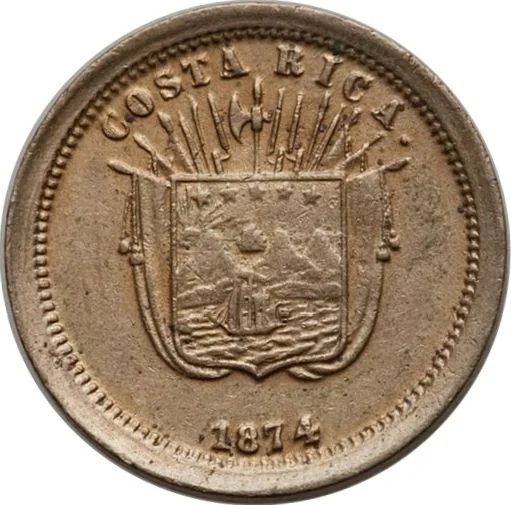
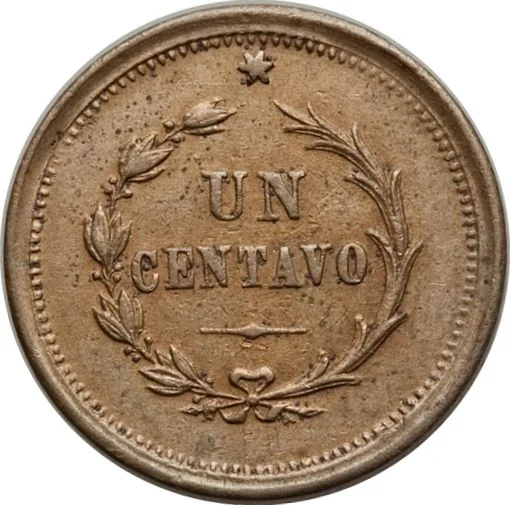
1 centavo – Costa Rica
Add to wishlist
Costa Rica
Context
Year: 1874
Issuer: Costa Rica
Period:
(1848—1948)
Currency:
(1863—1896)
Demonetized: Yes
Total mintage: 30,000
Material
Diameter: 19 mm
Weight: 3.8 g
Thickness: 2 mm
Shape: Round
Composition: Copper-nickel
Technique: Milled
Alignment: Coin alignment
flip
References
KM: #
Numista: #23929
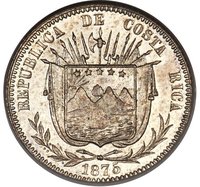
Obverse
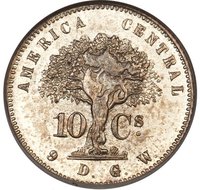
Reverse
Edge
Categories
| Symbols> Coat of Arms |
| Symbol> Wreath |
Mints
| Name | Mark |
|---|---|
| Casa Nacional de Moneda de Costa Rica | — |
Mintings
| Year | Mint Mark | Mintage | Quality | Collection |
|---|---|---|---|---|
| 1874 | — | 30,000 |
Historical background
In 1874, Costa Rica's currency situation was characterized by a complex and unstable system of multiple, competing currencies, a legacy of its colonial past and early independence. The official currency was the silver peso, but in practice, a wide array of foreign coins—primarily Peruvian, Bolivian, Chilean, and Colombian silver—circulated alongside it. These coins were often worn, clipped, or of varying purity, leading to significant confusion in trade and valuation. The government attempted to assign them official exchange rates relative to the Costa Rican peso, but these fixed rates frequently diverged from their actual metallic value, creating arbitrage opportunities and undermining public confidence.
This monetary disorder was exacerbated by a chronic shortage of small-denomination coinage for everyday transactions. To fill this gap, private entities, notably coffee plantations and merchants, issued their own paper tokens or fichas as a form of scrip payable at their own stores. While this system facilitated local commerce, especially in the booming coffee regions, it further fragmented the money supply and tied laborers to specific employers. The lack of a unified, trustworthy national currency was seen as a major obstacle to economic modernization, efficient tax collection, and the development of a national banking system.
Consequently, the year 1874 fell within a period of active reform. Just three years prior, in 1871, the government had contracted with the British Royal Mint to produce new, high-quality subsidiary silver coins (centavos) to address the small-change shortage. The broader solution, however, was the establishment of a national bank with exclusive note-issuing authority. This effort culminated in 1877 with the creation of the Banco de la Unión, but the debates and preparatory steps were very much alive in 1874. Thus, the monetary landscape of that year was one of acknowledged crisis, transitional measures, and mounting pressure for the centralized, state-controlled currency system that would soon follow.
This monetary disorder was exacerbated by a chronic shortage of small-denomination coinage for everyday transactions. To fill this gap, private entities, notably coffee plantations and merchants, issued their own paper tokens or fichas as a form of scrip payable at their own stores. While this system facilitated local commerce, especially in the booming coffee regions, it further fragmented the money supply and tied laborers to specific employers. The lack of a unified, trustworthy national currency was seen as a major obstacle to economic modernization, efficient tax collection, and the development of a national banking system.
Consequently, the year 1874 fell within a period of active reform. Just three years prior, in 1871, the government had contracted with the British Royal Mint to produce new, high-quality subsidiary silver coins (centavos) to address the small-change shortage. The broader solution, however, was the establishment of a national bank with exclusive note-issuing authority. This effort culminated in 1877 with the creation of the Banco de la Unión, but the debates and preparatory steps were very much alive in 1874. Thus, the monetary landscape of that year was one of acknowledged crisis, transitional measures, and mounting pressure for the centralized, state-controlled currency system that would soon follow.
⭐ Rare