

20 milliemes – Egypt
Add to wishlist
Circulating commemorative coins
Commemoration: Cairo Agriculture Fair
Egypt
Context
Year: 1958
Islamic (Hijri) Year:: 1378
Issuer: Egypt
Period:
(1958—1971)
Currency:
(since 1916)
Demonetized: Yes
Total mintage: 4,000,000
Material
References
KM: #
Numista: #8679
Value
Exchange value: 0.020 EGP
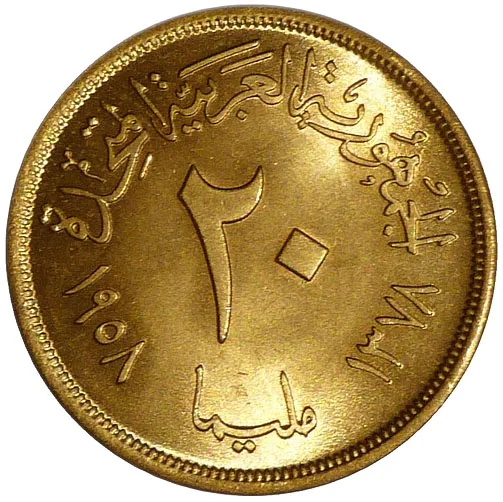
Obverse
Description:
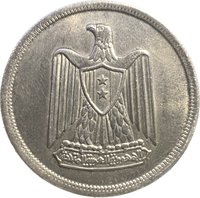
Denomination splits dates, legend atop.
Inscription:
الجمهورية العربية المتحدة
٢٠
مليما
٢٠
مليما
Translation:
United Arab Republic
20
Millimes
20
Millimes
Script: Arabic
Language: Arabic
Designer: Muhamed Abdul Kader
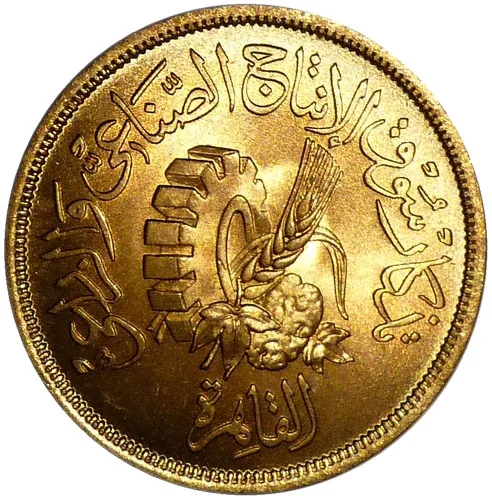
Reverse
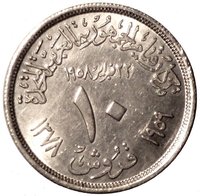
Description:
Agricultural and industrial emblems
Inscription:
تذكار سوق الإنتاج الصناعى والزراعى
القاهرة
القاهرة
Translation:
Commemoration of the Industrial and Agricultural Production Market
Cairo
Cairo
Script: Arabic
Language: Arabic
Designer: Ibrahim El Helw
Edge
Plain
Categories
| Agriculture |
| Event> Fair |
| Industry |
Mints
| Name | Mark |
|---|---|
| Egyptian Mint Authority | — |
Mintings
| Year | Mint Mark | Mintage | Quality | Collection |
|---|---|---|---|---|
| 1958 | — | 4,000,000 |
Historical background
In 1958, Egypt's currency situation was fundamentally shaped by the political and economic transformations following the 1952 Revolution and the creation of the United Arab Republic (UAR) with Syria. President Gamal Abdel Nasser's government had embarked on a sweeping program of nationalization and state-led industrialization, which required significant control over financial resources. The Egyptian pound (EGP), formally pegged to sterling, was managed within a strict system of exchange controls administered by the Central Bank of Egypt. These controls were essential for conserving foreign exchange, directing capital toward state priorities, and preventing capital flight, but they also created a complex bureaucratic environment for trade and investment.
The year itself was marked by the logistical challenge of unifying the monetary systems of Egypt and Syria following the UAR's formation. While both regions retained their existing currencies—the Egyptian pound and the Syrian pound—they were declared legally equivalent, and a unified currency was planned. In practice, this integration was difficult, as the two economies had different structures and levels of development. Furthermore, Egypt's commitment to ambitious projects like the Aswan High Dam, coupled with declining foreign reserves, placed ongoing pressure on the pound's stability. The official exchange rate was maintained, but the groundwork for future economic strain was being laid.
Consequently, the currency regime of 1958 existed in a state of managed tension. On the surface, the Egyptian pound was stable and internationally convertible for approved transactions, underpinning Nasser's vision of independent economic development. Beneath this stability, however, the pressures of expansive state spending, import-substitution policies, and the complexities of the Syrian merger were accumulating. This period represents the apex of Egypt's controlled financial system before the economic challenges of the 1960s would lead to a major devaluation and the emergence of a black market for foreign currency.
The year itself was marked by the logistical challenge of unifying the monetary systems of Egypt and Syria following the UAR's formation. While both regions retained their existing currencies—the Egyptian pound and the Syrian pound—they were declared legally equivalent, and a unified currency was planned. In practice, this integration was difficult, as the two economies had different structures and levels of development. Furthermore, Egypt's commitment to ambitious projects like the Aswan High Dam, coupled with declining foreign reserves, placed ongoing pressure on the pound's stability. The official exchange rate was maintained, but the groundwork for future economic strain was being laid.
Consequently, the currency regime of 1958 existed in a state of managed tension. On the surface, the Egyptian pound was stable and internationally convertible for approved transactions, underpinning Nasser's vision of independent economic development. Beneath this stability, however, the pressures of expansive state spending, import-substitution policies, and the complexities of the Syrian merger were accumulating. This period represents the apex of Egypt's controlled financial system before the economic challenges of the 1960s would lead to a major devaluation and the emergence of a black market for foreign currency.
🌱 Common