

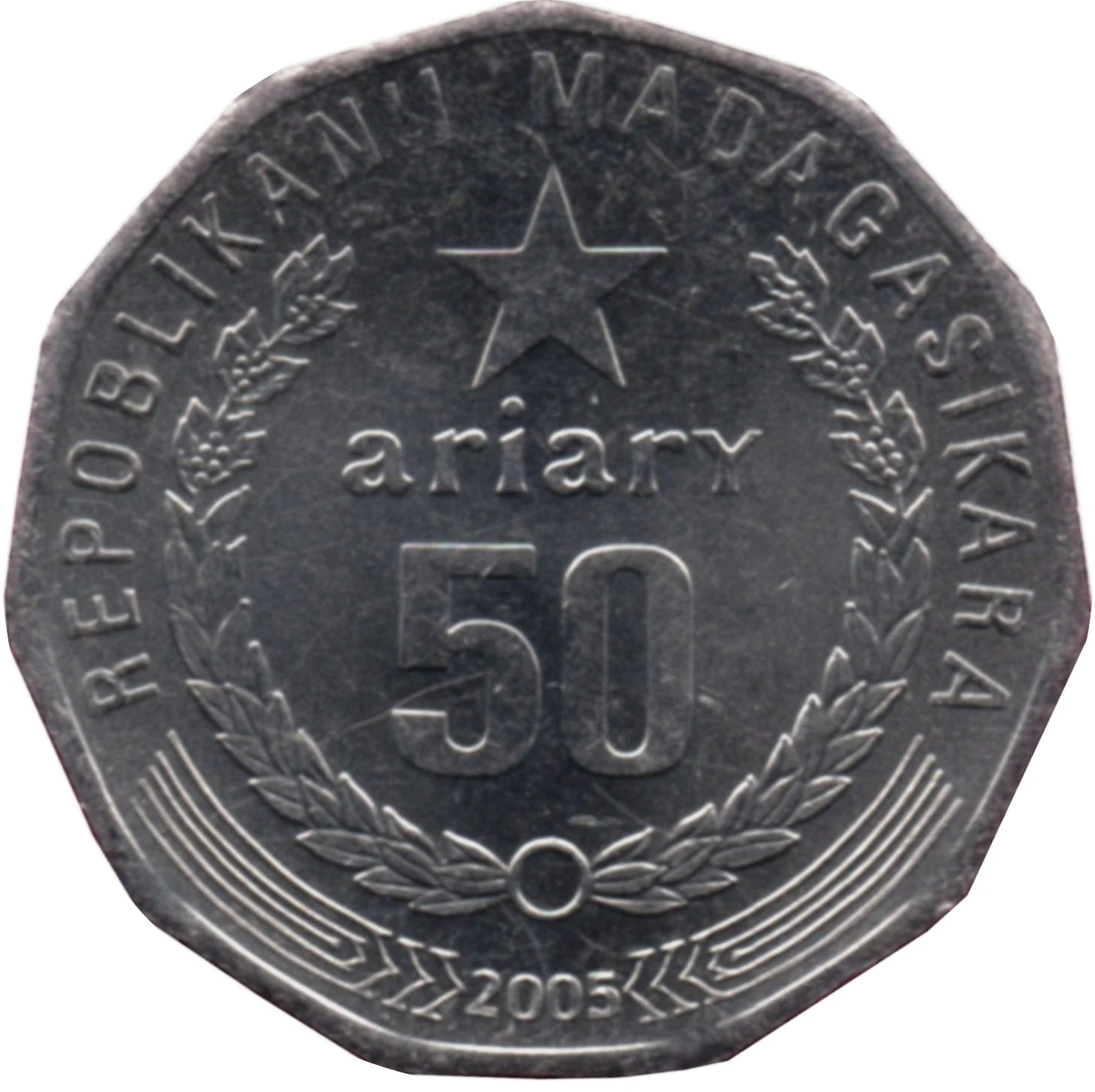
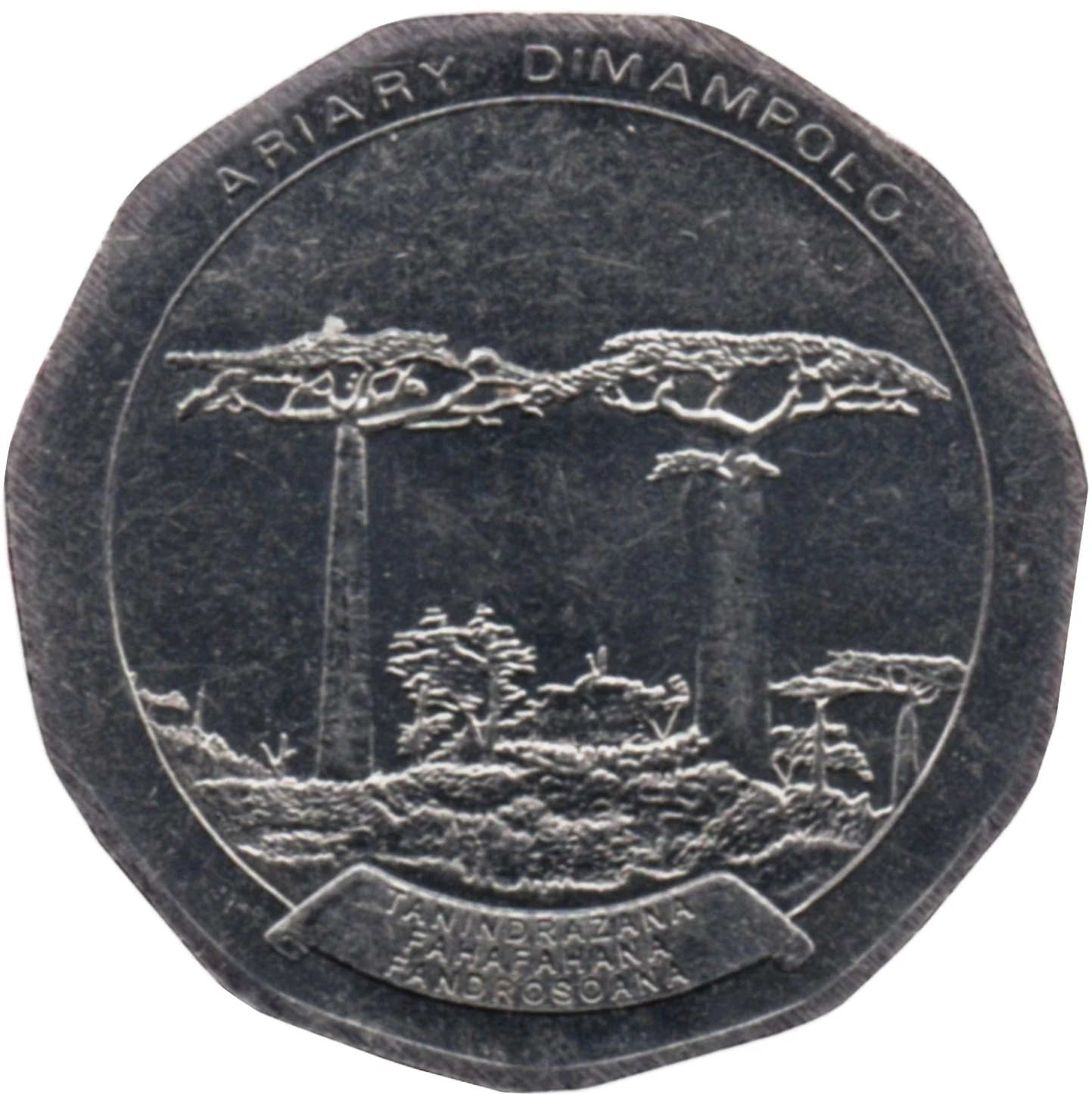
50 ariary – Madagascar
Add to wishlist
Madagascar
Context
Material
Diameter: 30 mm
Weight: 10.15 g
Thickness: 2 mm
Shape: Hendecagonal
Composition: Stainless steel
Technique: Milled
Alignment: Coin alignment
flip
References
KM: #
Numista: #85932
Value
Exchange value: 50 MGA
Obverse
Reverse
Edge
Plain
Mints
| Name | Mark |
|---|---|
| Royal Canadian Mint of Winnipeg | — |
Mintings
| Year | Mint Mark | Mintage | Quality | Collection |
|---|---|---|---|---|
| 2005 | — | — |
Historical background
In 2005, Madagascar's currency situation was characterized by the persistent weakness of the Malagasy Ariary (MGA), which was undergoing a formal transition. Although the Ariary had been the nominal currency since 1961, the previous unit, the Malagasy Franc (FMG), remained in widespread parallel use, with 1 Ariary equaling 5 FMG. This dual-system caused public confusion and inefficiency. The year 2005 was pivotal as it marked the final phase of a government-led campaign to complete the demonetization of the FMG, aiming to solidify the Ariary as the sole legal tender and simplify the monetary system.
Economically, the Ariary faced significant downward pressure due to structural challenges. Madagascar, one of the world's poorest nations, relied heavily on a few volatile export commodities like vanilla and cloves. Political instability following the 2002 crisis continued to undermine investor confidence. Consequently, the country experienced chronic trade deficits and low foreign exchange reserves, leading to a depreciating currency. This depreciation increased the cost of essential imports, such as fuel and medicine, contributing to inflationary pressures that eroded the purchasing power of ordinary citizens.
The government, under President Marc Ravalomanana, maintained a managed float exchange rate regime, with the Central Bank of Madagascar intervening to moderate extreme fluctuations. However, its capacity was limited by reserve constraints. Key economic strategies in 2005 focused on attracting foreign direct investment, particularly in the burgeoning mining and tourism sectors, to generate hard currency and stabilize the Ariary. The success of the Ariary's full adoption and its stability were seen as crucial for broader economic reforms and poverty reduction programs supported by the IMF and World Bank.
Economically, the Ariary faced significant downward pressure due to structural challenges. Madagascar, one of the world's poorest nations, relied heavily on a few volatile export commodities like vanilla and cloves. Political instability following the 2002 crisis continued to undermine investor confidence. Consequently, the country experienced chronic trade deficits and low foreign exchange reserves, leading to a depreciating currency. This depreciation increased the cost of essential imports, such as fuel and medicine, contributing to inflationary pressures that eroded the purchasing power of ordinary citizens.
The government, under President Marc Ravalomanana, maintained a managed float exchange rate regime, with the Central Bank of Madagascar intervening to moderate extreme fluctuations. However, its capacity was limited by reserve constraints. Key economic strategies in 2005 focused on attracting foreign direct investment, particularly in the burgeoning mining and tourism sectors, to generate hard currency and stabilize the Ariary. The success of the Ariary's full adoption and its stability were seen as crucial for broader economic reforms and poverty reduction programs supported by the IMF and World Bank.
🌱 Common