

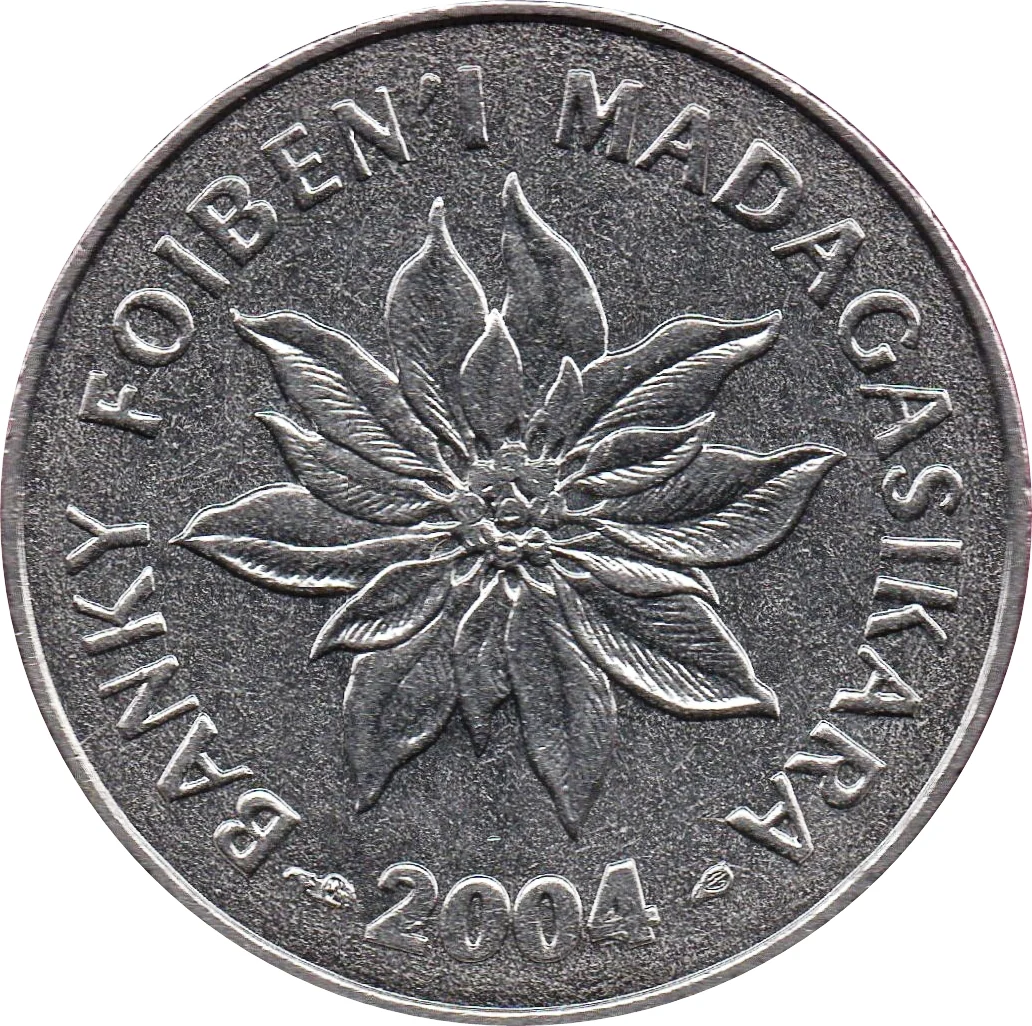
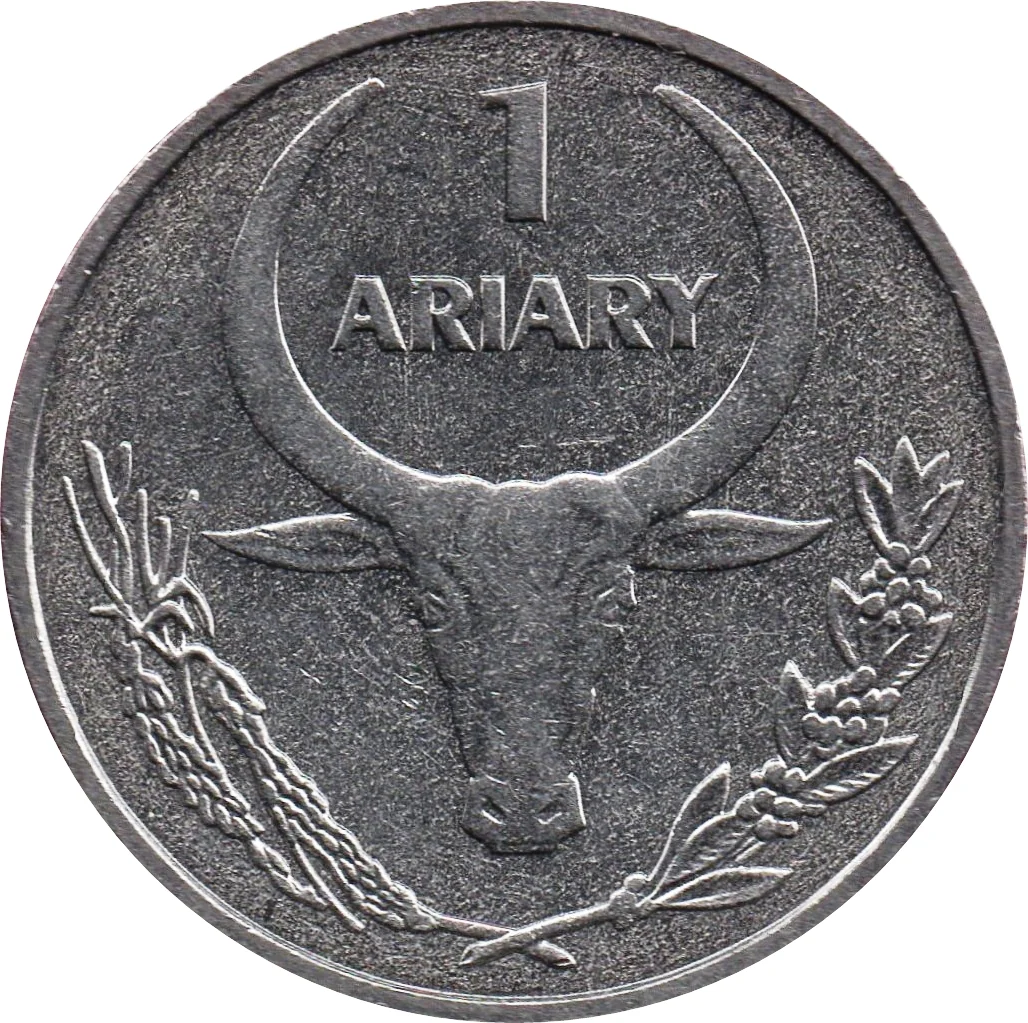
1 ariary – Madagascar
Add to wishlist
Madagascar
Context
Material
Diameter: 22 mm
Weight: 4.93 g
Thickness: 2 mm
Shape: Round
Composition: Stainless steel
Technique: Milled
Alignment: Coin alignment
flip
References
KM: #
Numista: #6092
Value
Exchange value: 1 MGA
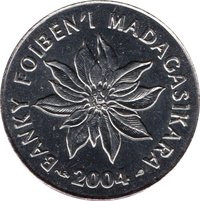
Obverse
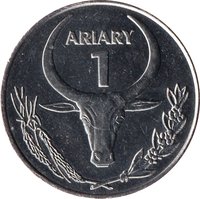
Reverse
Edge
Plain
Mints
| Name | Mark |
|---|---|
| Monnaie de Paris | — |
Mintings
| Year | Mint Mark | Mintage | Quality | Collection |
|---|---|---|---|---|
| 2004 | — | — |
Historical background
In 2004, Madagascar's currency, the Malagasy Ariary (MGA), operated within a challenging economic context marked by the aftermath of a severe political crisis. The country was still recovering from the 2002 political standoff between former President Didier Ratsiraka and Marc Ravalomanana, which had crippled the economy, damaged infrastructure, and led to significant capital flight. This period of instability left the national economy fragile, with high inflation and a reliance on donor support, which in turn placed pressure on the Ariary's stability and foreign exchange reserves.
The currency itself was managed under a floating exchange rate regime, but the Central Bank of Madagascar frequently intervened to prevent excessive volatility. During 2004, the Ariary experienced gradual depreciation against major currencies like the US Dollar and the Euro, driven by a persistent trade deficit, limited foreign direct investment, and underlying inflationary pressures. This depreciation increased the cost of imports, particularly essential goods and petroleum products, contributing to a rising cost of living for the Malagasy population.
Economically, 2004 was a year of tentative stabilization and slow growth under President Ravalomanana's administration, which was implementing market-friendly reforms and prioritizing infrastructure projects. However, the benefits of this recovery were not yet broadly felt, and the currency's weakness reflected the underlying structural challenges of the economy, including a narrow export base dominated by vanilla, textiles, and mining. Consequently, the currency situation in 2004 was emblematic of an economy in a delicate transition, working to rebuild confidence and macroeconomic stability after profound political disruption.
The currency itself was managed under a floating exchange rate regime, but the Central Bank of Madagascar frequently intervened to prevent excessive volatility. During 2004, the Ariary experienced gradual depreciation against major currencies like the US Dollar and the Euro, driven by a persistent trade deficit, limited foreign direct investment, and underlying inflationary pressures. This depreciation increased the cost of imports, particularly essential goods and petroleum products, contributing to a rising cost of living for the Malagasy population.
Economically, 2004 was a year of tentative stabilization and slow growth under President Ravalomanana's administration, which was implementing market-friendly reforms and prioritizing infrastructure projects. However, the benefits of this recovery were not yet broadly felt, and the currency's weakness reflected the underlying structural challenges of the economy, including a narrow export base dominated by vanilla, textiles, and mining. Consequently, the currency situation in 2004 was emblematic of an economy in a delicate transition, working to rebuild confidence and macroeconomic stability after profound political disruption.
🌱 Common