

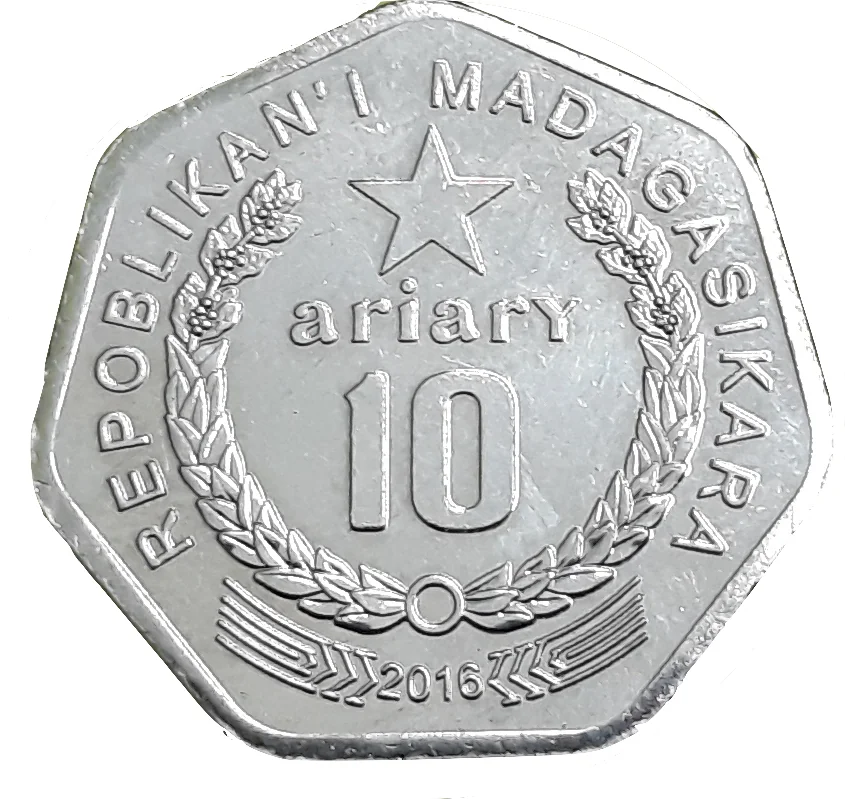
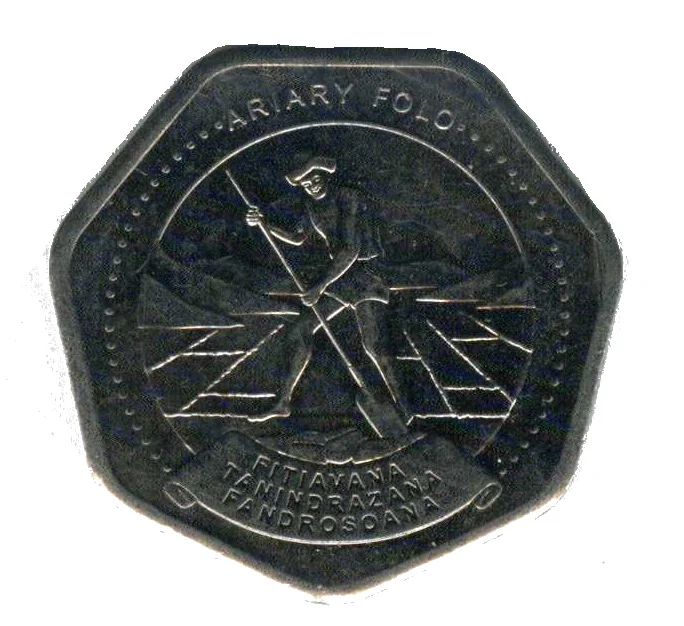
10 ariary – Madagascar
Add to wishlist
Madagascar
Context
Material
Diameter: 24 mm
Weight: 6.5 g
Shape: Heptagonal
Composition: Stainless steel
Technique: Milled
Alignment: Coin alignment
flip
References
KM: #
Numista: #155126
Value
Exchange value: 10 MGA
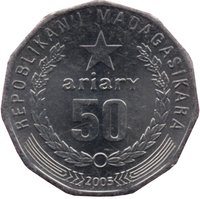
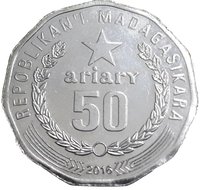
Obverse
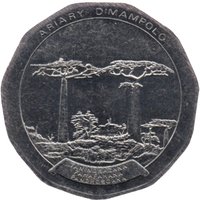
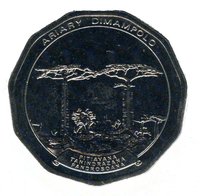
Reverse
Edge
Plain
Categories
| Agriculture |
Mints
| Name | Mark |
|---|---|
| Royal Canadian Mint of Winnipeg | — |
Mintings
| Year | Mint Mark | Mintage | Quality | Collection |
|---|---|---|---|---|
| 2016 | — | — | ||
| 2021 | — | — |
Historical background
In 2016, Madagascar's currency, the Malagasy Ariary (MGA), faced significant depreciation and volatility, continuing a trend exacerbated by a prolonged political crisis earlier in the decade. The currency lost approximately 20% of its value against the US dollar over the course of the year, driven by a combination of structural economic weaknesses and specific external shocks. Key factors included a severe drought in the south that devastated agricultural output—a pillar of the economy—and a sharp decline in global commodity prices, which hurt export revenues from key sectors like vanilla and minerals. This created a widening trade deficit and put sustained pressure on the foreign exchange reserves of the Central Bank of Madagascar.
The government, under President Hery Rajaonarimampianina who took office in 2014, was implementing an IMF-supported economic reform program to stabilize the macroeconomy. However, policy challenges persisted, including low tax revenues and high public debt. The Central Bank's efforts to manage the currency were constrained by its limited reserves, leading to periods of currency intervention followed by sharp corrections. This uncertainty contributed to higher inflation, which reached around 6-7% annually, eroding purchasing power for a population where a majority lives in poverty.
Consequently, the currency situation in 2016 reflected the fragile state of Madagascar's economic recovery. The depreciating Ariary increased the cost of essential imports like fuel, medicine, and food, straining households and businesses alike. While the IMF program aimed to restore fiscal discipline and attract foreign investment, the immediate reality for most Malagasy citizens was an economy struggling with inflation, currency instability, and the tangible impacts of climate and global market fluctuations on their livelihoods.
The government, under President Hery Rajaonarimampianina who took office in 2014, was implementing an IMF-supported economic reform program to stabilize the macroeconomy. However, policy challenges persisted, including low tax revenues and high public debt. The Central Bank's efforts to manage the currency were constrained by its limited reserves, leading to periods of currency intervention followed by sharp corrections. This uncertainty contributed to higher inflation, which reached around 6-7% annually, eroding purchasing power for a population where a majority lives in poverty.
Consequently, the currency situation in 2016 reflected the fragile state of Madagascar's economic recovery. The depreciating Ariary increased the cost of essential imports like fuel, medicine, and food, straining households and businesses alike. While the IMF program aimed to restore fiscal discipline and attract foreign investment, the immediate reality for most Malagasy citizens was an economy struggling with inflation, currency instability, and the tangible impacts of climate and global market fluctuations on their livelihoods.
🌟 Uncommon