

100 francs cfa – Republic of the Congo
Add to wishlist
Context
Years: 1975–1990
Issuer: Republic of the Congo
Period:
(1969—1992)
Currency:
(since 1973)
Total mintage: 6,100,000
Material
References
KM: #
Numista: #8523
Value
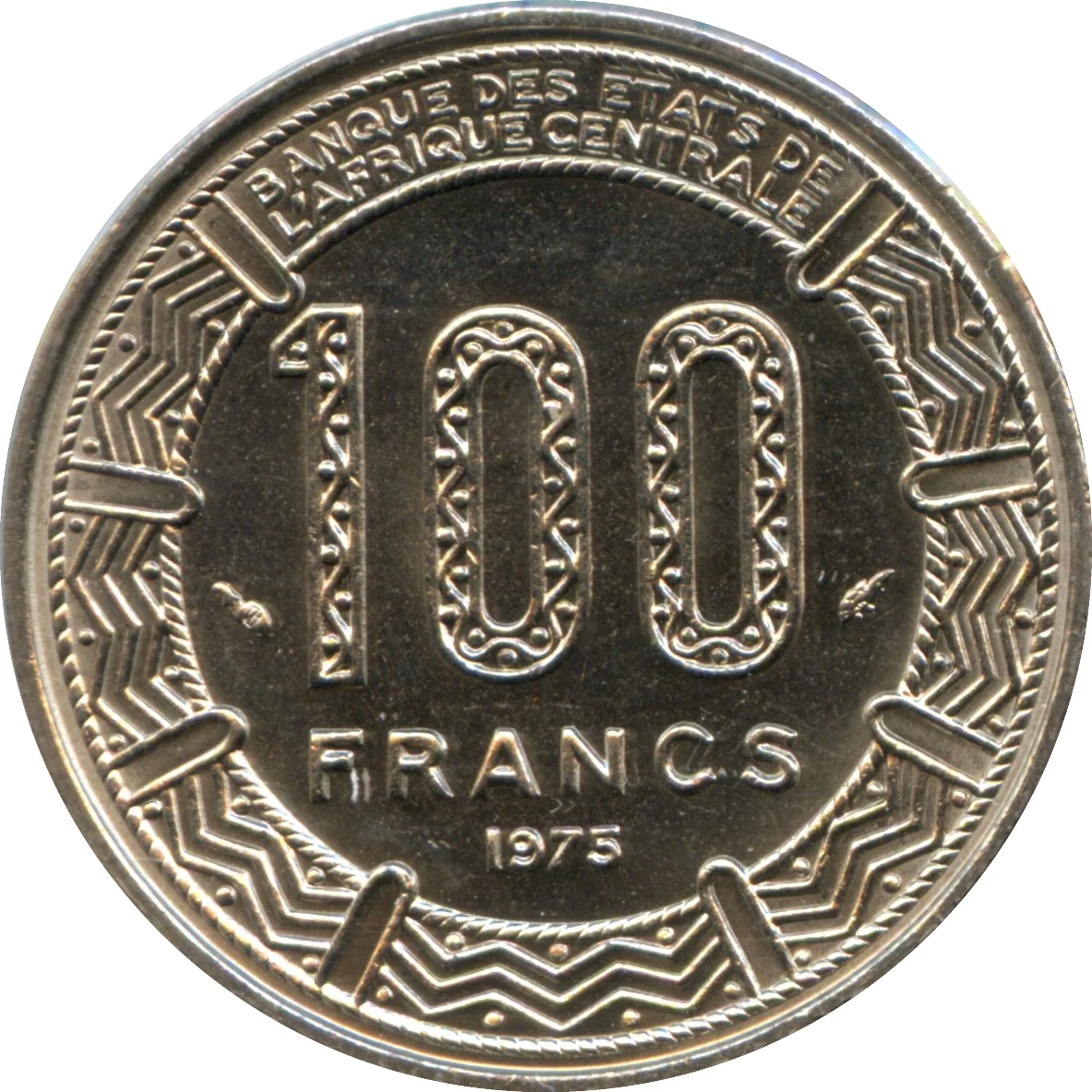
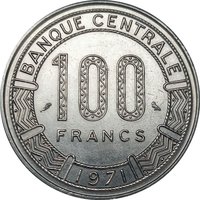
Exchange value: 100 XAF
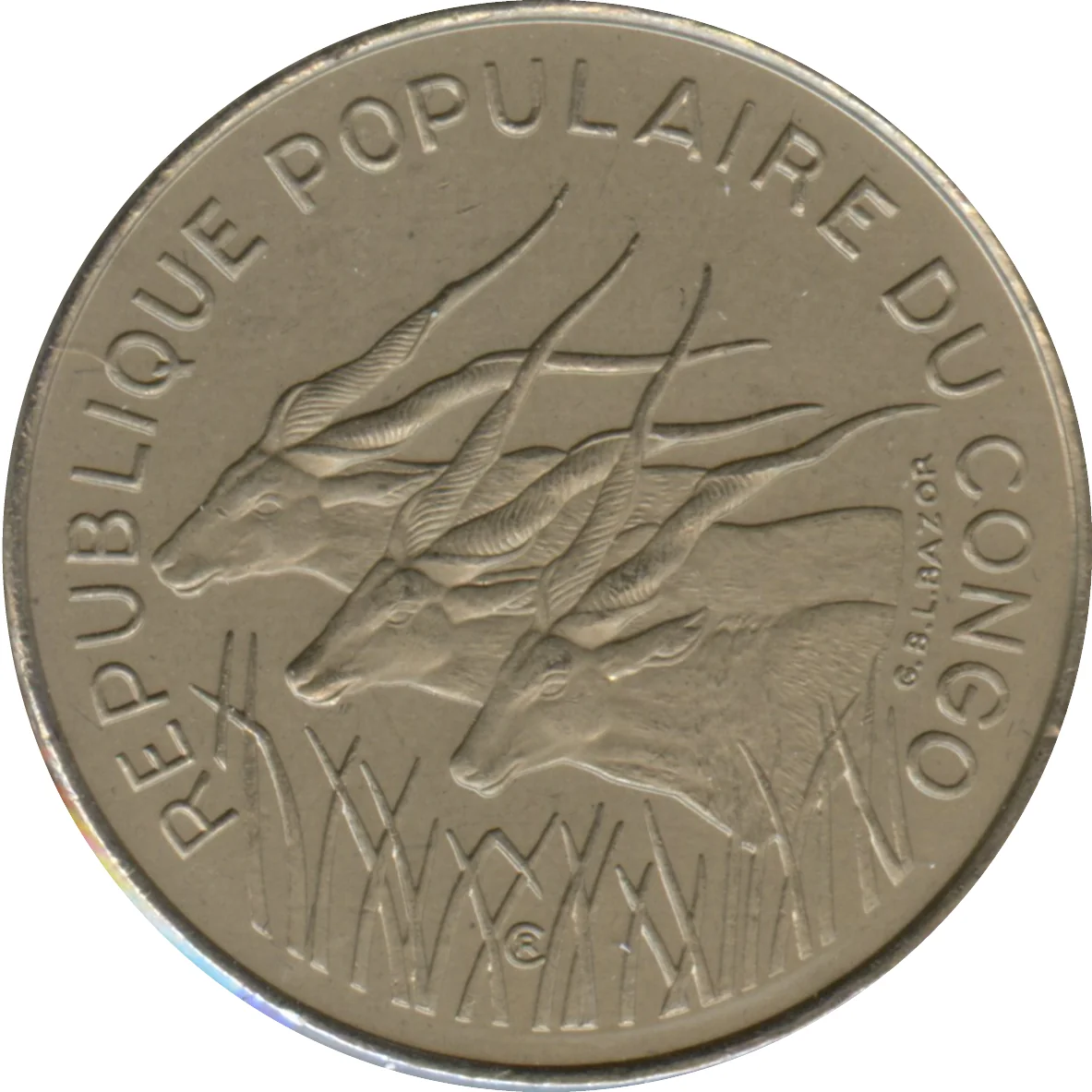
Obverse
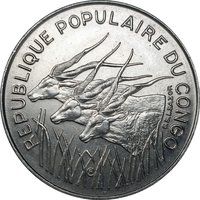
Description:
Giant eland.
Inscription:
REPUBLIQUE POPULAIRE DU CONGO
Translation:
People's Republic of the Congo
Script: Latin
Language: French
Engraver: Lucien Georges Bazor
Reverse
Edge
Reeded
Mints
| Name | Mark |
|---|---|
| Monnaie de Paris | — |
Mintings
| Year | Mint Mark | Mintage | Quality | Collection |
|---|---|---|---|---|
| 1975 | — | 2,500,000 | ||
| 1982 | — | — | ||
| 1983 | — | 3,000,000 | ||
| 1985 | — | 600,000 | ||
| 1990 | — | — |
Historical background
In 1975, the Republic of the Congo’s currency was the CFA franc, specifically the Central African CFA franc (XAF), issued by the Banque des États de l'Afrique Centrale (BEAC). This currency was (and remains) part of a broader monetary union, then comprising Chad, Cameroon, the Central African Republic, Gabon, and Congo-Brazzaville. A key feature was the fixed exchange rate and convertibility guaranteed by France, as the CFA franc was pegged to the French franc at a rate of 1 French franc = 50 CFA francs. This arrangement provided monetary stability and facilitated trade with France, the former colonial power, but also meant Congo’s monetary policy was largely determined externally by the BEAC and the French Treasury.
Economically, 1975 fell within a period of relative prosperity for the Republic of the Congo, driven by the oil boom. The discovery and exploitation of offshore oil reserves, which began in earnest in the early 1970s, provided significant state revenue. This influx of petrodollars strengthened the country's foreign exchange reserves and supported the stability of the CFA franc within the monetary union. Consequently, unlike many developing nations, Congo did not face immediate currency devaluation or hyperinflation at this time. The government, under President Marien Ngouabi’s Marxist-Leninist orientation, used oil wealth to fund state-led industrialization and social programs.
However, this stability was underpinned by a dependent economic structure. The currency union and fixed peg, while ensuring stability, limited the government’s ability to use monetary policy as a tool for managing the domestic economy. Furthermore, the economy became increasingly reliant on a single volatile commodity—oil. This made the currency and national finances vulnerable to future oil price shocks, a dependency that would lead to severe debt crises in the 1980s. Thus, in 1975, the Congolese currency situation was characterized by institutional stability imported from the CFA system, buoyed temporarily by oil revenues, but with underlying vulnerabilities tied to external monetary control and a lack of economic diversification.
Economically, 1975 fell within a period of relative prosperity for the Republic of the Congo, driven by the oil boom. The discovery and exploitation of offshore oil reserves, which began in earnest in the early 1970s, provided significant state revenue. This influx of petrodollars strengthened the country's foreign exchange reserves and supported the stability of the CFA franc within the monetary union. Consequently, unlike many developing nations, Congo did not face immediate currency devaluation or hyperinflation at this time. The government, under President Marien Ngouabi’s Marxist-Leninist orientation, used oil wealth to fund state-led industrialization and social programs.
However, this stability was underpinned by a dependent economic structure. The currency union and fixed peg, while ensuring stability, limited the government’s ability to use monetary policy as a tool for managing the domestic economy. Furthermore, the economy became increasingly reliant on a single volatile commodity—oil. This made the currency and national finances vulnerable to future oil price shocks, a dependency that would lead to severe debt crises in the 1980s. Thus, in 1975, the Congolese currency situation was characterized by institutional stability imported from the CFA system, buoyed temporarily by oil revenues, but with underlying vulnerabilities tied to external monetary control and a lack of economic diversification.
🌱 Common