

100 francs cfa – Republic of the Congo
Add to wishlist
Context
Years: 1971–1972
Issuer: Republic of the Congo
Issuing organization: Central Bank of Equatorial African States and Cameroon
Period:
(1969—1992)
Currency:
(1961—1973)
Total mintage: 5,200,000
Material
References
KM: #
Numista: #3205
Value
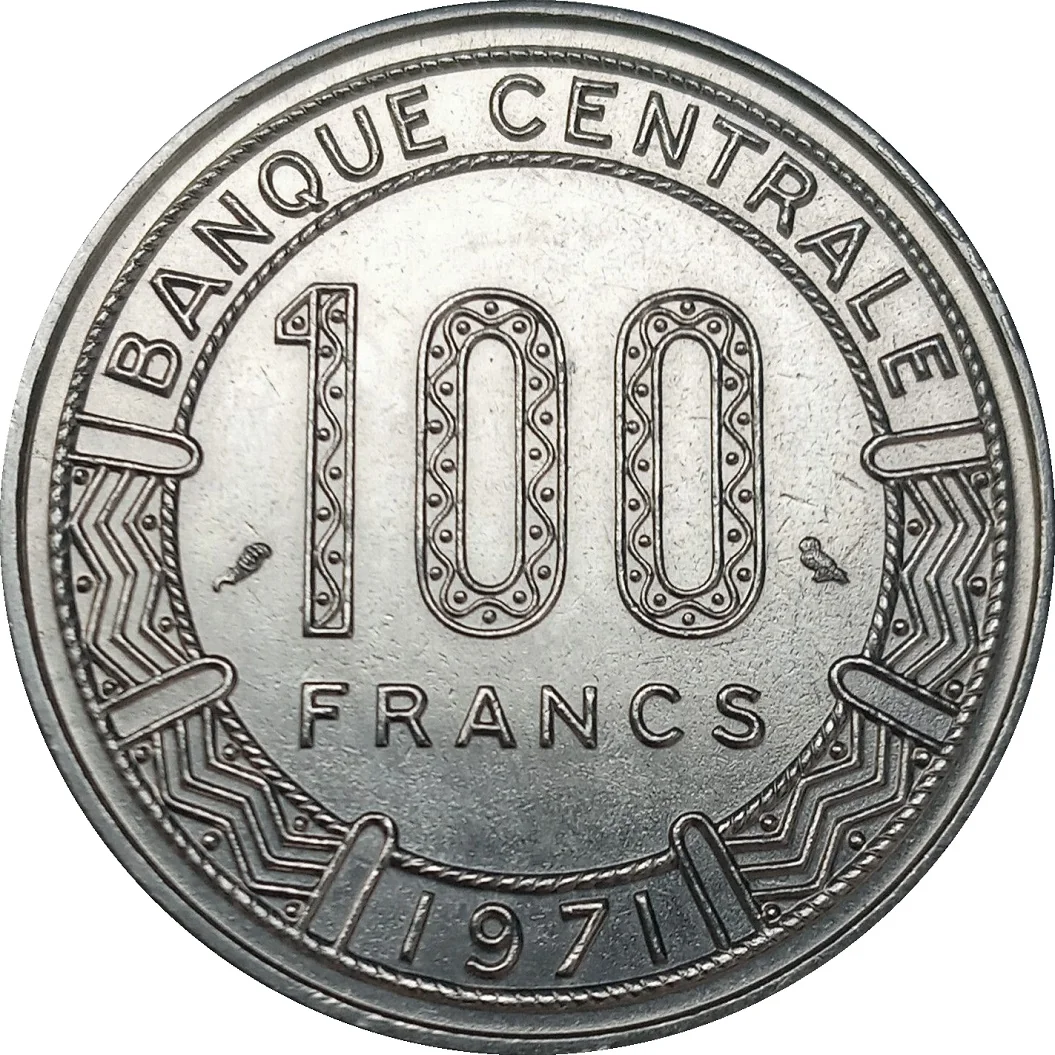
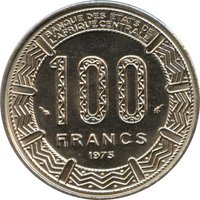
Exchange value: 100 FCFA
Obverse
Description:
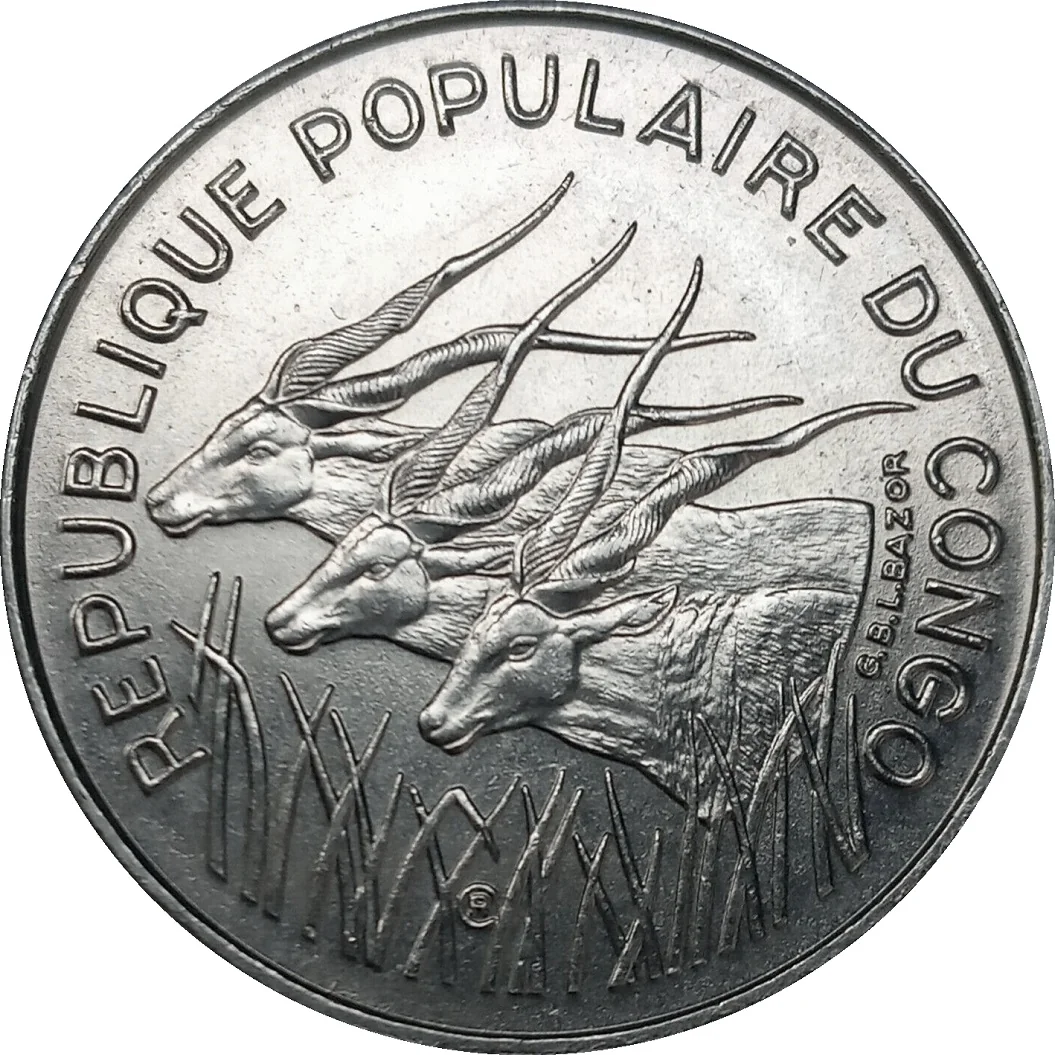
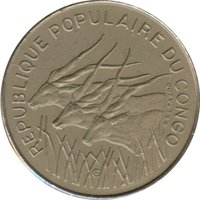
Giant eland.
Inscription:
REPUBLIQUE POPULAIRE DU CONGO
Translation:
People's Republic of the Congo
Script: Latin
Language: French
Engraver: Lucien Georges Bazor
Reverse
Edge
Reeded
Mints
| Name | Mark |
|---|---|
| Monnaie de Paris | — |
Mintings
| Year | Mint Mark | Mintage | Quality | Collection |
|---|---|---|---|---|
| 1971 | — | 2,700,000 | ||
| 1972 | — | 2,500,000 |
Historical background
In 1971, the Republic of the Congo (often referred to as Congo-Brazzaville to distinguish it from its larger neighbor, the Democratic Republic of the Congo) was operating within the monetary framework of the CFA franc zone. The CFA franc, which stood for Colonies Françaises d'Afrique at its creation, was (and remains) a currency guaranteed by the French Treasury and pegged at a fixed rate to the French franc. This arrangement provided monetary stability and facilitated trade with France, but it also meant that the Congolese government had limited independent control over its monetary policy, interest rates, and currency valuation.
Politically and economically, the year 1971 fell within the transformative period of President Marien Ngouabi's rule, who had declared Congo Africa's first "people's republic" in 1969, aligning the state with Marxist-Leninist principles. Despite this radical socialist orientation, the country maintained its pragmatic membership in the CFA franc zone. This created a notable contradiction: a state officially pursuing a centrally planned, socialist economy was integrated into a monetary union backed by a capitalist European power. The fixed exchange rate and free convertibility provided essential stability for the country's key exports, notably oil, which was beginning to emerge as a significant revenue source.
Therefore, the currency situation in 1971 was defined by this duality. While the government sought to reshape the domestic economy through nationalization and state-led development, its monetary foundation was externally anchored and conservative. The CFA franc system provided a shield against hyperinflation and currency crisis, but it also meant that Congo's monetary fortunes were inextricably linked to the French franc and the broader economic management of the Franc Zone, limiting the state's tools for responding to local economic challenges.
Politically and economically, the year 1971 fell within the transformative period of President Marien Ngouabi's rule, who had declared Congo Africa's first "people's republic" in 1969, aligning the state with Marxist-Leninist principles. Despite this radical socialist orientation, the country maintained its pragmatic membership in the CFA franc zone. This created a notable contradiction: a state officially pursuing a centrally planned, socialist economy was integrated into a monetary union backed by a capitalist European power. The fixed exchange rate and free convertibility provided essential stability for the country's key exports, notably oil, which was beginning to emerge as a significant revenue source.
Therefore, the currency situation in 1971 was defined by this duality. While the government sought to reshape the domestic economy through nationalization and state-led development, its monetary foundation was externally anchored and conservative. The CFA franc system provided a shield against hyperinflation and currency crisis, but it also meant that Congo's monetary fortunes were inextricably linked to the French franc and the broader economic management of the Franc Zone, limiting the state's tools for responding to local economic challenges.
🌱 Common