

100 francs cfa – Gabon
Add to wishlist
Gabon
Context
Years: 1975–1985
Issuer: Gabon
Issuing organization: Bank of Central African States
Period:
(since 1960)
Currency:
(since 1973)
Total mintage: 14,600,000
Material
References
KM: #
Numista: #8522
Value
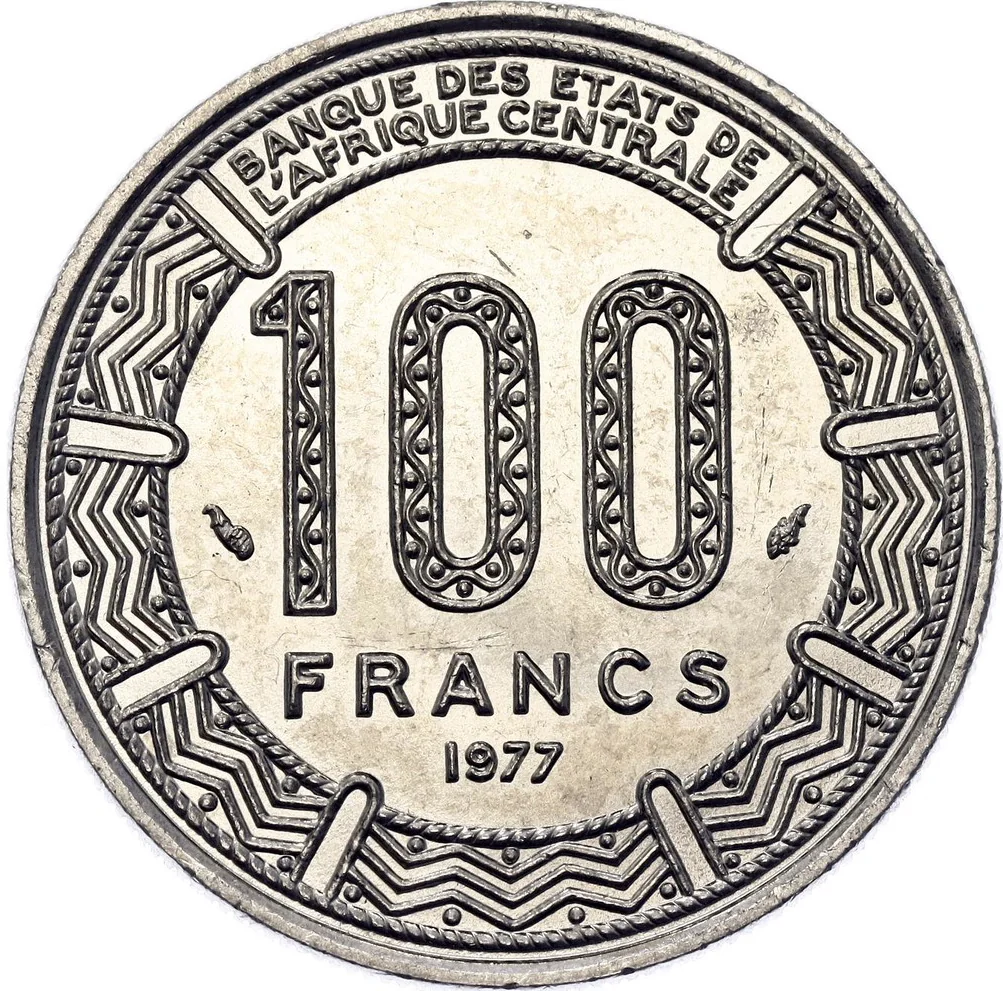
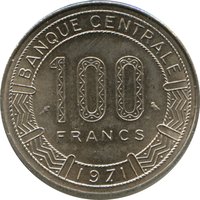
Exchange value: 100 XAF
Obverse
Description:
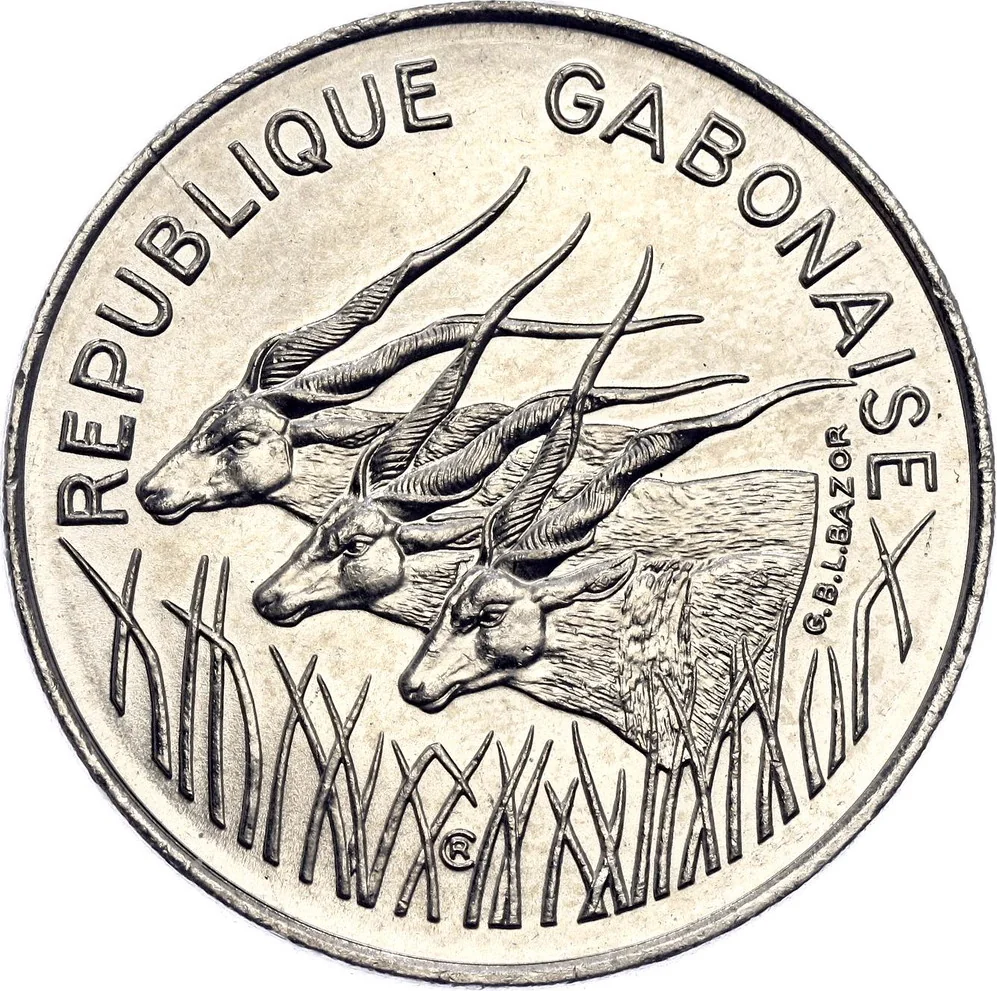
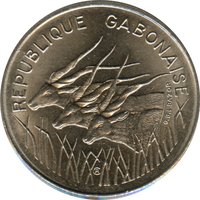
Three large eland departed.
Inscription:
REPUBLIQUE GABONAISE
G.B.L.BAZOR
RC
G.B.L.BAZOR
RC
Translation:
GABONESE REPUBLIC
G.B.L.BAZOR
RC
G.B.L.BAZOR
RC
Script: Latin
Language: French
Engraver: Lucien Georges Bazor
Designer: Robert Cochet
Reverse
Edge
Reeded
Mints
| Name | Mark |
|---|---|
| Monnaie de Paris | — |
Mintings
| Year | Mint Mark | Mintage | Quality | Collection |
|---|---|---|---|---|
| 1975 | — | 4,000,000 | ||
| 1977 | — | 2,000,000 | ||
| 1978 | — | 2,600,000 | ||
| 1982 | — | — | ||
| 1983 | — | — | ||
| 1984 | — | 3,000,000 | ||
| 1985 | — | 3,000,000 |
Historical background
In 1975, Gabon's currency situation was firmly anchored within the CFA franc system, a colonial-era monetary arrangement that continued post-independence. The country used the CFA franc (BEAC zone), which was (and remains) pegged to the French franc at a fixed exchange rate. This peg provided significant monetary stability and low inflation, but it also meant Gabon ceded control over its monetary policy to the regional central bank, the Bank of Central African States (BEAC), and ultimately to the French Treasury, which guaranteed the currency's convertibility.
This period coincided with the early years of Gabon's oil boom, which began in the late 1960s. The influx of petroleum revenues strengthened the country's external position and its ability to maintain the CFA franc peg. However, it also created a dual economic structure: a lucrative, capital-intensive oil sector that generated vast government revenue in foreign currency, alongside a largely underdeveloped traditional sector. The fixed exchange rate, some economists argued, made non-oil exports less competitive and may have hindered broader economic diversification.
Overall, the currency situation in 1975 reflected a trade-off. For the government of President Omar Bongo, the stability of the CFA franc was advantageous, facilitating imports of luxury and capital goods, servicing foreign debt, and attracting French investment. It avoided the currency volatility experienced by many resource-rich developing nations. Yet, this stability came at the cost of independent monetary tools to manage the economy, embedding a structural dependence on France and fossil fuel exports that would define Gabon's economic trajectory for decades to come.
This period coincided with the early years of Gabon's oil boom, which began in the late 1960s. The influx of petroleum revenues strengthened the country's external position and its ability to maintain the CFA franc peg. However, it also created a dual economic structure: a lucrative, capital-intensive oil sector that generated vast government revenue in foreign currency, alongside a largely underdeveloped traditional sector. The fixed exchange rate, some economists argued, made non-oil exports less competitive and may have hindered broader economic diversification.
Overall, the currency situation in 1975 reflected a trade-off. For the government of President Omar Bongo, the stability of the CFA franc was advantageous, facilitating imports of luxury and capital goods, servicing foreign debt, and attracting French investment. It avoided the currency volatility experienced by many resource-rich developing nations. Yet, this stability came at the cost of independent monetary tools to manage the economy, embedding a structural dependence on France and fossil fuel exports that would define Gabon's economic trajectory for decades to come.
🌱 Very Common