

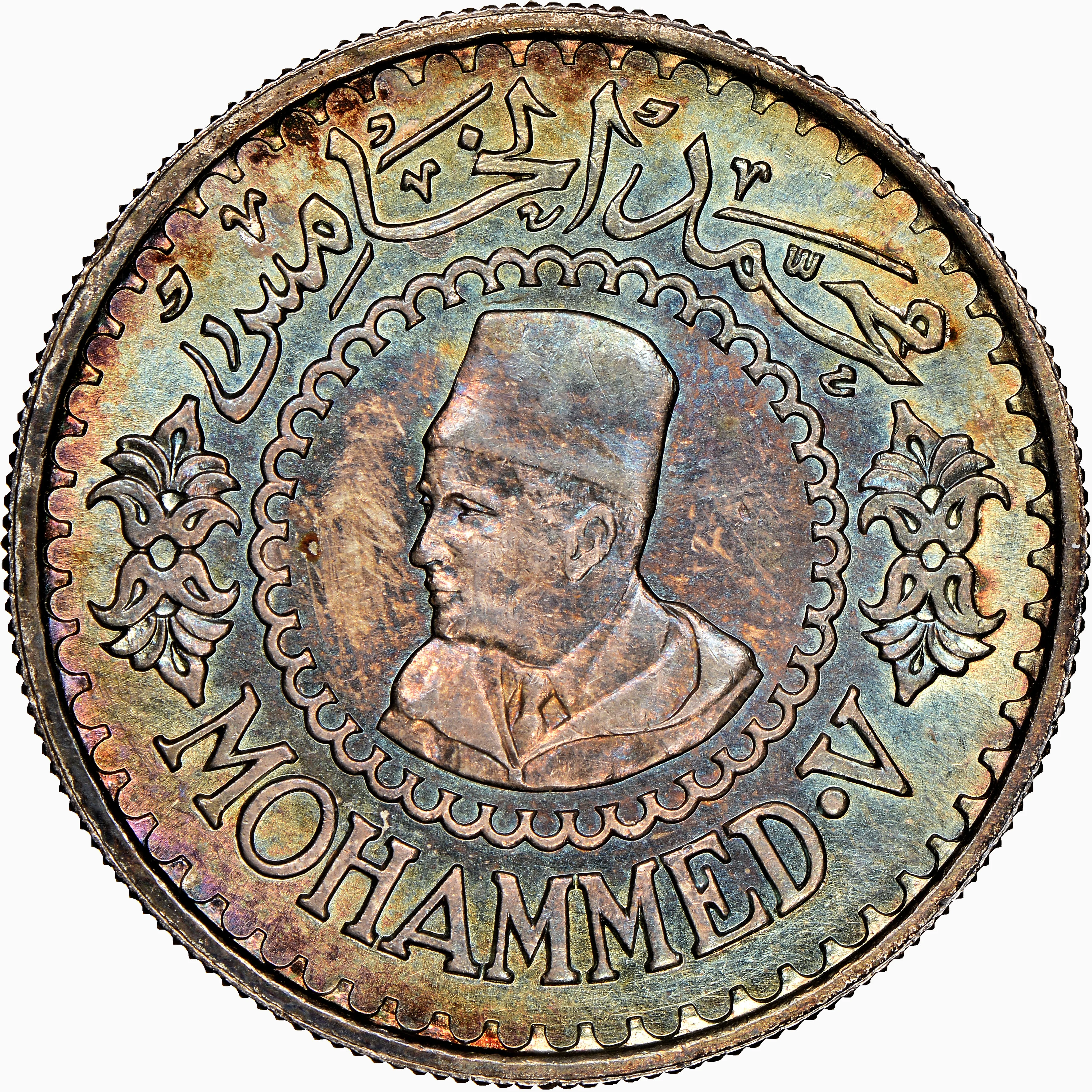
500 francs – Morocco
Add to wishlist
Morocco
Context
Year: 1956
Islamic (Hijri) Year:: 1376
Issuer: Morocco
Ruler: Mohammed V
Currency:
(1910—1959)
Demonetized: Yes
Total mintage: 2,000,000
Material
References
Y: #
Numista: #8403
Value
Bullion value: $49.28
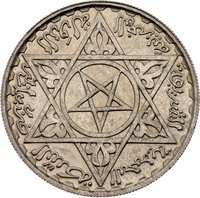
Obverse
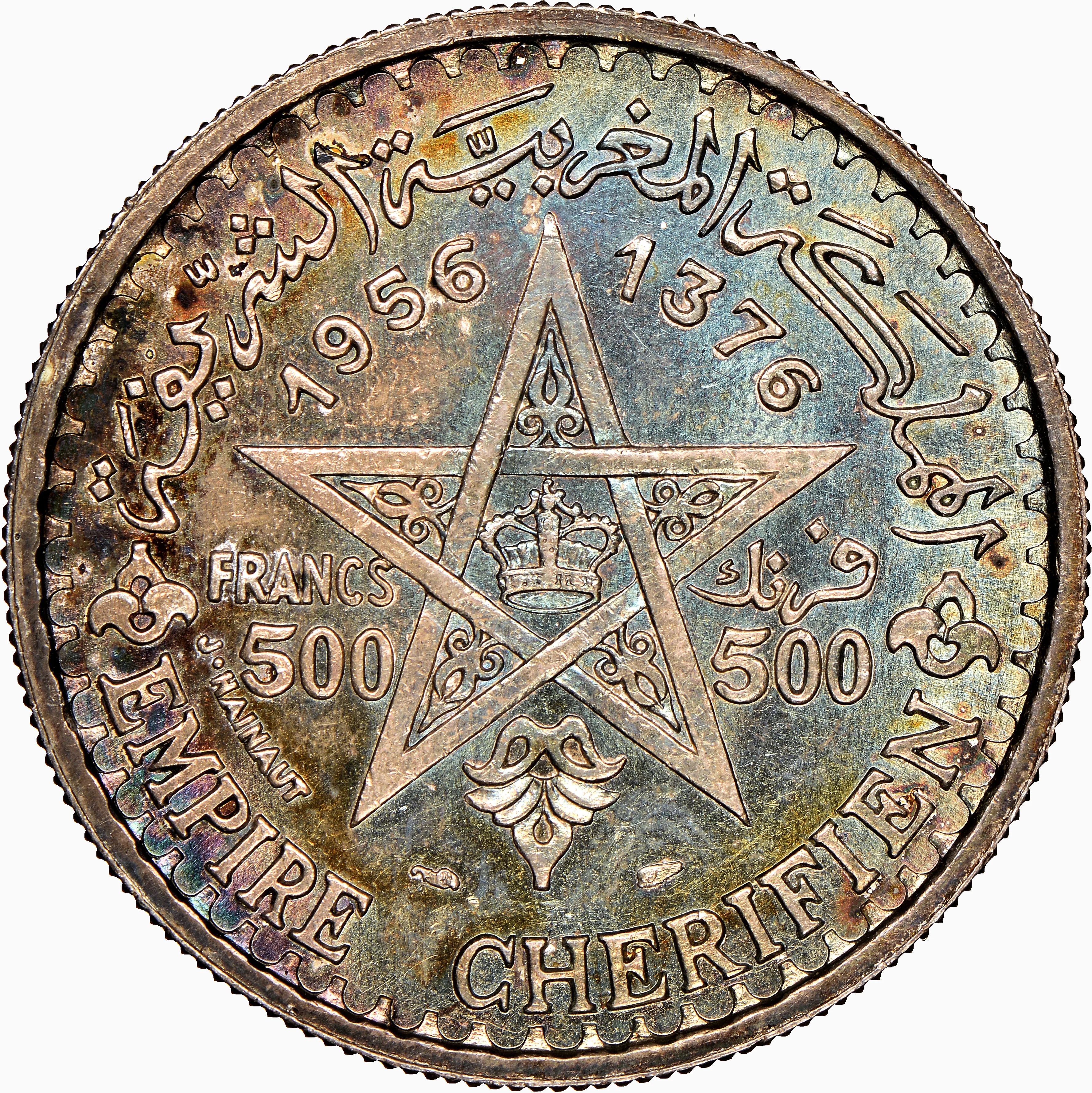
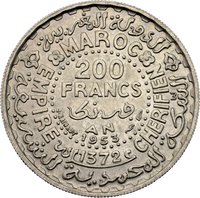
Reverse
Description:
Star with central crown, flanked by dates and value.
Inscription:
السكة المحمدية الشريفة
1956 1376
FRANCS 500
٥٠٠ فرنك
EMPIRE CHERIFIEN
1956 1376
FRANCS 500
٥٠٠ فرنك
EMPIRE CHERIFIEN
Translation:
The Honorable Muhammadan Coinage
1956 1376
FRANCS 500
500 Francs
Cherifian Empire
1956 1376
FRANCS 500
500 Francs
Cherifian Empire
Engraver: J.HAINAUT
Edge
Milled
Mints
| Name | Mark |
|---|---|
| Monnaie de Paris | — |
Mintings
| Year | Mint Mark | Mintage | Quality | Collection |
|---|---|---|---|---|
| 1956 | — | 2,000,000 |
Historical background
Following its independence from France and Spain in 1956, Morocco inherited a complex and fragmented currency system. The French Protectorate had established the Moroccan franc, which was pegged to and guaranteed by the French franc, circulating alongside Spanish pesetas in the northern zone. This arrangement left the new kingdom's monetary sovereignty incomplete and its economy financially tied to its former colonial powers.
The immediate post-independence period was characterized by a pragmatic dual-currency system. While the Moroccan franc remained the primary legal tender, the government, led by King Mohammed V, also reintroduced the traditional dirham as a unit of account, equivalent to 100 Moroccan francs. This symbolic move reasserted national identity, but the practical goal was to unify the currency zones and establish a central bank to guide monetary policy. The creation of Bank Al-Maghrib in 1959 was the critical institutional step toward this goal.
Consequently, the major currency reform was enacted in 1959-1960. Bank Al-Maghrib issued the new Moroccan dirham (MAD) to replace the Moroccan franc, with a conversion rate of 1 dirham to 100 francs. This move successfully dissolved the colonial monetary legacy, unified the national territory under a single currency, and provided the foundational tool for independent economic management. The dirham's initial parity was still loosely linked to the French franc, reflecting enduring economic ties, but Morocco had decisively reclaimed its monetary sovereignty.
The immediate post-independence period was characterized by a pragmatic dual-currency system. While the Moroccan franc remained the primary legal tender, the government, led by King Mohammed V, also reintroduced the traditional dirham as a unit of account, equivalent to 100 Moroccan francs. This symbolic move reasserted national identity, but the practical goal was to unify the currency zones and establish a central bank to guide monetary policy. The creation of Bank Al-Maghrib in 1959 was the critical institutional step toward this goal.
Consequently, the major currency reform was enacted in 1959-1960. Bank Al-Maghrib issued the new Moroccan dirham (MAD) to replace the Moroccan franc, with a conversion rate of 1 dirham to 100 francs. This move successfully dissolved the colonial monetary legacy, unified the national territory under a single currency, and provided the foundational tool for independent economic management. The dirham's initial parity was still loosely linked to the French franc, reflecting enduring economic ties, but Morocco had decisively reclaimed its monetary sovereignty.
🌱 Common