

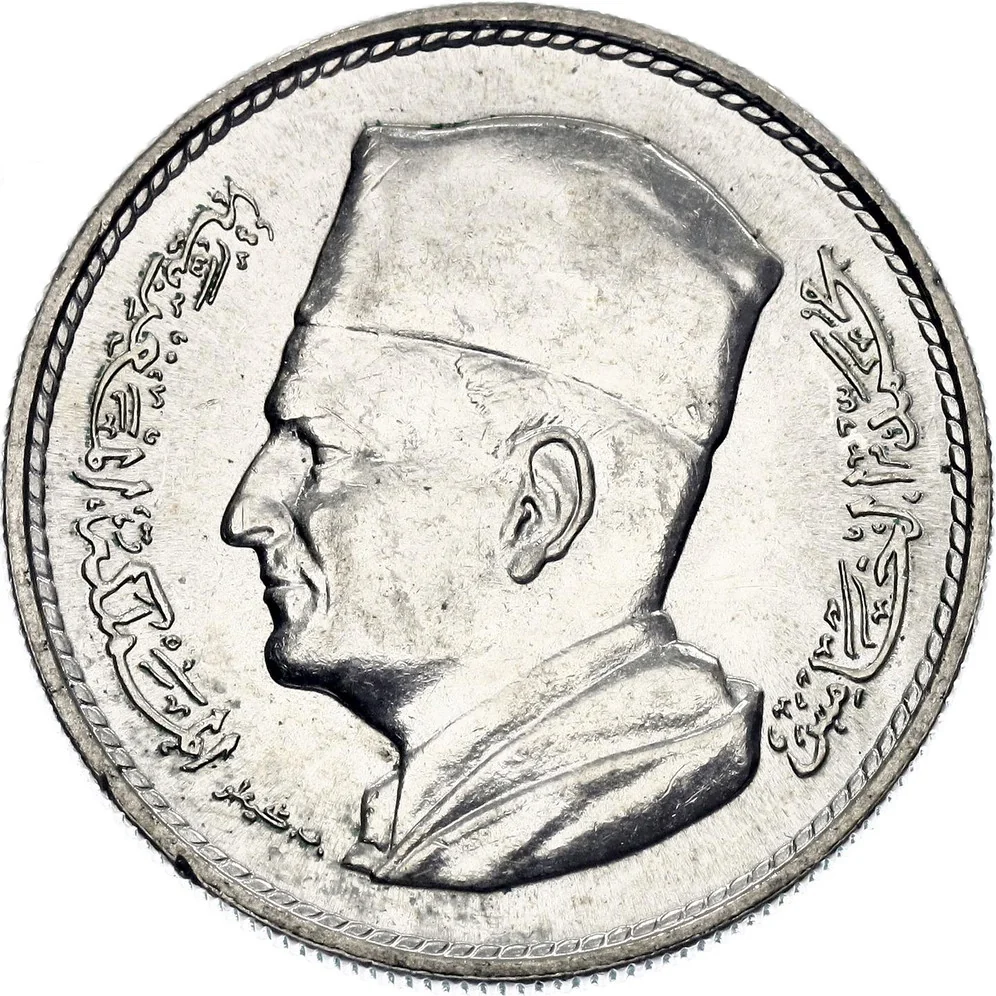
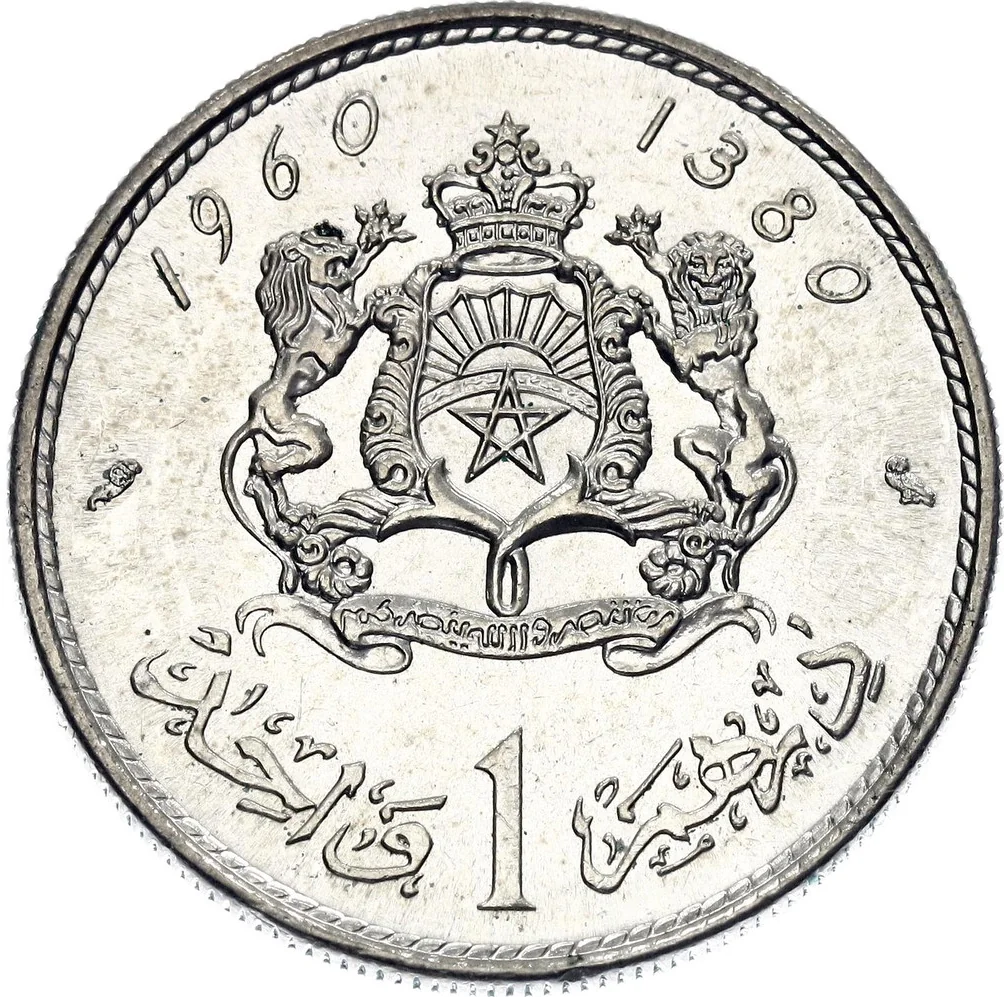
1 dirham – Morocco
Add to wishlist
Morocco
Context
Year: 1960
Islamic (Hijri) Year:: 1380
Issuer: Morocco
Ruler: Mohammed V
Currency:
(since 1960)
Demonetized: Yes
Total mintage: 18,829,986
Material
References
Y: #
Numista: #6411
Value
Exchange value: 1 MAD
Bullion value: $8.83
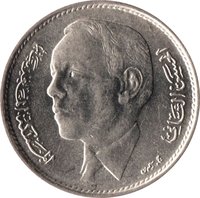
Obverse
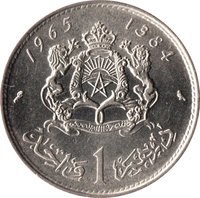
Reverse
Edge
Reeded
Mints
| Name | Mark |
|---|---|
| Monnaie de Paris | — |
Mintings
| Year | Mint Mark | Mintage | Quality | Collection |
|---|---|---|---|---|
| 1960 | — | 18,829,986 |
Historical background
In 1960, Morocco's currency situation was characterized by its continued use of the Moroccan franc, a legacy of the French Protectorate (1912-1956). This franc was pegged to the French franc at a fixed parity and remained part of the Franc Zone (zone franc), a monetary union guaranteeing convertibility and centralized reserves through the French Treasury. This arrangement provided monetary stability and facilitated trade with France, Morocco's dominant economic partner, but it also symbolized lingering economic dependence and limited the young kingdom's sovereign control over its own monetary policy.
Economically, the system faced pressures. The fixed peg and free capital movement within the Franc Zone, while ensuring stability, sometimes conflicted with Morocco's domestic needs. The government, under King Mohammed V and pursuing a path of nationalist development, required policy flexibility to fund infrastructure projects and state-led industrialization. Furthermore, the dirham, as a unit of account, already existed alongside the circulating franc, highlighting a national monetary identity waiting to be fully realized. The costs and benefits of continued membership in the Franc Zone were thus a subject of internal debate.
Consequently, 1960 stood on the eve of significant change. The groundwork was being laid for a bold move toward full monetary sovereignty. Just five years later, in 1965, Morocco would formally introduce the Moroccan dirham to replace the franc, sever the fixed link to the French franc, and establish the Bank al-Maghrib as a true central bank. Therefore, the currency situation in 1960 was one of managed stability within a colonial-era framework, but with mounting political and economic imperatives that would soon lead to a decisive break and the creation of an independent national currency.
Economically, the system faced pressures. The fixed peg and free capital movement within the Franc Zone, while ensuring stability, sometimes conflicted with Morocco's domestic needs. The government, under King Mohammed V and pursuing a path of nationalist development, required policy flexibility to fund infrastructure projects and state-led industrialization. Furthermore, the dirham, as a unit of account, already existed alongside the circulating franc, highlighting a national monetary identity waiting to be fully realized. The costs and benefits of continued membership in the Franc Zone were thus a subject of internal debate.
Consequently, 1960 stood on the eve of significant change. The groundwork was being laid for a bold move toward full monetary sovereignty. Just five years later, in 1965, Morocco would formally introduce the Moroccan dirham to replace the franc, sever the fixed link to the French franc, and establish the Bank al-Maghrib as a true central bank. Therefore, the currency situation in 1960 was one of managed stability within a colonial-era framework, but with mounting political and economic imperatives that would soon lead to a decisive break and the creation of an independent national currency.
🌱 Very Common