

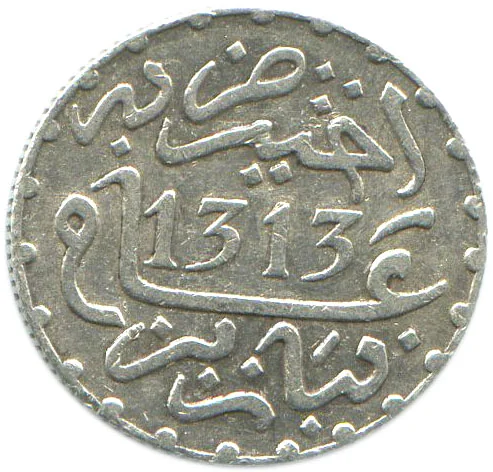
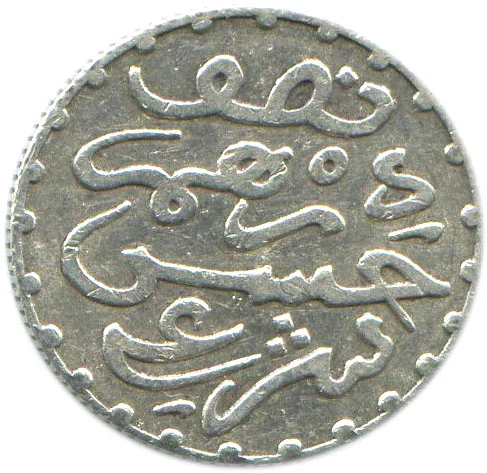
½ dirham – Morocco
Add to wishlist
Morocco
Context
Years: 1882–1897
Issuer: Morocco
Ruler: Moulay al-Hasan I
Currency:
(1882—1921)
Subdivision: ½ dirham = 1⁄20 Rial
Demonetized: Yes
Total mintage: 20,967,662
Material
References
Y: #
Numista: #8394
Value
Exchange value: 1⁄20 MAH
Bullion value: $3.04
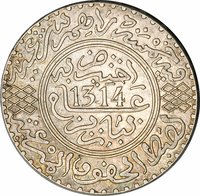
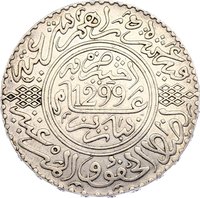
Obverse
Description:
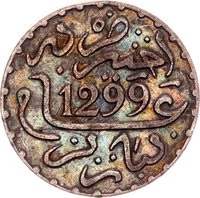
Date centered.
Inscription:
ضربه
اختير
1313
عام
بباريز
اختير
1313
عام
بباريز
Translation:
Struck
Chosen
1313
Year
In Paris
Chosen
1313
Year
In Paris
Script: Arabic
Language: Arabic
Engraver: Jean Lagrange
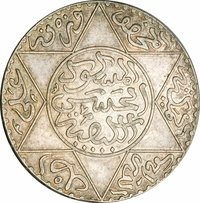
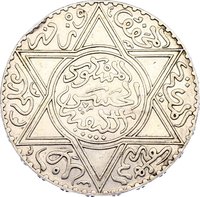
Reverse
Description:
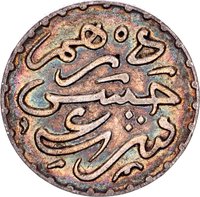
Arabic script
Inscription:
نصف
درهم
حسن
شرعي
درهم
حسن
شرعي
Translation:
Half Dirham
Hasan
Legal
Hasan
Legal
Script: Arabic
Language: Arabic
Engraver: Jean Lagrange
Edge
Reeded
Mints
| Name | Mark |
|---|---|
| Monnaie de Paris | — |
Mintings
| Year | Mint Mark | Mintage | Quality | Collection |
|---|---|---|---|---|
| 1882 | — | 13,527,335 | ||
| 1882 | — | 5 | Proof | |
| 1892 | — | 1,142,870 | ||
| 1893 | — | 1,141,962 | ||
| 1894 | — | 1,716,060 | ||
| 1895 | — | 1,716,803 | ||
| 1896 | — | 1,722,627 | ||
| 1897 | — | — |
Historical background
In 1882, Morocco's currency situation was characterized by a complex and unstable monetary system, reflecting the broader pressures on the Sultanate's sovereignty and economy. The country operated on a bimetallic standard in theory, with both gold (benduqi) and silver (dirham) coins minted by the state. However, the system was fragmented and chaotic. A plethora of foreign coins—especially Spanish silver duros (pesetas), British sovereigns, French francs, and Maria Theresa thalers—circulated freely alongside local issues, their values fluctuating wildly based on weight, metal content, and local market trust. This lack of a uniform, trusted national currency hampered trade and state revenue collection.
This monetary disorder was exacerbated by severe fiscal strain. The Moroccan Makhzen (government), weakened by tribal rebellions and costly military campaigns, faced a growing debt crisis following the expensive Hispano-Moroccan War of 1859-60. To finance its deficits, the government increasingly resorted to debasing its silver coinage, reducing its silver content to produce more coins from the same bullion reserves. This practice, known as ta'rif, led to rapid inflation, a collapse in public confidence in the Sultan's currency, and the hoarding of full-weight foreign coins. Consequently, different coins traded at different premiums, creating a confusing and inefficient market.
The year 1882 fell within a critical decade of European financial encroachment. While the international Madrid Conference of 1880 had formalized protections for foreign interests, European powers, particularly France and Spain, were intensifying their economic influence. The chaotic currency system directly facilitated this influence, as European merchants and bankers often controlled exchange operations. The situation would soon force the Makhzen to seek foreign loans, culminating in the 1904 loan backed by French banks, which placed Moroccan finances under direct European administration—a key step toward the establishment of the French and Spanish protectorates in 1912. Thus, the monetary chaos of 1882 was both a symptom of internal decline and a catalyst for external control.
This monetary disorder was exacerbated by severe fiscal strain. The Moroccan Makhzen (government), weakened by tribal rebellions and costly military campaigns, faced a growing debt crisis following the expensive Hispano-Moroccan War of 1859-60. To finance its deficits, the government increasingly resorted to debasing its silver coinage, reducing its silver content to produce more coins from the same bullion reserves. This practice, known as ta'rif, led to rapid inflation, a collapse in public confidence in the Sultan's currency, and the hoarding of full-weight foreign coins. Consequently, different coins traded at different premiums, creating a confusing and inefficient market.
The year 1882 fell within a critical decade of European financial encroachment. While the international Madrid Conference of 1880 had formalized protections for foreign interests, European powers, particularly France and Spain, were intensifying their economic influence. The chaotic currency system directly facilitated this influence, as European merchants and bankers often controlled exchange operations. The situation would soon force the Makhzen to seek foreign loans, culminating in the 1904 loan backed by French banks, which placed Moroccan finances under direct European administration—a key step toward the establishment of the French and Spanish protectorates in 1912. Thus, the monetary chaos of 1882 was both a symptom of internal decline and a catalyst for external control.
Series: 1882 Morocco circulation coins

🌱 Common