

1 cent – South Africa
Add to wishlist
South Africa
Context
Years: 1990–1995
Issuer: South Africa
Period:
(since 1961)
Currency:
(since 1961)
Total mintage: 1,415,114,178
Material
References
KM: #
Numista: #835
Value
Exchange value: 0.01 ZAR
Inflation-adjusted value: 0.09 ZAR
Obverse
Description:
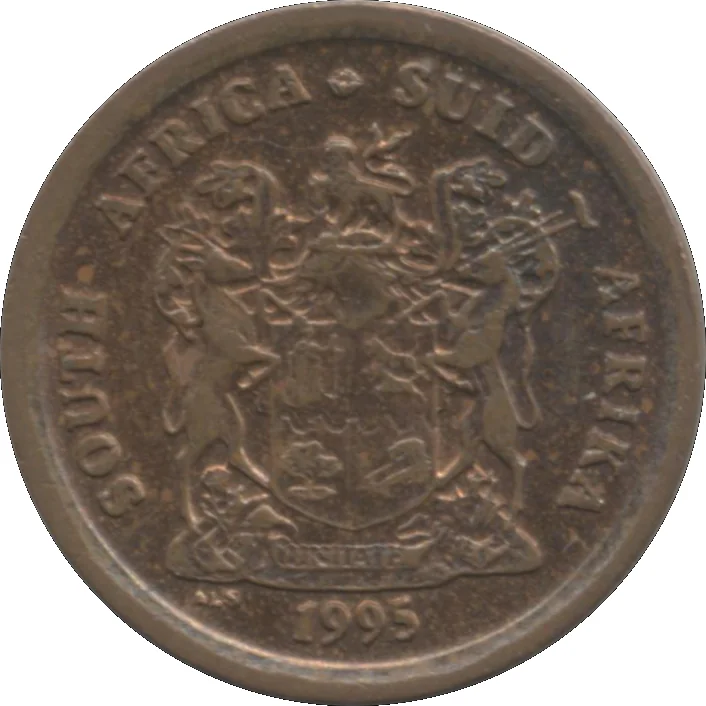
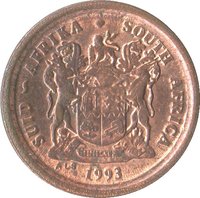
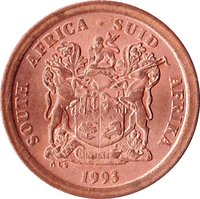
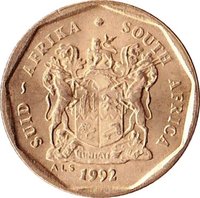
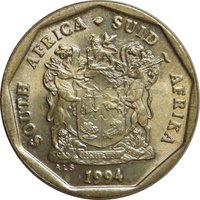
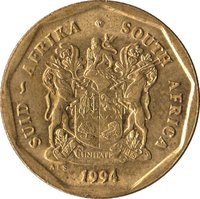
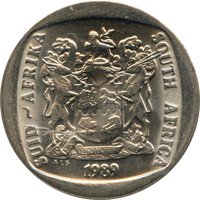
South Africa's coat of arms with the motto "Ex Unitate Vires" (Power Through Unity). Country name in English and Afrikaans.
Inscription:
SOUTH AFRICA SUID-AFRIKA 1995
ALS
EX UNITATE VIRES
ALS
EX UNITATE VIRES
Script: Latin
Engraver: Arthur Sutherland
Reverse
Description:
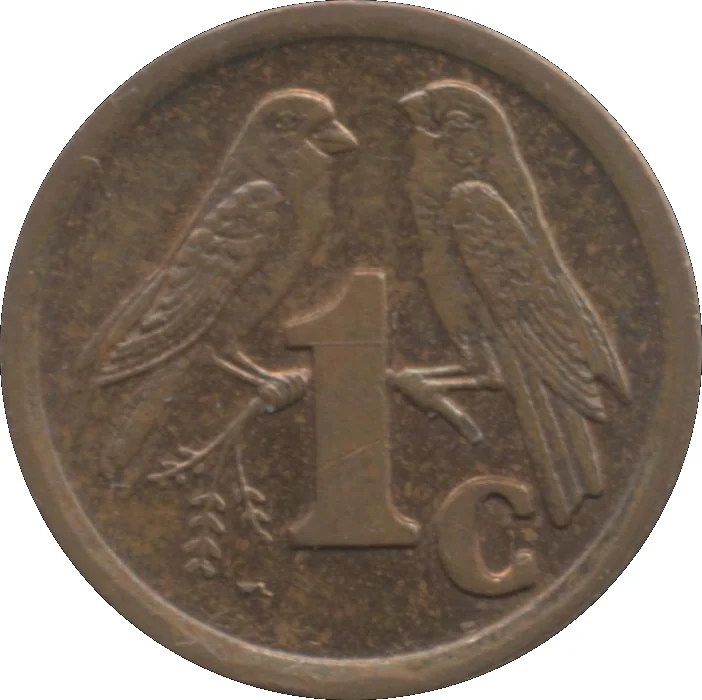
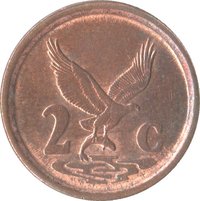
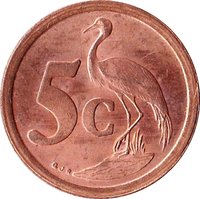
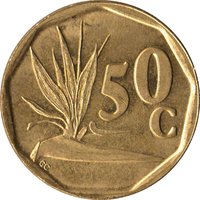
Cape Sparrows are small, social birds native to southern Africa, recognized by their distinctive black and white head markings.
Inscription:
1c WL
Script: Latin
Engraver: William Lumley
Edge
Plain
Categories
| Animal> Bird |
| Symbols> Coat of Arms |
Mints
| Name | Mark |
|---|---|
| Pretoria | — |
Mintings
| Year | Mint Mark | Mintage | Quality | Collection |
|---|---|---|---|---|
| 1990 | — | 12,230 | BU | |
| 1990 | — | 149,000,000 | ||
| 1990 | — | 10,230 | Proof | |
| 1991 | — | 379,000,000 | ||
| 1991 | — | 15,000 | BU | |
| 1991 | — | 11,800 | Proof | |
| 1992 | — | 15,087 | BU | |
| 1992 | — | 213,000,000 | ||
| 1992 | — | 10,260 | Proof | |
| 1993 | — | 7,790 | Proof | |
| 1993 | — | 178,000,000 | ||
| 1993 | — | 10,902 | BU | |
| 1994 | — | 238,994,000 | ||
| 1994 | — | 6,786 | BU | |
| 1994 | — | 5,800 | Proof | |
| 1995 | — | 257,000,000 | ||
| 1995 | — | 8,477 | BU | |
| 1995 | — | 5,816 | Proof |
Historical background
In 1990, South Africa's currency, the Rand, operated within a complex and strained economic environment shaped by apartheid and international isolation. The country was facing severe economic sanctions, capital flight, and a debt crisis that had forced a unilateral moratorium on foreign debt repayments in 1985. Consequently, the financial rand, a dual-exchange rate mechanism introduced in that period, was still in effect. This system created a separation between commercial and financial rands, artificially controlling capital flows and creating a significant discount for non-resident investors seeking to repatriate funds, reflecting the high political risk premium demanded by international markets.
Domestically, the economy was in recession, grappling with high inflation (around 14%), stagnant growth, and rising unemployment. The Reserve Bank maintained a relatively high interest rate policy in an attempt to curb inflation and support the currency, but confidence was fundamentally low. The historic political developments of 1990—including the unbanning of liberation movements and Nelson Mandela's release—introduced profound uncertainty about the nation's future. While raising hopes for long-term stability, the immediate effect was increased volatility, as markets anxiously weighed the risks of a turbulent transition against the potential for a more inclusive and internationally accepted economy.
Thus, the currency situation was one of controlled vulnerability. The Rand's value was heavily managed and propped up by the dual-exchange rate system, masking its true market weakness. It was a currency under pressure, symbolizing an economy at a crossroads: constrained by the legacy of apartheid financial structures yet on the brink of a political transformation that would eventually necessitate its full reintegration into the global financial system and the abandonment of the financial rand mechanism in 1995.
Domestically, the economy was in recession, grappling with high inflation (around 14%), stagnant growth, and rising unemployment. The Reserve Bank maintained a relatively high interest rate policy in an attempt to curb inflation and support the currency, but confidence was fundamentally low. The historic political developments of 1990—including the unbanning of liberation movements and Nelson Mandela's release—introduced profound uncertainty about the nation's future. While raising hopes for long-term stability, the immediate effect was increased volatility, as markets anxiously weighed the risks of a turbulent transition against the potential for a more inclusive and internationally accepted economy.
Thus, the currency situation was one of controlled vulnerability. The Rand's value was heavily managed and propped up by the dual-exchange rate system, masking its true market weakness. It was a currency under pressure, symbolizing an economy at a crossroads: constrained by the legacy of apartheid financial structures yet on the brink of a political transformation that would eventually necessitate its full reintegration into the global financial system and the abandonment of the financial rand mechanism in 1995.
🌱 Very Common